👇🏿
The Emoji
Backhand Index Pointing Down: Dark Skin Tone
U+1F447 U+1F3FF · :backhand_index_pointing_down_dark_skin_tone:
Trend 68
Meaning layers
- interpretation
- Used to highlight something important below, call attention to a link or caption, or emphasize a point with sass. The dark skin tone is often chosen for cultural representation or solidarity.
- tiktok usage
- Placed in captions to point readers to a link in bio, a pinned comment, or to emphasize a key line in a stitch or duet. Also used ironically to point to something cringe or hilarious.
- irony level
- 4 / 10
Platform meanings
- meaning
- Points viewers to a link in bio, pinned comment, or highlights content below a caption.
- trend usage
- Used extensively in creator CTAs (calls to action) like 'Shop here 👇🏿' or 'Full video 👇🏿'. Also appears in duet/stitch setups pointing to the original video.
- hashtags
- #linkinbio#checkitout#swipeup#foryoupage#pointingdown
- virality score
- 72 / 100
Cultural meanings
🇺🇸
Western / Gen-Z
Widely used across all skin tone variants; the dark skin tone is often chosen for representation or solidarity with Black communities. Carries no special cultural weight beyond its directional function.
🇵🇰
Pakistan & India
Used commonly in social media captions and WhatsApp to direct attention downward. The skin tone is generally not emphasized; the emoji is treated as a universal pointer.
🌍
Middle East
Functions as a standard directional pointer in Arabic and Farsi social media content. The dark skin tone may be selected for self-representation by darker-skinned users in the region.
🌐
Global Neutral
Universally understood as a downward pointer regardless of skin tone. The Fitzpatrick modifier adds representation but does not alter the core directional meaning.
🇧🇩
Bangladesh
Used in Facebook and WhatsApp conversations to point to shared content below. Skin tone selection is largely pragmatic or default rather than identity-driven.
🇱🇰
Sri Lanka
Commonly seen on Facebook and WhatsApp directing followers to links or content. Skin tone variant is used by individuals who identify with darker complexions.
🇨🇳
China
Less common on domestic platforms like WeChat or Weibo, where native emojis are preferred. When used, it functions as a straightforward directional pointer.
🇯🇵
Japan
Used on Twitter/X and LINE as a directional indicator, though Japan has its own rich set of native pointing emojis. The skin tone modifier is sometimes a novelty choice.
🇰🇷
South Korea
Appears on KakaoTalk and Instagram as a directional pointer. Korean users tend to prefer their platform's native emojis but recognize this one in international content.
🇹🇼
Taiwan
Used similarly to other East Asian markets as a directional tool on Instagram and LINE. Skin tone is not a culturally loaded choice in most contexts.
🇭🇰
Hong Kong
Appears in bilingual (English-Cantonese) social media contexts as a pointing device. Used straightforwardly without significant cultural layering beyond its directional meaning.
🇵🇭
Philippines
Widely used on Facebook and TikTok to direct followers to links or highlighted content. Filipinos of darker skin tone may use this variant for self-representation.
🇮🇩
Indonesia
Common in Instagram captions and WhatsApp groups pointing to links or announcements. The dark skin tone is adopted by users who relate to it complexion-wise.
🇹🇭
Thailand
Used on Facebook and TikTok as a simple directional emoji. Skin tone selection is generally aesthetic or identity-based rather than culturally symbolic.
🇻🇳
Vietnam
Appears in Facebook and Zalo conversations as a straightforward pointer. The dark skin tone modifier is less commonly chosen given the region's dominant lighter skin tone preferences.
🇲🇾
Malaysia
Used across WhatsApp, Instagram, and TikTok to direct attention to content below. The multiracial nature of Malaysia means skin tone selection often reflects personal identity.
🇸🇦
Saudi Arabia
Used on Snapchat and Twitter to point to links or announcements. Saudi users of darker complexion may identify with the dark skin tone variant.
🇦🇪
UAE
Common in a cosmopolitan social media landscape where diverse skin tones are normalized. Used as a standard directional pointer with representation value for South Asian and African communities in the UAE.
🇪🇬
Egypt
Seen on Facebook and TikTok to direct followers to content below. Egyptian users with darker Nubian heritage may choose this variant for identification.
🇹🇷
Turkey
Used on Instagram and Twitter as a directional pointer. Skin tone selection is personal and the dark variant is adopted by those who identify with it.
🇮🇷
Iran
Used on Instagram and Telegram primarily as a functional pointer. The dark skin tone is not a common cultural signifier in Iranian digital culture.
🇳🇬
Nigeria
Highly embraced in Nigerian Twitter (X), Instagram, and WhatsApp culture. The dark skin tone is a point of cultural pride and representation, making this variant particularly popular.
🇿🇦
South Africa
Widely used across racial communities on Twitter and Instagram. For Black South African users, the dark skin tone carries explicit representation and pride.
🇬🇧
UK & Ireland
Used casually across all platforms as a directional emoji. British and Irish Black communities may specifically select the dark skin tone for cultural identity and representation.
🇫🇷
France
Used on Twitter and Instagram as a directional pointer. French Afro-Caribbean and West African communities may adopt the dark skin tone variant for self-expression.
🇩🇪
Germany
Treated as a functional directional emoji in German digital culture. The dark skin tone may be chosen by Afro-German users or allies as a representation gesture.
🇪🇸
Spain & Italy
Used as a standard pointer in Spanish and Italian social media. Communities of African or Latin American descent may prefer this skin tone for identification.
🇧🇷
Brazil
Frequently used in Brazilian Instagram, TikTok, and WhatsApp culture. Given Brazil's large Afro-Brazilian population, the dark skin tone is a common and meaningful choice for self-representation.
🇲🇽
Mexico
Used widely on social media as a directional pointer. Indigenous and Afro-Mexican users may select darker skin tones for identification, though this is less explicitly discussed than in Brazil.
🌎
Latin America
Across Latin America, the dark skin tone version is used both functionally and as an identity marker by Afro-Latinx communities who see it as representation in digital spaces.
🇦🇺
Australia & NZ
Used casually as a directional emoji. Aboriginal and Torres Strait Islander Australians and Māori New Zealanders may use the dark skin tone variant as a marker of identity and representation.
How its meaning shifted
- 2010
Emoji with skin tone modifiers did not yet exist; only the default yellow hand emoji was available. Directional hand emojis were used sparingly in early smartphone messaging.
- 2015
Unicode 8.0 introduced skin tone modifiers in 2015, allowing this dark skin tone variant to exist. Initial adoption was exploratory as users discovered they could personalize hand emojis.
- 2020
Widespread adoption across platforms with the dark skin tone carrying both practical directional use and growing social significance tied to Black Lives Matter and representation movements.
- 2026
Fully normalized as a directional tool and identity marker. The dark skin tone variant is one of the most used among the skin tone options, embraced for both function and cultural pride in global digital communication.
See it on every platform
Compare with
Adjacent emojis
Share & embed
Frequently asked
01What does the 👇🏿 Backhand Index Pointing Down: Dark Skin Tone emoji mean?
A hand with dark skin tone pointing downward using the index finger, shown from the back of the hand.
02What does 👇🏿 mean on TikTok?
Points viewers to a link in bio, pinned comment, or highlights content below a caption.
03What does 👇🏿 mean on WhatsApp?
Points to a message, file, or link shared just below in the conversation, directing the recipient's attention.
04What does 👇🏿 mean in Gen-Z slang?
Used to highlight something important below, call attention to a link or caption, or emphasize a point with sass. The dark skin tone is often chosen for cultural representation or solidarity.
05Is the 👇🏿 emoji safe to use?
A directional pointer used to highlight content below; universally understood as a functional navigation tool in digital communication.
06What does 👇🏿 mean in texting?
Pointing gestures activate authority and attention-directing impulses in readers; the downward direction implies urgency or emphasis on what follows, which can feel commanding or urgent depending on context.
07What is the shortcode for 👇🏿?
The shortcode for Backhand Index Pointing Down: Dark Skin Tone is :backhand_index_pointing_down_dark_skin_tone:
08What does 👇🏿 mean in dating?
Can be used playfully to point downward in a suggestive or flirtatious way, hinting at something below (a photo, a link, or innuendo depending on context).
Safety & usage
- Safe meaning
- A directional pointer used to highlight content below; universally understood as a functional navigation tool in digital communication.
- Caution
- In rare contexts, used to demean or dismiss someone by pointing downward in a condescending way, or paired with degrading text as a put-down gesture.
The emoji is generally safe. However, in combination with explicit or harassing text, the pointing gesture can amplify toxic intent. Monitor for context when used in heated arguments.
How it looks across platforms
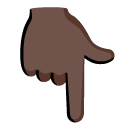


Appearance varies by platform and device. Google Noto, Twemoji, and OpenMoji are open-source.