🤠
The Emoji
Cowboy Hat Face
U+1F920 · :cowboy_hat_face:
Trend 85
Meaning layers
- interpretation
- Used ironically to signal unbothered confidence, a 'yeehaw' energy, or to cope with chaos by pretending everything is fine with a performative smile. Often deployed when doing something reckless, unhinged, or chaotic while acting cool about it.
- tiktok usage
- Frequently used in captions like 'just did something terrible to my sleep schedule 🤠' or 'running on 2 hours of sleep 🤠' — a hallmark of chaotic self-awareness.
- irony level
- 8 / 10
Platform meanings
- meaning
- Symbol of chaotic, unbothered energy — used when doing something questionable or self-destructive while pretending to be totally fine about it.
- trend usage
- Common in voiceover trends where creators describe their worst decisions. Frequently used in text overlays during 'POV: you' chaos videos and 'day in my life' disaster vlogs.
- hashtags
- #yeehaw#cowboyvibes#thisisfine#chaosmode#unbothered
- virality score
- 82 / 100
Cultural meanings
🇺🇸
Western / Gen-Z
The defining irony emoji of Gen Z — universally understood as 'this is fine' energy, chaotic resilience, and performative unbothered confidence. Extremely high literacy and usage.
🇵🇰
Pakistan & India
Used primarily among urban, English-speaking youth who consume Western meme culture. Signals cowboy movie vibes or is borrowed directly from Gen Z irony without deep local cultural adaptation.
🌍
Middle East
Recognized through Hollywood and American cultural exports. Urban youth use it with the same ironic Gen Z meaning; older users associate it with American cowboy films.
🌐
Global Neutral
Broadly understood as representing the American West, cowboys, and bold adventurousness. The ironic Gen Z usage is spreading globally through TikTok and meme culture.
🇧🇩
Bangladesh
Limited but growing usage among English-fluent youth on social media. Primarily understood through Western meme culture as a fun or adventurous emoji.
🇱🇰
Sri Lanka
Used by younger, digitally active users who follow international meme trends. Associated with American cowboy culture and increasingly with the Gen Z ironic meaning.
🇨🇳
China
Less commonly used on domestic platforms like WeChat or Weibo due to cultural distance from cowboy themes. On international platforms, tech-savvy youth use it with ironic Gen Z meaning.
🇯🇵
Japan
Recognized from American Western pop culture influence. Used occasionally on Twitter (X) by Japanese users familiar with global meme culture, often with the ironic 'yare yare' vibe.
🇰🇷
South Korea
Popular among K-pop stans and meme-literate youth who engage with global internet culture. Used ironically to signal 'going in confidently' or chaotic self-awareness.
🇹🇼
Taiwan
Used by globally connected youth in the same ironic Gen Z capacity. Also appears in posts referencing American culture or Western aesthetic content.
🇭🇰
Hong Kong
Common among English-speaking youth and those active on global social media. Used with both genuine Western cultural appreciation and ironic Gen Z meaning.
🇵🇭
Philippines
Highly meme-literate population uses this emoji frequently with full Gen Z ironic awareness. Also genuinely used for rodeo and cowboy-themed content given some cultural familiarity.
🇮🇩
Indonesia
Growing usage among young, social-media-active Indonesians who follow TikTok and meme trends. Primarily the ironic 'this is fine' interpretation has taken hold.
🇹🇭
Thailand
Used by Thai youth active on TikTok and Twitter who consume global meme culture. The chaotic confidence interpretation resonates strongly with Thai internet humor.
🇻🇳
Vietnam
Appears in meme communities and among young people on Facebook and TikTok. The ironic meaning is adopted from global trends; cowboy culture itself has less local resonance.
🇲🇾
Malaysia
Used broadly among English-speaking and meme-fluent Malaysian youth. Both the genuine cowboy aesthetic and the ironic Gen Z meaning are understood and employed.
🇸🇦
Saudi Arabia
Used primarily by younger, globally connected Saudis on Snapchat and Twitter. Associated with American culture and used in the ironic meme context by digitally fluent users.
🇦🇪
UAE
Cosmopolitan and globally connected population means the emoji is used both genuinely for western/ranch aesthetic and ironically in the Gen Z sense across platforms.
🇪🇬
Egypt
Used by younger Egyptian social media users who engage with Western meme content. Often signals 'going for it boldly' or American-influenced chaotic confidence.
🇹🇷
Turkey
Appears in Turkish meme culture on Twitter and Instagram among youth. The cowboy archetype resonates somewhat through American film influence; ironic usage is growing.
🇮🇷
Iran
Used by younger Iranians on Instagram and Telegram who follow global internet culture. The emoji signals Western cultural influence and is used with ironic confidence.
🇳🇬
Nigeria
Used with high fluency in Nigerian internet culture, especially on Twitter. Blends with local 'sapa' and chaotic life humor — 'managing the situation 🤠' is deeply relatable.
🇿🇦
South Africa
Strongly used in South African meme culture, especially on Twitter. Resonates with local humor about surviving chaos and absurdity — very high cultural adoption of the ironic meaning.
🇬🇧
UK & Ireland
Widely used with full Gen Z ironic awareness. British and Irish users particularly enjoy the self-deprecating, 'this is absolutely fine' application during national or personal disasters.
🇫🇷
France
Used among younger, digitally active French users who engage with Anglo-American internet culture. The cowboy imagery carries some cultural distance but the ironic meaning is adopted.
🇩🇪
Germany
Used by German Gen Z and Millennials familiar with global meme culture. The performative confidence angle resonates; used in contexts of 'tackling chaos head-on, supposedly.'
🇪🇸
Spain & Italy
Adopted by younger Spanish and Italian social media users through TikTok and meme culture. The bold, adventurous cowboy energy aligns well with expressive Southern European communication styles.
🇧🇷
Brazil
Extremely high usage — cowboy (vaqueiro/gaúcho) culture has deep roots in Brazil, giving this emoji genuine local resonance beyond the imported irony. A cultural double-hit of authenticity and meme usage.
🇲🇽
Mexico
Strong cultural resonance given the shared cowboy (charro/vaquero) heritage. Used both genuinely to celebrate northern Mexican cowboy culture and ironically in the Gen Z meme sense.
🌎
Latin America
Broadly recognized across Latin America through vaquero/cowboy cultural traditions. High adoption of both genuine and ironic usage, with the meme meaning growing rapidly via TikTok.
🇦🇺
Australia & NZ
Highly meme-literate cultures with strong Gen Z ironic usage. The 'this is fine while everything burns' application has particular resonance in Australian internet culture given bushfire and chaos humor.
How its meaning shifted
- 2010
Emoji did not exist yet (introduced in 2016). Western and cowboy themes were expressed through text emoticons or described in words on early social platforms.
- 2015
Still pre-release. Cowboy culture online was primarily expressed through country music hashtags, Instagram filters, and text-based 'yeehaw' expressions.
- 2020
Rapidly evolving from genuine cowboy/western symbol to a core irony emoji. The COVID-19 pandemic accelerated its adoption as a 'this is fine, everything is chaos' reaction emoji across platforms.
- 2026
Fully cemented as one of the defining Gen Z irony emojis. Both its genuine western-aesthetic usage and its chaotic-unbothered ironic meaning are globally understood. A permanent fixture of digital communication.
See it on every platform
Adjacent emojis
Share & embed
Frequently asked
01What does the 🤠 Cowboy Hat Face emoji mean?
A yellow smiley face wearing a wide-brimmed cowboy hat, typically depicted with a broad grin, representing cowboy culture, the American West, and a carefree, adventurous spirit.
02What does 🤠 mean on TikTok?
Symbol of chaotic, unbothered energy — used when doing something questionable or self-destructive while pretending to be totally fine about it.
03What does 🤠 mean on WhatsApp?
Signals a playful, adventurous, or laid-back mood. Can mean 'I'm going for it' or 'wish me luck on this risky move.'
04What does 🤠 mean in Gen-Z slang?
Used ironically to signal unbothered confidence, a 'yeehaw' energy, or to cope with chaos by pretending everything is fine with a performative smile. Often deployed when doing something reckless, unhinged, or chaotic while acting cool about it.
05Is the 🤠 emoji safe to use?
Expresses cowboy culture appreciation, bold confidence, adventurous spirit, playful irony, and chaotic resilience — entirely benign in virtually all contexts.
06What does 🤠 mean in texting?
Psychologically, this emoji functions as a defense mechanism — using humor and a performative cowboy bravado to mask anxiety, stress, or self-destructive behavior. It signals 'I know this is a bad idea but I'm doing it anyway with a smile.'
07What is the shortcode for 🤠?
The shortcode for Cowboy Hat Face is :cowboy_hat_face:
08What does 🤠 mean in dating?
Can be used flirtatiously to signal playful confidence or a laid-back, adventurous personality. Sometimes used to indicate 'I'm a wild card but in a fun way.'
Safety & usage
- Safe meaning
- Expresses cowboy culture appreciation, bold confidence, adventurous spirit, playful irony, and chaotic resilience — entirely benign in virtually all contexts.
- Caution
- Rarely weaponized, but can occasionally be used sarcastically in a passive-aggressive or dismissive way to minimize someone's serious concerns.
No significant safety concerns. In extremely rare cases, the performative 'I'm fine' energy could be a red flag if used repeatedly to deflect genuine emotional distress in personal conversations.
How it looks across platforms
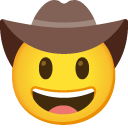


Appearance varies by platform and device. Google Noto, Twemoji, and OpenMoji are open-source.