🤞🏿
The Emoji
Crossed Fingers: Dark Skin Tone
U+1F91E U+1F3FF · :crossed_fingers_dark_skin_tone:
Trend 72
Meaning layers
- interpretation
- Used to hype someone up, show solidarity, or express genuine hope for an outcome. The dark skin tone variant is often used specifically by Black and dark-skinned users as a form of self-representation.
- tiktok usage
- Dropped in comment sections to root for someone's success, often paired with affirmations or Black excellence content.
- irony level
- 2 / 10
Platform meanings
- meaning
- Symbol of hope, good luck, and rooting for someone's success. Frequently appears in comment sections under motivational and achievement videos.
- trend usage
- Used in 'manifestation' trends, Black excellence showcases, and 'I hope this works' challenge videos.
- hashtags
- #GoodLuck#Manifesting#HopingForTheBest#BlackExcellence#CrossedFingers
- virality score
- 74 / 100
Cultural meanings
🇺🇸
Western / Gen-Z
Widely used as a good luck and hope symbol; the dark skin tone is actively chosen by Black and dark-skinned users for self-representation and resonates broadly as an inclusive gesture.
🇵🇰
Pakistan & India
The crossed-fingers gesture is understood as a Western good-luck symbol; the dark skin tone may be selected by users to match their own complexion, though emoji skin tone selection is less emphasized culturally.
🌍
Middle East
Recognized as a hope or luck symbol imported through global digital culture; skin tone variants are gaining traction as representation becomes more normalized in Gulf and Levant social media spaces.
🌐
Global Neutral
Universally interpreted as wishing for good luck or expressing hope, with the dark skin tone adding a layer of personal or cultural identity for users who identify with it.
🇧🇩
Bangladesh
Used primarily in its literal good-luck meaning; younger urban users are beginning to engage with skin tone variants as a form of digital self-expression.
🇱🇰
Sri Lanka
Understood as a good-luck gesture borrowed from Western digital culture; skin tone variations are less culturally emphasized but are slowly being adopted by younger users.
🇨🇳
China
The crossed-fingers gesture does not have deep indigenous cultural roots; it is read as a Western import meaning good luck. Skin tone customization is less common on Chinese platforms like WeChat.
🇯🇵
Japan
Interpreted as a good-luck symbol in the Western sense; Japanese users more commonly use 🙏 for hope and prayer. The dark skin tone variant is rarely selected due to limited skin tone customization culture.
🇰🇷
South Korea
Crossed fingers carry the Western luck meaning; however, the single-finger heart 🤞 gesture from K-pop culture adds a unique local layer — though the dark skin tone is rarely used in Korean digital spaces.
🇹🇼
Taiwan
Read as a Western good-luck symbol; emoji skin tones are occasionally used for representation but less systematically than in Western contexts.
🇭🇰
Hong Kong
Understood as hope and good luck; bilingual digital culture means it is used fluidly across English and Cantonese conversations. Skin tone variants are used with growing awareness.
🇵🇭
Philippines
Very widely used to wish good luck; Filipinos are heavy emoji users and the dark skin tone is embraced particularly by users who identify with Morena beauty standards.
🇮🇩
Indonesia
Used to express hope and good luck in everyday messaging; skin tone emojis are gaining popularity as Indonesian digital culture grows more expressive.
🇹🇭
Thailand
Recognized as a Western good-luck symbol; 🙏 (wai gesture) remains more culturally resonant for hope and prayer but crossed fingers are common in Gen Z Thai digital culture.
🇻🇳
Vietnam
Used primarily to convey hope and good luck in messaging apps; younger Vietnamese users are adopting skin tone emoji variants as self-expression tools.
🇲🇾
Malaysia
Widely understood as good luck; Malaysia's multiracial context makes skin tone emojis culturally sensitive, and darker-skinned Malaysian users may specifically select this variant.
🇸🇦
Saudi Arabia
Used as a good-luck symbol in digital communication; cultural conservatism means it is used straightforwardly without deeper layered meanings.
🇦🇪
UAE
Widely used in the UAE's cosmopolitan digital landscape; the dark skin tone variant is particularly relevant in a nation with significant South Asian, African, and Arab populations.
🇪🇬
Egypt
Recognized as a Western good-luck symbol; increasingly used among Egyptian youth on TikTok and Instagram with the skin tone selected for personal representation.
🇹🇷
Turkey
Used casually to wish good luck, especially among younger Turkish internet users influenced by Western and American digital culture.
🇮🇷
Iran
Used among younger Iranians on Instagram and Telegram to express hope, particularly for outcomes related to daily struggles; skin tone variants are less culturally emphasized.
🇳🇬
Nigeria
Extremely popular and culturally resonant; the dark skin tone is frequently chosen by Nigerian users as a point of pride and representation, especially on Twitter/X and WhatsApp.
🇿🇦
South Africa
Used broadly across South Africa's diverse digital community; the dark skin tone is particularly embraced by Black South African users as a form of cultural representation and affirmation.
🇬🇧
UK & Ireland
Very common good-luck emoji; 'fingers crossed' is a well-established British idiom so the emoji translates naturally. The dark skin tone is used by Black British users as self-representation.
🇫🇷
France
Used as a good-luck and hope symbol; less emphasis on emoji skin tone customization culturally though awareness is growing among French Gen Z.
🇩🇪
Germany
Understood as a good-luck symbol; Germans more traditionally use 'Daumen drücken' (pressing thumbs) for luck, so crossed fingers carry a distinctly international feel.
🇪🇸
Spain & Italy
Used to express hope and good luck; Mediterranean digital culture uses it casually and frequently. Skin tone variants are increasingly selected for personal representation.
🇧🇷
Brazil
Very popular across Brazilian social media; the dark skin tone is widely embraced by Afro-Brazilian users as an expression of identity and representation, especially on Instagram and TikTok.
🇲🇽
Mexico
Used to express hope and good luck in everyday digital communication; skin tone customization is growing in popularity among Mexican users as representation becomes more discussed.
🌎
Latin America
Broadly understood as good luck across Latin America; Afro-Latino communities particularly resonate with the dark skin tone variant as a marker of visibility and pride.
🇦🇺
Australia & NZ
Standard good-luck emoji; widely used across Australia and New Zealand. The dark skin tone is used by Aboriginal, Torres Strait Islander, Māori, and Pacific Islander users as representation.
How its meaning shifted
- 2010
Emoji skin tone modifiers did not yet exist; the base crossed-fingers emoji was not yet part of Unicode. The gesture existed only as text-based emoticons.
- 2015
Skin tone modifiers were introduced with Unicode 8.0 in 2015; 🤞🏿 became available and was immediately adopted by users seeking darker skin tone representation, though overall emoji customization awareness was still growing.
- 2020
Widely adopted across social media platforms; the dark skin tone variant gained significant cultural visibility alongside movements like Black Lives Matter, with Black creators and users actively choosing representative emojis.
- 2026
Firmly established as both a good-luck symbol and a cultural identity marker; the dark skin tone variant is normalized and expected in inclusive digital communication, with heavy use in Black creator spaces, manifesting culture, and global Gen Z discourse.
See it on every platform
Compare with
Adjacent emojis
Share & embed
Frequently asked
01What does the 🤞🏿 Crossed Fingers: Dark Skin Tone emoji mean?
A hand with index and middle fingers crossed, displayed with a dark skin tone modifier. Universally used to wish for good luck or to express hope.
02What does 🤞🏿 mean on TikTok?
Symbol of hope, good luck, and rooting for someone's success. Frequently appears in comment sections under motivational and achievement videos.
03What does 🤞🏿 mean on WhatsApp?
Wishing someone good luck before a big event like an exam, job interview, or medical procedure.
04What does 🤞🏿 mean in Gen-Z slang?
Used to hype someone up, show solidarity, or express genuine hope for an outcome. The dark skin tone variant is often used specifically by Black and dark-skinned users as a form of self-representation.
05Is the 🤞🏿 emoji safe to use?
Wishing good luck, expressing hope, showing support and solidarity, representing cultural identity through skin tone selection.
06What does 🤞🏿 mean in texting?
The crossing gesture taps into superstitious behavior as a coping mechanism for uncertainty. The dark skin tone adds a layer of cultural identity and representation, making the emotional expression feel more personal and authentic.
07What is the shortcode for 🤞🏿?
The shortcode for Crossed Fingers: Dark Skin Tone is :crossed_fingers_dark_skin_tone:
08What does 🤞🏿 mean in dating?
Sent after expressing interest in a date or hinting at wanting things to work out — 'hoping you say yes 🤞🏿'.
Safety & usage
- Safe meaning
- Wishing good luck, expressing hope, showing support and solidarity, representing cultural identity through skin tone selection.
- Caution
- Rarely used toxically; in some contexts can signal someone made a promise they never intended to keep ('said it with fingers crossed').
Generally safe and positive. No significant toxic or NSFW associations. Skin tone emojis occasionally draw bad-faith commentary about 'emoji race politics' but this is a fringe behavior.
How it looks across platforms
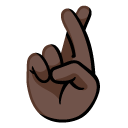


Appearance varies by platform and device. Google Noto, Twemoji, and OpenMoji are open-source.