🤞🏾
The Emoji
Crossed Fingers: Medium-dark Skin Tone
U+1F91E U+1F3FE · :crossed_fingers_mediumdark_skin_tone:
Trend 72
Meaning layers
- interpretation
- Used to signal hope, wishful thinking, or low-key anxiety about an outcome. Also deployed ironically when something is obviously not going to work out but you're pretending to be optimistic.
- tiktok usage
- Appears in 'manifesting' content, waiting-for-results videos, and as a reaction to unlikely scenarios. Often paired with 🙏🏾 or ✨ in manifestation rituals.
- irony level
- 5 / 10
Platform meanings
- meaning
- Hope, manifesting, and low-key nervous energy about a pending outcome.
- trend usage
- Used in 'POV: waiting for your results' videos, manifesting audios, and duets where the original creator is anxious about something.
- hashtags
- #manifest#fingerscrossed#hopingforthebest#waitingmode#sendgoodvibes
- virality score
- 74 / 100
Cultural meanings
🇺🇸
Western / Gen-Z
Core manifesting and hoping emoji. Used constantly in daily digital communication to express anticipation, often with ironic or semi-serious tone. The medium-dark skin tone is embraced as representation.
🇵🇰
Pakistan & India
Widely understood as a good-luck gesture, though the skin tone modifier carries positive representation significance for darker-skinned South Asians who see it as more personally relatable. Common in student and professional contexts around exam results and job news.
🌍
Middle East
Recognized as a good-luck symbol through globalized digital culture, though traditional luck expressions (like 'inshallah' or the evil eye 🧿) are more culturally embedded. The skin tone resonates with Arab users of medium-dark complexion.
🌐
Global Neutral
Universally read as 'hoping for the best' or 'wishing luck' across all connected digital cultures. One of the most cross-culturally consistent emoji meanings.
🇧🇩
Bangladesh
Used primarily among urban, digitally active youth to express hope for exam results, admission news, and career outcomes. The darker skin tone modifier is positively received as representation.
🇱🇰
Sri Lanka
Understood through global digital culture as a good-luck gesture. Young Sri Lankans use it similarly to Western peers in academic and social media contexts.
🇨🇳
China
Less culturally native — the crossed fingers gesture is not traditional in Chinese luck culture. However, digitally savvy youth understand it through global pop culture and use it in international-facing contexts.
🇯🇵
Japan
Understood through global emoji literacy but not rooted in native Japanese gesture culture. Used more matter-of-factly in digital communication to express hope without deep cultural resonance.
🇰🇷
South Korea
Popular among younger Koreans active on global platforms like Instagram and TikTok. Frequently used in K-pop fan communities when hoping for wins, chart positions, or album news.
🇹🇼
Taiwan
Adopted through global digital culture. Used casually among youth when expressing hope about outcomes, often mixed with other international emojis.
🇭🇰
Hong Kong
Common in bilingual (English/Cantonese) digital spaces. Young Hong Kongers use it the same way as Western Gen Z — casual, hopeful, sometimes ironic.
🇵🇭
Philippines
Very popular. Filipino social media users adopt global emoji trends quickly, and 🤞🏾 appears frequently in religious or spiritual contexts alongside prayer emojis — 'sana all' (hope for all) energy.
🇮🇩
Indonesia
Used widely among Indonesian youth on TikTok and Instagram to express hope. The darker skin tone modifier resonates strongly with Indonesian users given prevalent skin tone diversity.
🇹🇭
Thailand
Understood through global digital context. Thai users incorporate it into everyday social media with no major cultural conflict, often pairing it with 🙏 (which holds deeper Thai cultural meaning).
🇻🇳
Vietnam
Adopted through global social media trends. Vietnamese youth use it on TikTok and Instagram in manifesting or hoping contexts, especially around academic results.
🇲🇾
Malaysia
Well understood across Malaysia's multicultural digital youth population. Used across all ethnic communities in the same 'hoping for good luck' sense.
🇸🇦
Saudi Arabia
Recognized through global digital culture but the skin tone modifier adds particular resonance for darker-skinned Arab users. Used more in private chats than public posts in conservative online spaces.
🇦🇪
UAE
Common in UAE's highly cosmopolitan, multicultural digital landscape. The medium-dark skin tone feels inclusive given the country's diverse population.
🇪🇬
Egypt
Used among Egyptian youth who are globally digitally connected. Resonates alongside Arabic expressions of hope. Darker skin tone carries positive representation for Upper Egyptian and Nubian communities.
🇹🇷
Turkey
Understood through global emoji culture. Turkish youth use it freely on all platforms in the same hopeful/manifesting context as Western Gen Z.
🇮🇷
Iran
Used among Iranian youth on Instagram and Telegram (major platforms in Iran). Carries the same global 'hoping for luck' meaning. Skin tone representation matters to darker-skinned Iranians.
🇳🇬
Nigeria
Very popular. The medium-dark skin tone makes this one of the most personally relatable crossed-fingers variants for Nigerian users. Used constantly across Twitter/X, WhatsApp, and Instagram.
🇿🇦
South Africa
Widely used across racial communities in South Africa's diverse digital space. The medium-dark skin tone resonates especially with Black South African users as representation.
🇬🇧
UK & Ireland
Very common — 'fingers crossed' is a deeply embedded UK/Irish cultural phrase. This emoji is a direct digital extension of that verbal expression, used constantly in everyday digital conversation.
🇫🇷
France
Used among French youth familiar with global emoji culture. 'Croiser les doigts' is the French equivalent phrase, so the meaning transfers naturally.
🇩🇪
Germany
Interestingly, in traditional German culture 'thumbs up' (not crossed fingers) is the main luck gesture — but younger Germans use this emoji through global digital influence without confusion.
🇪🇸
Spain & Italy
Well understood through global digital culture and resonates with Mediterranean users of darker complexions. Used freely in casual digital communication.
🇧🇷
Brazil
Extremely popular. Brazilians are among the world's most expressive emoji users and embrace 🤞🏾 in manifestation and hope content. The darker skin tone aligns well with Brazil's mixed skin tone diversity.
🇲🇽
Mexico
Common in Mexican digital culture among youth. Used in social media hoping/manifesting content. Darker skin tone resonates with Indigenous and mestizo Mexicans with medium-dark complexions.
🌎
Latin America
Broadly used across Latin America with consistent 'hoping for luck' meaning. The medium-dark skin tone has wide representation value across the region's diverse population.
🇦🇺
Australia & NZ
Used exactly as in UK/US culture — a direct digital expression of 'fingers crossed.' The skin tone modifier is embraced positively in Australia's multicultural digital space.
How its meaning shifted
- 2010
Emoji did not yet exist in this form. Crossed fingers were expressed via text emoticons or written phrases like 'fingers crossed!'.
- 2015
Base crossed fingers emoji (🤞) introduced. Skin tone modifiers beginning to roll out across platforms. Used primarily for literal good-luck wishes.
- 2020
Skin-toned variants fully mainstream. Medium-dark skin tone version embraced for representation. Usage expanded into 'manifesting' culture and ironic digital humor, especially during COVID-19 uncertainty.
- 2026
Deeply embedded in manifesting and 'main character energy' content. Medium-dark variant prominently featured in inclusive content creation. Ironic usage nearly matches sincere usage among Gen Z and Gen Alpha.
See it on every platform
Adjacent emojis
- Often confused with
- call me handsign of the hornsvictory hand
- Can replace
- folded handssparklesfour leaf clover
Share & embed
Frequently asked
01What does the 🤞🏾 Crossed Fingers: Medium-dark Skin Tone emoji mean?
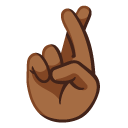
A hand with the index and middle fingers crossed, displayed with a medium-dark brown skin tone modifier. Universally recognized as a gesture of hoping for good luck or wishing something comes true.
02What does 🤞🏾 mean on TikTok?
Hope, manifesting, and low-key nervous energy about a pending outcome.
03What does 🤞🏾 mean on WhatsApp?
Wishing someone luck in a direct conversation — 'Good luck on your interview 🤞🏾'.
04What does 🤞🏾 mean in Gen-Z slang?
Used to signal hope, wishful thinking, or low-key anxiety about an outcome. Also deployed ironically when something is obviously not going to work out but you're pretending to be optimistic.
05Is the 🤞🏾 emoji safe to use?
Expression of hope, good luck, and positive anticipation. One of the most universally benign and wholesome emojis in common use.
06What does 🤞🏾 mean in texting?
Crossing fingers is a coping mechanism rooted in magical thinking — it externalizes anxiety into a physical or symbolic act, giving a sense of agency over uncontrollable outcomes. The skin tone modifier adds a layer of personal identity and representation.
07What is the shortcode for 🤞🏾?
The shortcode for Crossed Fingers: Medium-dark Skin Tone is :crossed_fingers_mediumdark_skin_tone:
08What does 🤞🏾 mean in dating?
Subtle signal of hope when waiting for a reply or a date confirmation — 'fingers crossed you say yes 🤞🏾'. Not overtly flirtatious but carries emotional vulnerability.
Safety & usage
- Safe meaning
- Expression of hope, good luck, and positive anticipation. One of the most universally benign and wholesome emojis in common use.
- Caution
- Rarely weaponized, but can appear in passive-aggressive contexts implying someone needs luck because they're about to fail. In some very niche contexts used sarcastically to dismiss someone's chances.
No significant toxic associations. Extremely low risk across all platforms and demographics. Skin tone modifiers occasionally draw identity-based commentary but the emoji itself is not controversial.
How it looks across platforms


Appearance varies by platform and device. Google Noto, Twemoji, and OpenMoji are open-source.