🫱🏿🫲🏻
The Emoji
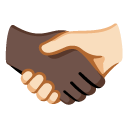
Handshake: Dark Skin Tone, Light Skin Tone
U+1FAF1 U+1F3FF U+200D U+1FAF2 U+1F3FB · :handshake_dark_skin_tone_light_skin_tone:
Trend 58
Meaning layers
- interpretation
- Used to signal solidarity across racial or cultural lines, often paired with statements about allyship, friendship between diverse groups, or cross-community respect. Also used unironically to flex inclusive friendships.
- tiktok usage
- Appears in videos about interracial friendships, diversity discourse, or anti-racism content. Sometimes used to punctuate 'we move different' captions about mixed friend groups.
- irony level
- 2 / 10
Platform meanings
- meaning
- Represents interracial unity, diverse friendships, or cross-cultural agreements; used sincerely in solidarity content and occasionally ironically in discourse videos.
- trend usage
- Frequently placed in text overlays during montages of mixed-race friend groups, 'POV: your friend group is diverse' trends, or allyship challenge content.
- hashtags
- #DiverseFriends#Solidarity#Inclusion#WeMove#CrossCultural
- virality score
- 62 / 100
Cultural meanings
🇺🇸
Western / Gen-Z
Widely used as a sincere marker of interracial solidarity and inclusive friend groups, though sometimes deployed with ironic awareness of performative allyship.
🇵🇰
Pakistan & India
Used to represent Hindu-Muslim harmony, India-Pakistan peace gestures, or cross-religious friendship — carries significant political and emotional weight in this context.
🌍
Middle East
Represents interfaith or cross-ethnic cooperation, sometimes used to symbolize Arab-non-Arab alliances or hope for regional peace dialogues.
🌐
Global Neutral
Universally understood as a symbol of cooperation and partnership across difference, with little ambiguity in its positive intent.
🇧🇩
Bangladesh
Used to represent unity between religious communities or to celebrate multicultural friendships, particularly among educated urban youth.
🇱🇰
Sri Lanka
Carries meaning around Sinhalese-Tamil reconciliation or multi-ethnic national unity, making it politically resonant in some contexts.
🇨🇳
China
Used to represent international partnerships or China-Africa/China-Western relations; may carry diplomatic undertones in political commentary.
🇯🇵
Japan
Interpreted as a symbol of international cooperation or cross-cultural exchange; Japan's homogeneous cultural context makes it more symbolic than personal.
🇰🇷
South Korea
Used among Hallyu fans and K-pop communities to signal global cultural exchange, or in activist spaces around multicultural awareness in Korea.
🇹🇼
Taiwan
Associated with international solidarity and cross-cultural diplomacy; used positively in contexts of Taiwan's diverse international relationships.
🇭🇰
Hong Kong
Used in contexts of cross-cultural solidarity or to represent cooperation between different communities in HK's complex social landscape.
🇵🇭
Philippines
Embraced warmly in OFW (overseas Filipino worker) communities to represent cross-cultural friendships formed abroad.
🇮🇩
Indonesia
Used to represent Bhinneka Tunggal Ika (unity in diversity) values; resonates strongly in the world's most diverse archipelago nation.
🇹🇭
Thailand
Associated with international tourism culture and cross-cultural friendships; used positively with little political charge.
🇻🇳
Vietnam
Appears in contexts of international partnership, Vietnamese diaspora cross-cultural connections, or youth-led diversity content.
🇲🇾
Malaysia
Highly meaningful in Malaysia's multiracial context (Malay, Chinese, Indian communities) — used to represent national unity ideals.
🇸🇦
Saudi Arabia
Used in corporate and diplomatic contexts to represent international business partnerships; less common in personal social messaging.
🇦🇪
UAE
Very resonant given UAE's massively multicultural expat population; used frequently to celebrate the country's diverse workforce and friendships.
🇪🇬
Egypt
Used in contexts of Arab-African solidarity, interfaith cooperation, or international diplomatic announcements.
🇹🇷
Turkey
Associated with East-West bridge symbolism, reflecting Turkey's cultural positioning between Europe and the Middle East.
🇮🇷
Iran
Used by younger, progressive Iranians online to signal openness to cross-cultural friendship, often in diaspora contexts.
🇳🇬
Nigeria
Widely used to celebrate Afro-global connections, international partnerships, or Black solidarity with other communities worldwide.
🇿🇦
South Africa
Deeply meaningful given South Africa's history; used to represent rainbow nation ideals, post-apartheid reconciliation, and interracial friendship.
🇬🇧
UK & Ireland
Used to represent multicultural Britain or Ireland's growing diversity; appears in anti-racism content and diverse community celebrations.
🇫🇷
France
Used in debates around laïcité and multiculturalism; embraced by those celebrating France's diverse population, sometimes politically charged.
🇩🇪
Germany
Appears in Willkommenskultur (welcome culture) contexts, integration discourse, and multicultural community events.
🇪🇸
Spain & Italy
Used by younger generations to represent multicultural cities like Barcelona, Madrid, Milan, or Rome and their diverse communities.
🇧🇷
Brazil
Resonates in Brazil's deeply mixed-race culture; used to celebrate racial democracy ideals while sometimes critically examined against real inequalities.
🇲🇽
Mexico
Used to represent indigenous-mestizo unity, cross-border US-Mexico cultural ties, or multicultural friendship in urban centers.
🌎
Latin America
Broadly represents mestizo and Afro-Latino solidarity, pan-Latin American unity, or cross-cultural ties within the diverse Latin American region.
🇦🇺
Australia & NZ
Used in reconciliation contexts (Aboriginal-settler relations), multicultural city pride content, and Treaty of Waitangi discussions in NZ.
How its meaning shifted
- 2010
This specific mixed skin tone handshake didn't exist in 2010; the basic handshake emoji was a single generic yellow by default, with no skin tone options available.
- 2015
Skin tone modifiers began rolling out but mixed skin tone combinations for multi-person emojis weren't yet technically supported; users used default handshake + separate skin tone emojis.
- 2020
Introduced in this era as part of Unicode's push for diverse emoji combinations; gained traction during heightened racial justice conversations following global BLM movement momentum.
- 2026
Established as a genuine symbol of interracial solidarity and cross-cultural partnership, used sincerely in activism, corporate DEI, personal expression, and meme culture with layered irony awareness.
See it on every platform
Adjacent emojis
- Often confused with
- handshakeopen handsrightwards hand
- Can replace
- handshakepeople holding handsraised fist
Share & embed
Frequently asked
01What does the 🫱🏿🫲🏻 Handshake: Dark Skin Tone, Light Skin Tone emoji mean?
A handshake emoji showing two hands clasping together, with the left hand displaying dark skin tone and the right hand displaying light skin tone, representing interracial agreement, partnership, or cooperation.
02What does 🫱🏿🫲🏻 mean on TikTok?
Represents interracial unity, diverse friendships, or cross-cultural agreements; used sincerely in solidarity content and occasionally ironically in discourse videos.
03What does 🫱🏿🫲🏻 mean on WhatsApp?
Signals agreement or a deal struck between people who see themselves as coming from different worlds — different cultures, backgrounds, or social circles.
04What does 🫱🏿🫲🏻 mean in Gen-Z slang?
Used to signal solidarity across racial or cultural lines, often paired with statements about allyship, friendship between diverse groups, or cross-community respect. Also used unironically to flex inclusive friendships.
05Is the 🫱🏿🫲🏻 emoji safe to use?
A positive, inclusive symbol of interracial cooperation, cross-cultural friendship, solidarity, and partnership between people of different backgrounds.
06What does 🫱🏿🫲🏻 mean in texting?
The skin tone combination triggers psychological associations with social bridging and cross-group empathy. Research suggests diverse representation in symbols can reinforce positive intergroup attitudes and reduce implicit bias.
07What is the shortcode for 🫱🏿🫲🏻?
The shortcode for Handshake: Dark Skin Tone, Light Skin Tone is :handshake_dark_skin_tone_light_skin_tone:
08What does 🫱🏿🫲🏻 mean in dating?
Rarely used as a flirt tool; more likely used to acknowledge comfort across cultural or racial differences in early conversations, signaling open-mindedness.
Safety & usage
- Safe meaning
- A positive, inclusive symbol of interracial cooperation, cross-cultural friendship, solidarity, and partnership between people of different backgrounds.
- Caution
- Can be weaponized sarcastically to mock performative allyship or corporate diversity theater; rarely used in genuinely harmful ways.
Generally very safe. In rare cases, may be used ironically to mock 'diversity washing' by brands or politicians, but carries no inherently dangerous meaning. Context determines tone.
How it looks across platforms


Appearance varies by platform and device. Google Noto, Twemoji, and OpenMoji are open-source.