🫱🏿🫲🏾
The Emoji
Handshake: Dark Skin Tone, Medium-dark Skin Tone
U+1FAF1 U+1F3FF U+200D U+1FAF2 U+1F3FE · :handshake_dark_skin_tone_mediumdark_skin_tone:
Trend 65
Meaning layers
- interpretation
- Used to signal solidarity, mutual respect, or a confirmed pact between two people, often across racial or cultural lines. Frequently signals allyship or cross-community unity.
- tiktok usage
- Appears in duets or collaboration videos to signal teamwork, mutual hype, or 'we're in this together' energy between creators of different backgrounds.
- irony level
- 2 / 10
Platform meanings
- meaning
- Symbol of cross-cultural collaboration, mutual respect, or a confirmed deal between creators or communities.
- trend usage
- Used in duet videos, collab announcements, or diversity-celebrating content to signal unity across backgrounds.
- hashtags
- #solidarity#diversityandinclusion#crosscultural#collab#unity
- virality score
- 62 / 100
Cultural meanings
🇺🇸
Western / Gen-Z
Widely used as a symbol of intentional allyship and cross-racial solidarity; the specific skin tone combination is seen as a meaningful, conscious choice rather than default.
🇵🇰
Pakistan & India
Used to symbolize cross-religious, cross-caste, or cross-regional unity, especially meaningful given South Asia's complex diversity landscape.
🌍
Middle East
Represents inter-community agreements or friendships across sectarian, national, or ethnic lines; carries weight in contexts of regional peace or cooperation.
🌐
Global Neutral
Universally readable as a handshake symbolizing agreement or friendship, with the mixed skin tones adding a subtle layer of diversity acknowledgment.
🇧🇩
Bangladesh
Used to signify unity and cooperation across religious or ethnic communities, resonating in a country with significant diversity narratives.
🇱🇰
Sri Lanka
Carries particular resonance as a symbol of Sinhalese-Tamil or inter-ethnic harmony, echoing post-civil war reconciliation themes.
🇨🇳
China
Primarily read as a business deal or cooperation symbol; the skin tone nuance is less culturally foregrounded and more likely seen as a stylistic variation.
🇯🇵
Japan
Interpreted as a polite, formal agreement gesture; the diversity aspect may be noted but is less central given Japan's more homogeneous social context.
🇰🇷
South Korea
Used in the context of international K-pop collaborations or global cultural exchange, where cross-cultural partnerships are celebrated.
🇹🇼
Taiwan
Read as a symbol of international partnership and open-minded cross-cultural cooperation, fitting Taiwan's self-image as a globally connected society.
🇭🇰
Hong Kong
Used to signal solidarity across different community groups or international business partnerships, resonant in a culturally diverse financial hub.
🇵🇭
Philippines
Commonly used to express OFW (Overseas Filipino Worker) community solidarity or cross-cultural friendships formed abroad.
🇮🇩
Indonesia
Resonates as a symbol of the national 'Bhinneka Tunggal Ika' (Unity in Diversity) ethos, celebrating cross-ethnic and cross-religious harmony.
🇹🇭
Thailand
Used primarily in cross-cultural friendship or business contexts; the diversity nuance is recognized but secondary to the general agreement meaning.
🇻🇳
Vietnam
Interpreted as a sign of international cooperation or cross-cultural friendship, fitting Vietnam's increasingly global economic and social outlook.
🇲🇾
Malaysia
Deeply resonant as a symbol of Malaysia's multiracial identity (Malay, Chinese, Indian communities), often used to celebrate national unity.
🇸🇦
Saudi Arabia
Read as a professional agreement or partnership symbol; the mixed skin tones may be noted as representing cross-national business relationships.
🇦🇪
UAE
Highly resonant in the UAE's hyper-diverse expat culture, symbolizing the cross-national friendships and partnerships common in Dubai and Abu Dhabi.
🇪🇬
Egypt
Used to signal solidarity or cooperation across different communities; resonant in contexts of Pan-African or Pan-Arab unity discussions.
🇹🇷
Turkey
Interpreted as a bridge between East and West, often used in contexts celebrating Turkey's role as a cultural crossroads.
🇮🇷
Iran
Primarily read as an agreement or friendship symbol; in diaspora contexts it may carry additional meaning of cross-cultural solidarity.
🇳🇬
Nigeria
Strongly resonant as a symbol of inter-tribal or inter-ethnic unity, deeply meaningful in Nigeria's complex multi-ethnic national identity.
🇿🇦
South Africa
Carries powerful post-apartheid resonance, symbolizing rainbow nation ideals and cross-racial friendship and reconciliation.
🇬🇧
UK & Ireland
Used to celebrate multicultural Britain and Ireland, particularly in contexts of cross-racial friendship, diversity initiatives, or anti-racism messaging.
🇫🇷
France
Used in multicultural or anti-racist contexts, though France's official 'colorblind' republican ideology means the skin tone specificity may be more politically charged.
🇩🇪
Germany
Read as a symbol of intercultural friendship and integration, resonant in discussions of Germany's multicultural society and immigration landscape.
🇪🇸
Spain & Italy
Used in cross-cultural friendship or immigrant integration contexts; increasingly common as Spain and Italy grapple with multicultural identity.
🇧🇷
Brazil
Fits naturally into Brazil's celebrated but complex mixed-race identity narrative; used to express Afro-Brazilian solidarity or cross-racial friendship.
🇲🇽
Mexico
Used to signal solidarity across racial, indigenous, and mestizo communities, resonating with ongoing conversations about racial diversity in Mexico.
🌎
Latin America
Broadly used across Latin America to celebrate mestizo, Afro-Latino, and indigenous unity, fitting the region's rich racial and cultural tapestry.
🇦🇺
Australia & NZ
Used to celebrate cross-cultural friendships, Indigenous-settler reconciliation themes, and multicultural community values.
How its meaning shifted
- 2010
Mixed skin tone handshake combinations did not exist yet; the standard yellow handshake emoji was used generically for agreement without any diversity dimension.
- 2015
Single skin tone modifiers became available for some handshakes, but mixed combinations were not yet possible; diversity emoji conversations were just beginning.
- 2020
Mixed skin tone handshake combinations became available with Unicode 14 support building; usage grew rapidly in the context of the Black Lives Matter movement and global racial justice conversations.
- 2026
Firmly established as a go-to symbol for conscious cross-racial solidarity, diverse partnerships, and multicultural unity; normalized across professional and casual digital communication globally.
See it on every platform
Adjacent emojis
- Often confused with
- raised handwaving handvulcan salute
- Can replace
- handshakeraised fistclapping hands
Share & embed
Frequently asked
01What does the 🫱🏿🫲🏾 Handshake: Dark Skin Tone, Medium-dark Skin Tone emoji mean?
A handshake emoji where the left hand has dark skin tone and the right hand has medium-dark skin tone, representing an agreement, deal, or greeting between two people with different skin tones.
02What does 🫱🏿🫲🏾 mean on TikTok?
Symbol of cross-cultural collaboration, mutual respect, or a confirmed deal between creators or communities.
03What does 🫱🏿🫲🏾 mean on WhatsApp?
Signals an agreement or confirmation of plans, with the skin tone variation subtly nodding to diversity or interracial friendship.
04What does 🫱🏿🫲🏾 mean in Gen-Z slang?
Used to signal solidarity, mutual respect, or a confirmed pact between two people, often across racial or cultural lines. Frequently signals allyship or cross-community unity.
05Is the 🫱🏿🫲🏾 emoji safe to use?
Agreement, solidarity, cross-cultural friendship, diversity celebration, mutual respect, and partnership between people of different backgrounds.
06What does 🫱🏿🫲🏾 mean in texting?
The deliberate choice of mismatched skin tones signals conscious acknowledgment of diversity, evoking feelings of inclusion and intentional allyship rather than a casual greeting.
07What is the shortcode for 🫱🏿🫲🏾?
The shortcode for Handshake: Dark Skin Tone, Medium-dark Skin Tone is :handshake_dark_skin_tone_mediumdark_skin_tone:
08What does 🫱🏿🫲🏾 mean in dating?
Rarely used as a flirt tool; when it is, it may signal a respectful, equality-minded partner who values diversity and cultural awareness.
Safety & usage
- Safe meaning
- Agreement, solidarity, cross-cultural friendship, diversity celebration, mutual respect, and partnership between people of different backgrounds.
- Caution
- Rarely used in toxic contexts; occasionally co-opted sarcastically to mock performative allyship or hollow diversity gestures.
Largely safe and positive; minor risk of being used ironically in anti-woke or performative allyship mockery contexts. Not associated with hate speech or NSFW content.
How it looks across platforms
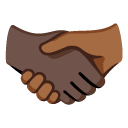


Appearance varies by platform and device. Google Noto, Twemoji, and OpenMoji are open-source.