🫱🏿🫲🏽
The Emoji
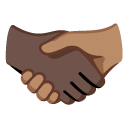
Handshake: Dark Skin Tone, Medium Skin Tone
U+1FAF1 U+1F3FF U+200D U+1FAF2 U+1F3FD · :handshake_dark_skin_tone_medium_skin_tone:
Trend 58
Meaning layers
- interpretation
- Solidarity across racial or cultural differences, allyship, cross-community collab, or 'we're locked in together regardless of background.' Often used to signal unity without being preachy about it.
- tiktok usage
- Used in duets or collab videos between creators of different backgrounds to signal genuine partnership. Also dropped in comments to show appreciation for interracial or cross-cultural friendships depicted in content.
- irony level
- 3 / 10
Platform meanings
- meaning
- Signals cross-cultural solidarity, interracial friendship, or collaborative energy between creators of different backgrounds.
- trend usage
- Dropped in duet and stitch videos featuring creators of different races or backgrounds. Used in 'POV: you found your people across cultures' style content.
- hashtags
- #diversity#solidarity#interracial#collab#unity
- virality score
- 62 / 100
Cultural meanings
🇺🇸
Western / Gen-Z
Widely understood as a symbol of interracial solidarity and conscious allyship; Gen Z uses it deliberately to signal racial awareness and inclusive values in both sincere and ironic contexts.
🇵🇰
Pakistan & India
Interpreted primarily as a friendly agreement or deal-sealing gesture; the mixed skin tones may be less consciously noted, though the emoji is increasingly recognized as a diversity symbol among urban youth.
🌍
Middle East
Seen as a symbol of cross-cultural agreement or partnership; in Gulf states with large expat populations, it resonates as a sign of multicultural coexistence and business partnership.
🌐
Global Neutral
Universally read as a handshake representing partnership or agreement; the mixed skin tone element adds a universally positive connotation of diversity and inclusion.
🇧🇩
Bangladesh
Primarily understood as a handshake for agreement or friendship; the skin tone nuance is increasingly recognized among youth familiar with international social media norms.
🇱🇰
Sri Lanka
Interpreted as a friendly greeting or agreement emoji; the cross-skin-tone element may be seen as representing Sri Lanka's own multicultural society of Sinhalese, Tamil, and other communities.
🇨🇳
China
The handshake is a strong business and diplomatic symbol in Chinese culture; the mixed skin tones may be interpreted as international partnership, resonating with Belt and Road Initiative narratives of global cooperation.
🇯🇵
Japan
Seen as a partnership or agreement emoji; Japan's relatively homogeneous cultural self-image means the mixed skin tone aspect is often read as an international or global cooperation symbol rather than a racial diversity statement.
🇰🇷
South Korea
Interpreted as collaboration or partnership; among K-content creators, it signals cross-cultural fan community connections or international collab announcements.
🇹🇼
Taiwan
Read as a symbol of partnership and friendly agreement; the diverse skin tones resonate in Taiwan's context of international openness and multicultural dialogue.
🇭🇰
Hong Kong
In a city with significant multicultural presence, this emoji is understood as cross-cultural partnership; also used in business contexts to signal international collaboration.
🇵🇭
Philippines
Widely used to express friendship and agreement; Filipinos abroad especially use it to signal cross-cultural bonds formed in diaspora communities.
🇮🇩
Indonesia
Interpreted as unity and partnership across diversity, which resonates strongly with Indonesia's national motto 'Bhinneka Tunggal Ika' (Unity in Diversity).
🇹🇭
Thailand
Seen as a friendly agreement or partnership symbol; the mixed skin tone aspect is increasingly understood as a diversity gesture among Thai social media users.
🇻🇳
Vietnam
Used to represent agreement, partnership, or friendship; the cross-skin-tone element resonates with Vietnam's growing international business connections and diaspora communities.
🇲🇾
Malaysia
Highly resonant in Malaysia's multiracial context of Malay, Chinese, Indian, and other communities; naturally understood as a symbol of interracial harmony and partnership.
🇸🇦
Saudi Arabia
Interpreted as a business or personal agreement symbol; in a country with a large expatriate workforce from diverse backgrounds, the mixed skin tones resonate as cross-cultural professional partnership.
🇦🇪
UAE
Deeply resonant in one of the world's most multicultural nations; used to represent the UAE's diverse population and cross-cultural professional and personal relationships.
🇪🇬
Egypt
Understood as a partnership or agreement symbol; the mixed skin tone aspect is recognized among digitally connected youth as a diversity gesture.
🇹🇷
Turkey
Seen as a friendship or business agreement emoji; Turkey's position as a cultural bridge between East and West gives the cross-skin-tone element added meaning of cultural exchange.
🇮🇷
Iran
Primarily read as a handshake of agreement or friendship; among younger Iranians on social media, the mixed skin tones are understood as a gesture of global solidarity.
🇳🇬
Nigeria
Strongly resonant as a symbol of unity and partnership; in Nigeria's diverse ethnic context, it signals cross-ethnic or cross-cultural solidarity and is enthusiastically used in business and friendship contexts.
🇿🇦
South Africa
Particularly meaningful in post-apartheid South Africa; the cross-skin-tone handshake carries deep significance as a symbol of racial reconciliation, unity, and the Rainbow Nation ideal.
🇬🇧
UK & Ireland
Used similarly to the US Gen Z context; signals interracial solidarity and diversity awareness, especially among younger users. Also used in multicultural urban community contexts.
🇫🇷
France
Used to signal partnership and agreement; French users may be split between those who embrace it as a diversity symbol and those who prefer color-blind approaches consistent with French republican values.
🇩🇪
Germany
Interpreted as cross-cultural partnership and solidarity; increasingly used in contexts celebrating Germany's multicultural society, especially among younger generations.
🇪🇸
Spain & Italy
Used as a partnership and agreement symbol; the cross-skin-tone element resonates in the context of immigration and multicultural urban communities, particularly among younger users.
🇧🇷
Brazil
Highly resonant in Brazil's racially diverse society; used to celebrate the country's mixed heritage and to signal racial pride and unity across communities.
🇲🇽
Mexico
Interpreted as friendship and partnership; the cross-skin-tone element resonates with Mexico's mestizo identity and pride in indigenous and diverse heritage.
🌎
Latin America
Broadly understood as a symbol of unity across diverse communities; resonates with Latin America's rich racial and cultural mixing and pride in diversity.
🇦🇺
Australia & NZ
Used to signal cross-cultural partnership and multicultural values; particularly resonant in the context of Indigenous reconciliation and multicultural community building.
How its meaning shifted
- 2010
Did not exist; the standard handshake emoji was only available in a default yellow tone, with no skin tone modifier options and no mixed-tone combinations.
- 2015
Still did not exist in mixed-tone form; single skin tone handshake modifiers were just beginning to be introduced, but mixed combinations were not yet supported.
- 2020
Not yet available in this specific combination; increased demand for diverse emoji representation was building pressure on Unicode to expand mixed skin tone options.
- 2026
Established as a meaningful symbol of interracial solidarity and cross-cultural partnership; widely used across platforms by users who want to consciously acknowledge diversity in their connections and agreements.
See it on every platform
Adjacent emojis
- Often confused with
- handshakeraised fisthandshake medium dark skin tone
- Can replace
- handshakepeople holding handsraised fist
Share & embed
Frequently asked
01What does the 🫱🏿🫲🏽 Handshake: Dark Skin Tone, Medium Skin Tone emoji mean?
A handshake emoji showing two hands clasped together, with the left hand having a dark skin tone and the right hand having a medium skin tone, representing agreement, partnership, or greeting across different skin tones.
02What does 🫱🏿🫲🏽 mean on TikTok?
Signals cross-cultural solidarity, interracial friendship, or collaborative energy between creators of different backgrounds.
03What does 🫱🏿🫲🏽 mean on WhatsApp?
Sealing a deal or agreement between friends, often used to confirm plans or make a pact. The mixed tones add a layer of acknowledging cultural difference in a positive way.
04What does 🫱🏿🫲🏽 mean in Gen-Z slang?
Solidarity across racial or cultural differences, allyship, cross-community collab, or 'we're locked in together regardless of background.' Often used to signal unity without being preachy about it.
05Is the 🫱🏿🫲🏽 emoji safe to use?
A positive symbol of cross-cultural partnership, interracial friendship, solidarity, and inclusive agreement between people of different backgrounds.
06What does 🫱🏿🫲🏽 mean in texting?
The deliberate use of mixed skin tones signals intentional acknowledgment of racial identity in a relationship or agreement, adding a layer of conscious inclusivity that a single-tone handshake does not carry. Psychologically, it conveys cross-cultural trust and bridges social distance.
07What is the shortcode for 🫱🏿🫲🏽?
The shortcode for Handshake: Dark Skin Tone, Medium Skin Tone is :handshake_dark_skin_tone_medium_skin_tone:
08What does 🫱🏿🫲🏽 mean in dating?
Rarely used in flirting contexts; more of a friendship or partnership signal. Could appear in early conversations to say 'I see you, I respect you' across cultural differences.
Safety & usage
- Safe meaning
- A positive symbol of cross-cultural partnership, interracial friendship, solidarity, and inclusive agreement between people of different backgrounds.
- Caution
- Can be weaponized sarcastically to mock performative diversity or tokenistic allyship; rarely used in genuinely toxic contexts.
Generally a very safe emoji. Minor risk of being used ironically to mock DEI efforts in bad-faith contexts. The specific skin tone combination (dark + medium) can sometimes be misread as politically loaded in highly polarized online spaces.
How it looks across platforms


Appearance varies by platform and device. Google Noto, Twemoji, and OpenMoji are open-source.