🙂↔️
The Emoji
Head Shaking Horizontally
U+1F642 U+200D U+2194 U+FE0F · :head_shaking_horizontally:
Trend 68
Meaning layers
- interpretation
- Used to express a slow, exasperated 'no' or disbelief — often when something is so bad, cringe, or unbelievable that words fail. Conveys 'I literally cannot' without being aggressive.
- tiktok usage
- Appears in comment sections when creators post something embarrassing or relatable, paired with 'me watching myself on BeReal' or 'me after reading that text again.'
- irony level
- 7 / 10
Platform meanings
- meaning
- Reaction emoji for content that makes you slowly shake your head — used to express soft disbelief, secondhand embarrassment, or fond exasperation.
- trend usage
- Appears in duets and stitch responses when someone disagrees politely, or in comment storms on controversial 'hot takes.'
- hashtags
- #nope#headshake#icant#theaudacity#vibes
- virality score
- 62 / 100
Cultural meanings
🇺🇸
Western / Gen-Z
Core usage territory — Gen Z in North America uses it as an irony-coded 'no' that still reads as chill and non-confrontational, perfectly aligned with their conflict-averse communication style.
🇵🇰
Pakistan & India
Used in casual WhatsApp and Instagram exchanges to indicate soft disagreement or disbelief, often replacing 'yaar nahi yaar' (no dude no) in digital shorthand.
🌍
Middle East
Interpreted as a polite refusal gesture that aligns with cultural norms around maintaining face — less confrontational than a flat-out 'no' in text.
🌐
Global Neutral
Broadly understood across cultures due to the universality of the head-shake 'no' gesture, making this one of the more cross-culturally legible emojis.
🇧🇩
Bangladesh
Used similarly to Pakistan/India contexts — appears in Facebook and WhatsApp chats to express gentle 'na na' (no no) vibes without full confrontation.
🇱🇰
Sri Lanka
Interesting tension exists here since in Sri Lankan culture a horizontal head wobble can mean 'yes' or 'okay' — this emoji may be misread as agreement by some users.
🇨🇳
China
Less culturally resonant as the horizontal head shake is not as universal a 'no' gesture in Chinese body language — used primarily by younger, globally influenced users who understand the Western context.
🇯🇵
Japan
The polite, soft energy of the emoji aligns well with Japanese communication norms around indirect refusal — used by younger users on Twitter/X and LINE to softly decline or express disbelief.
🇰🇷
South Korea
Popular among Korean Gen Z on KakaoTalk and Instagram as a way to express 'I can't even' or soft denial — fits the Korean internet culture of expressing big emotions through small gestures.
🇹🇼
Taiwan
Used casually in LINE chats and Instagram to signal amused disagreement — fits well in Taiwan's internet culture which blends irony with warmth.
🇭🇰
Hong Kong
Appears in Cantonese-speaking digital spaces as a shorthand for '唔係掛' (can't be right) — works alongside local slang for exasperated disbelief.
🇵🇭
Philippines
Filipinos use this in group chats to react to pasaway (mischievous/disobedient) behavior from friends or to signal kilig (giddy) disbelief at romantic scenarios.
🇮🇩
Indonesia
Popular on Twitter and WhatsApp in Indonesia as an equivalent to 'masa sih' (really though?) — used to question something unbelievable with a smile.
🇹🇭
Thailand
Used on Facebook and LINE to gently signal 'mai chai' (not right/no) without being rude — fits Thai communication culture that highly values politeness and indirectness.
🇻🇳
Vietnam
Younger Vietnamese users on Zalo and TikTok use it to react to something that's 'không thể tin được' (unbelievable) while keeping the mood light.
🇲🇾
Malaysia
In Malaysia's multilingual digital spaces, this emoji reads cleanly as a soft 'tak lah' (no lah) — the particle 'lah' culture of softening statements maps well onto this emoji's energy.
🇸🇦
Saudi Arabia
Used on Snapchat and Twitter by younger Saudis to express polite disagreement or disbelief, often in response to wild rumors or exaggerated claims.
🇦🇪
UAE
In the UAE's cosmopolitan digital culture, this emoji is used across Arabic and English conversations to signal a culturally neutral 'no way' that works across the expat-local divide.
🇪🇬
Egypt
Egyptian internet culture loves hyperbolic expressions — this emoji is used ironically when something is so unbelievable it loops back around to funny, often paired with local slang.
🇹🇷
Turkey
Used on Twitter and Instagram by Turkish users to react to chaotic news or unbelievable social media moments — functions as a digital version of 'olmaz ya' (that can't be).
🇮🇷
Iran
Younger Iranians on Instagram use this to subtly signal disagreement with content they can't openly challenge — the soft smile makes it deniably polite.
🇳🇬
Nigeria
In Nigerian digital culture this emoji appears in reaction to the constant stream of 'pepper dem' moments — used with humor and resilience to say 'I see this and I refuse it.'
🇿🇦
South Africa
Used across South African WhatsApp groups to signal a 'eish, no man' reaction — the emoji's resigned energy resonates with the local concept of 'eish' (exasperated disbelief).
🇬🇧
UK & Ireland
Perfectly suited to British and Irish dry humor culture — used to express deadpan disagreement or to react to something that is very much 'not it' without being dramatic about it.
🇫🇷
France
French users appreciate the understated, non-dramatic nature of this emoji for expressing 'non mais sérieusement' (no but seriously) without overreacting.
🇩🇪
Germany
German users deploy this emoji with characteristic directness-lite — it's as close to 'nein' as they get without typing it, used in ironic social media commentary.
🇪🇸
Spain & Italy
In Spain and Italy where body language is expressive, this emoji reads as a more restrained 'no no no' — used in contexts where the user wants to be disagreeable but charming about it.
🇧🇷
Brazil
Brazilian users on WhatsApp and Twitter use it as a fun 'não acredito' (I don't believe this) — often paired with fire or skull emojis in high-energy reactions.
🇲🇽
Mexico
In Mexican internet slang, this pairs with 'no manches' energy — a soft, humored disbelief rather than genuine anger, appearing frequently in meme culture.
🌎
Latin America
Across Latin America, the emoji reads as a friendly but firm 'no' — used in group chats and comment sections to register dissent without creating conflict.
🇦🇺
Australia & NZ
Aussie and Kiwi users lean into this emoji's dry, no-fuss energy — it's the digital equivalent of a slow head shake and a 'yeah nah mate.'
How its meaning shifted
- 2010
This specific emoji did not exist in 2010 — head movement emojis were not yet part of Unicode and this gesture was conveyed through text like 'SMH' (shaking my head) or '-_-'.
- 2015
Still predates the emoji's existence; by 2015 'SMH' was peak internet slang and the closest visual equivalent was 🙁 or 😑 paired with SMH in text.
- 2020
The emoji was not yet released; users were combining 🙂 + 'smh' or using 🤦 for this function — the gap in the emoji keyboard for this gesture was well-recognized.
- 2026
Newly introduced and rapidly gaining traction — Gen Z adopted it almost immediately as a more nuanced, animated alternative to SMH, integrating it into irony-coded communication across all major platforms.
See it on every platform
Adjacent emojis
- Often confused with
- face with head bandagewoozy facedotted line face
- Can replace
- smhunamused faceface with rolling eyes
Share & embed
Frequently asked
01What does the 🙂↔️ Head Shaking Horizontally emoji mean?
A face with a subtle smile whose head is animated or depicted shaking side to side horizontally, indicating a 'no' or disagreement gesture combined with a mild expression.
02What does 🙂↔️ mean on TikTok?
Reaction emoji for content that makes you slowly shake your head — used to express soft disbelief, secondhand embarrassment, or fond exasperation.
03What does 🙂↔️ mean on WhatsApp?
A gentle 'no' or 'I disagree' sent between friends without wanting to start an argument — softer than a blunt rejection.
04What does 🙂↔️ mean in Gen-Z slang?
Used to express a slow, exasperated 'no' or disbelief — often when something is so bad, cringe, or unbelievable that words fail. Conveys 'I literally cannot' without being aggressive.
05Is the 🙂↔️ emoji safe to use?
A broadly safe, non-offensive emoji used to express gentle disagreement, disbelief, or soft refusal in everyday digital communication.
06What does 🙂↔️ mean in texting?
The combination of a smile with a 'no' gesture creates cognitive dissonance that signals passive acceptance of something absurd — psychologically it mirrors the 'laugh to avoid crying' coping mechanism.
07What is the shortcode for 🙂↔️?
The shortcode for Head Shaking Horizontally is :head_shaking_horizontally:
08What does 🙂↔️ mean in dating?
Sent as a playful 'no way, you didn't just say that' response to a cheesy pickup line — signals amusement without full rejection.
Safety & usage
- Safe meaning
- A broadly safe, non-offensive emoji used to express gentle disagreement, disbelief, or soft refusal in everyday digital communication.
- Caution
- Can be used passive-aggressively in arguments to dismiss someone's point without engaging — the implied condescension of 'I'm shaking my head at you' can escalate conflict if the recipient reads it as dismissive.
In sensitive conversations (mental health, serious conflict, formal settings) this emoji can come across as trivializing or patronizing — context matters significantly.
How it looks across platforms
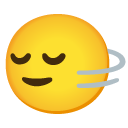
Appearance varies by platform and device. Google Noto, Twemoji, and OpenMoji are open-source.