🧑🏿⚕️
The Emoji
Health Worker: Dark Skin Tone
U+1F9D1 U+1F3FF U+200D U+2695 U+FE0F · :health_worker_dark_skin_tone:
Trend 58
Meaning layers
- interpretation
- Used to represent doctors, nurses, therapists, or any healthcare worker. Also used humorously when someone gives unsolicited medical advice or when self-diagnosing after a WebMD spiral.
- tiktok usage
- Appears in healthcare worker appreciation content, medical school journey vlogs, and ironic 'I diagnosed myself' content after scrolling health forums.
- irony level
- 4 / 10
Platform meanings
- meaning
- Represents healthcare workers, medical students, or anyone in a healing profession. Also used ironically in health misinformation parody content.
- trend usage
- Featured in 'day in my life as a nurse' videos, medical school vlogs, hospital POV content, and dark humor healthcare worker burnout videos.
- hashtags
- #HealthcareWorker#NurseLife#MedTok#DoctorTok#FrontlineHeroes
- virality score
- 65 / 100
Cultural meanings
🇺🇸
Western / Gen-Z
Widely used to represent healthcare diversity and inclusion, especially appreciated for its dark skin tone specificity in representation conversations. Also used ironically in self-diagnosis meme culture.
🇵🇰
Pakistan & India
Represents doctors with high social prestige — in both cultures, becoming a doctor is one of the most respected career paths, so this emoji carries significant pride and aspiration.
🌍
Middle East
Used to represent medical professionals, which hold high social status. The dark skin tone may be specifically noted in contexts discussing South Asian or African expat healthcare workers in the region.
🌐
Global Neutral
Universally understood as representing a healthcare worker or medical professional, regardless of cultural context.
🇧🇩
Bangladesh
Doctors and nurses are highly respected, and this emoji is used proudly by medical students and professionals. Also used in public health awareness campaigns.
🇱🇰
Sri Lanka
Represents medical professionals who are highly respected in society. Used in healthcare appreciation posts and medical student communities online.
🇨🇳
China
Used to represent yīshēng (doctors) or hùshi (nurses). The skin tone specificity is less culturally focused, but the medical role is broadly understood and respected.
🇯🇵
Japan
Medical professionals hold high esteem; this emoji is used in healthcare content but the ZWJ skin tone sequence may not render consistently across older Japanese platforms.
🇰🇷
South Korea
Associated with highly competitive medical careers. Used by medical students and professionals in career content, and in K-drama fan discussions about doctor characters.
🇹🇼
Taiwan
Represents medical professionals in a society with strong universal healthcare pride. Used in health awareness and medical professional appreciation contexts.
🇭🇰
Hong Kong
Used to represent healthcare workers who gained significant public appreciation and recognition during the COVID-19 pandemic period.
🇵🇭
Philippines
Has strong resonance given the Philippines' large nurse and healthcare worker diaspora — used with national pride in OFW (Overseas Filipino Worker) communities discussing medical careers abroad.
🇮🇩
Indonesia
Used in healthcare and medical education content. Doctors are highly respected, and this emoji appears in medical student communities and health awareness campaigns.
🇹🇭
Thailand
Associated with medical professionals and healthcare, appearing in health awareness content and medical professional social media communities.
🇻🇳
Vietnam
Used in medical education and healthcare appreciation contexts. Vietnam's growing medical sector makes this emoji increasingly relevant in professional online spaces.
🇲🇾
Malaysia
Common in healthcare professional communities online, reflecting Malaysia's multicultural medical workforce. The dark skin tone is relevant in representing the diverse healthcare community.
🇸🇦
Saudi Arabia
Represents medical professionals in a country with significant investment in healthcare. May specifically resonate when referencing the large South Asian and African healthcare worker population in the kingdom.
🇦🇪
UAE
Highly relevant given the UAE's diverse healthcare workforce composed significantly of South Asian and African professionals. Used in healthcare appreciation and expat professional communities.
🇪🇬
Egypt
Doctors hold high social prestige. This emoji is used in medical education content, healthcare awareness posts, and professional medical social media communities.
🇹🇷
Turkey
Used to represent doctors and healthcare workers who gained significant national appreciation during recent health crises. Common in medical student online communities.
🇮🇷
Iran
Medical professionals are highly respected. This emoji appears in health awareness content and medical student communities, though skin tone nuance may be less discussed culturally.
🇳🇬
Nigeria
Carries significant weight given Nigeria's complex healthcare landscape and the large Nigerian diaspora in global medical fields. Used with pride and also in advocacy for better healthcare systems.
🇿🇦
South Africa
Relevant in discussions about healthcare equity and diversity in medicine. The dark skin tone representation is particularly meaningful in the South African context of racial healthcare disparities.
🇬🇧
UK & Ireland
Used broadly in NHS appreciation content, healthcare worker advocacy, and diverse medical professional representation discussions. Spiked significantly during COVID-19 clapping campaigns.
🇫🇷
France
Used in healthcare professional content and public health campaigns. The dark skin tone representation is noted in broader diversity and inclusion conversations in French medical institutions.
🇩🇪
Germany
Appears in professional healthcare content and medical student communities. Germany's systematic approach to healthcare makes this emoji common in policy and professional discussions.
🇪🇸
Spain & Italy
Used in healthcare worker appreciation contexts, especially following intense COVID-19 experiences in both countries that created deep cultural respect for medical professionals.
🇧🇷
Brazil
Represents healthcare workers in a country with a complex public health system (SUS). Used in both appreciation content and healthcare advocacy, with the dark skin tone being meaningful in Brazil's racial context.
🇲🇽
Mexico
Used in medical professional content and healthcare advocacy. The emoji represents doctors and nurses in a country where healthcare accessibility is an ongoing national conversation.
🌎
Latin America
Broadly used across Latin America to represent medical professionals. Healthcare workers are respected figures, and the emoji appears in both professional contexts and public health awareness content.
🇦🇺
Australia & NZ
Used in healthcare worker appreciation content and Indigenous health advocacy discussions, where dark skin tone representation is particularly noted and valued in diversity conversations.
How its meaning shifted
- 2010
This specific emoji did not exist — skin tone modifier sequences and ZWJ health worker emojis were not yet part of Unicode. Generic medical symbols or the simple 💊 would be used instead.
- 2015
Skin tone modifiers were introduced in Unicode 8.0 (2015), but the specific health worker ZWJ sequence was not yet available. Early diversity emoji conversations were beginning to shape future additions.
- 2020
Added to major platforms and gained significant visibility during COVID-19, becoming a symbol of frontline hero appreciation. The dark skin tone variant gained particular attention in racial equity and representation discussions during 2020's social justice movements.
- 2026
Established as a standard representation emoji for healthcare professionals. Used routinely by medical professionals in their social media identity, in health advocacy content, and in diversity representation discussions across all major platforms.
See it on every platform
Adjacent emojis
- Often confused with
- person in tuxedoscientistoffice worker
- Can replace
- stethoscopehospitalred cross
Share & embed
Frequently asked
01What does the 🧑🏿⚕️ Health Worker: Dark Skin Tone emoji mean?
A health worker emoji with dark skin tone, depicting a person in medical or healthcare attire, often shown with a stethoscope or medical cross symbol.
02What does 🧑🏿⚕️ mean on TikTok?
Represents healthcare workers, medical students, or anyone in a healing profession. Also used ironically in health misinformation parody content.
03What does 🧑🏿⚕️ mean on WhatsApp?
Sent when discussing medical appointments, health concerns, or to refer to a doctor or nurse in conversation.
04What does 🧑🏿⚕️ mean in Gen-Z slang?
Used to represent doctors, nurses, therapists, or any healthcare worker. Also used humorously when someone gives unsolicited medical advice or when self-diagnosing after a WebMD spiral.
05Is the 🧑🏿⚕️ emoji safe to use?
Represents healthcare professionals and medical workers in a positive, inclusive, and professional manner.
06What does 🧑🏿⚕️ mean in texting?
This emoji triggers feelings of safety, authority, and care. In post-pandemic culture, it carries heightened emotional weight tied to sacrifice, frontline heroism, and systemic healthcare inequity conversations.
07What is the shortcode for 🧑🏿⚕️?
The shortcode for Health Worker: Dark Skin Tone is :health_worker_dark_skin_tone:
08What does 🧑🏿⚕️ mean in dating?
Sometimes used flirtatiously when someone mentions they work in healthcare — 'you're basically my doctor now 🧑🏿⚕️'. Can imply attraction to the professional caregiver archetype.
Safety & usage
- Safe meaning
- Represents healthcare professionals and medical workers in a positive, inclusive, and professional manner.
- Caution
- Extremely rare misuse — could theoretically be used sarcastically in anti-medicine or medical misinformation contexts, but this is uncommon.
The dark skin tone specificity occasionally draws negative attention in racially charged online spaces, but the emoji itself is not inherently problematic. No known widespread toxic usage patterns.
How it looks across platforms
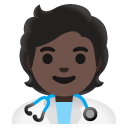
Appearance varies by platform and device. Google Noto, Twemoji, and OpenMoji are open-source.