☝🏻
The Emoji
Index Pointing Up: Light Skin Tone
U+261D U+1F3FB · :index_pointing_up_light_skin_tone:
Trend 68
Meaning layers
- interpretation
- Used to highlight a specific point being made, often dropped mid-sentence to say 'this right here' or 'pay attention to this.' Also used sarcastically to mock people who over-explain or lecture.
- tiktok usage
- Placed in comments or captions to single out the most important line in a video, often as '☝🏻 this' to agree with or amplify a specific statement.
- irony level
- 5 / 10
Platform meanings
- meaning
- Points out a specific moment, lyric, or statement in a video that deserves attention. Also used sarcastically in comments.
- trend usage
- Stitched into duets or comment replies to highlight the 'correct take' or the funniest part of a video. Part of the '☝🏻🤓' nerd meme trend.
- hashtags
- #wellactually#pointingup#thisright here#noteworthy#fyp
- virality score
- 72 / 100
Cultural meanings
🇺🇸
Western / Gen-Z
Heavily associated with the ironic '☝🏻🤓 well actually' meme and used earnestly to emphasize a key point in online discourse.
🇵🇰
Pakistan & India
Used literally to mean 'one point' or 'first of all' in arguments and explanations; also commonly used in educational and tutoring contexts online.
🌍
Middle East
Interpreted as a respectful gesture of emphasis in formal or semi-formal digital communication; pointing up can also carry connotations of referencing God or the divine.
🌐
Global Neutral
Universally understood as 'pointing to something important' or 'number one,' making it one of the most cross-culturally readable hand gesture emojis.
🇧🇩
Bangladesh
Used similarly to neighboring South Asian cultures — primarily literal, to indicate a first point in a list or to say 'wait, one thing first' in conversation.
🇱🇰
Sri Lanka
Commonly used in educational WhatsApp groups and Facebook posts to highlight important exam tips or announcements.
🇨🇳
China
Interpreted as pointing upward toward heaven or authority; also used in WeChat-style contexts to indicate the 'number one' ranking or achievement.
🇯🇵
Japan
The gesture is associated with the 'ichi-ban' (number one) concept and used to politely indicate a single important point without being too assertive.
🇰🇷
South Korea
Used in online communities to indicate 'this is the best' or agree enthusiastically with a previous comment, sometimes paired with praise.
🇹🇼
Taiwan
Deployed in LINE and Instagram comments to agree with a top comment or highlight the most important takeaway from a post.
🇭🇰
Hong Kong
Used casually in Cantonese online spaces to indicate 'one thing' or to point to a pinned post or link, often in Telegram groups.
🇵🇭
Philippines
Very commonly used in Facebook comments to indicate 'this!' or 'number one!' — often posted when agreeing with a viral opinion.
🇮🇩
Indonesia
Used on Twitter/X and TikTok to point to an important caption or video timestamp; also commonly used to say 'first' in list-based posts.
🇹🇭
Thailand
Frequently used on Facebook and TikTok to indicate a top-priority point or to say 'number one' when praising a product or person.
🇻🇳
Vietnam
Used in Zalo and Facebook groups to highlight a key message or agree with the moderator's most important announcement.
🇲🇾
Malaysia
Common in WhatsApp group chats to redirect members to a specific rule or pinned message; also used casually as 'first and foremost.'
🇸🇦
Saudi Arabia
The upward point can carry religious undertones (pointing toward Allah) in some contexts, so it's used carefully; more commonly used for emphasis in professional or educational settings.
🇦🇪
UAE
Used in multilingual digital spaces (Arabic-English) to signal 'key point' or 'most important thing' in business and lifestyle content.
🇪🇬
Egypt
Used on Facebook and TikTok to agree with a strong opinion or point to a specific comment that resonates, often in political or entertainment discussions.
🇹🇷
Turkey
Common in Twitter/X culture to amplify a specific tweet or reply; used frequently in political discourse threads to signal 'this is the point everyone's missing.'
🇮🇷
Iran
Used on Instagram (the dominant platform) to highlight a key part of a caption or to point to a link in bio; cautiously used given platform restrictions.
🇳🇬
Nigeria
Widely used on Twitter/X to cosign a hot take or viral opinion; the '☝🏻 this' format is very common in Nigerian Twitter discourse.
🇿🇦
South Africa
Used across platforms to agree with a point or point to an important update; common in WhatsApp community groups for announcements.
🇬🇧
UK & Ireland
Used with dry British humor — often placed sarcastically after a 'well actually' correction or to mock someone being overly pedantic.
🇫🇷
France
Used straightforwardly to indicate a main point in discussion; French social media users tend to use it earnestly rather than ironically.
🇩🇪
Germany
Typically used literally and precisely — to indicate 'item one' or 'the most important thing' in structured, methodical online communication.
🇪🇸
Spain & Italy
Used expressively as part of the gesture-heavy Southern European communication style; often placed to emphasize passion or a key point in debate.
🇧🇷
Brazil
Very common on Instagram and TikTok to point out the best part of a video or the most important line in a caption, often enthusiastically.
🇲🇽
Mexico
Used frequently on TikTok and Instagram to signal 'pay attention' or 'first of all' in commentary-style content and humorous videos.
🌎
Latin America
Broadly used to indicate agreement or highlight a key point across Spanish-speaking Latin American countries, especially in TikTok comments.
🇦🇺
Australia & NZ
Used casually and often sarcastically — Australians enjoy using it in the ironic '☝🏻 this bloke' context to either praise or mock someone.
How its meaning shifted
- 2010
Primarily used as a literal directional gesture online — pointing up to a link, a comment, or to say 'number one.' Very straightforward and functional.
- 2015
Began appearing more frequently in motivational content and educational posts; teachers and coaches adopted it for emphasis in infographics and social posts.
- 2020
Integrated into meme culture; the '☝🏻🤓 well actually' archetype began emerging. Skin tone variants became more intentional as emoji diversity grew in cultural awareness.
- 2026
A fully dual-purpose emoji — used earnestly to highlight key points and sarcastically as shorthand for pedantic know-it-all behavior. The light skin tone version is used naturally without significant additional cultural weight beyond the base gesture.
See it on every platform
Adjacent emojis
- Often confused with
- backhand index pointing upmiddle fingerraised hand
- Can replace
- index pointing upcheck mark buttonstar
Share & embed
Frequently asked
01What does the ☝🏻 Index Pointing Up: Light Skin Tone emoji mean?
A single index finger pointing upward, shown with a light skin tone modifier. Typically used to indicate 'one point,' draw attention to something above, or signal 'number one.'
02What does ☝🏻 mean on TikTok?
Points out a specific moment, lyric, or statement in a video that deserves attention. Also used sarcastically in comments.
03What does ☝🏻 mean on WhatsApp?
Used to refer back to a point already made in the chat, as in 'what they said ☝🏻' or to signal 'one more thing.'
04What does ☝🏻 mean in Gen-Z slang?
Used to highlight a specific point being made, often dropped mid-sentence to say 'this right here' or 'pay attention to this.' Also used sarcastically to mock people who over-explain or lecture.
05Is the ☝🏻 emoji safe to use?
Pointing upward to indicate emphasis, agreement, a number-one ranking, or to direct attention to something important above.
06What does ☝🏻 mean in texting?
The upward pointing finger triggers cognitive attention signals — it mimics the real-world gesture of a teacher or authority figure drawing focus, which can convey confidence, lecturing, or even condescension depending on context.
07What is the shortcode for ☝🏻?
The shortcode for Index Pointing Up: Light Skin Tone is :index_pointing_up_light_skin_tone:
08What does ☝🏻 mean in dating?
Occasionally used flirtatiously to say 'one condition' or 'one thing I want from you,' or teasingly paired with a demand. Can also imply 'I have one question for you' as an opener.
Safety & usage
- Safe meaning
- Pointing upward to indicate emphasis, agreement, a number-one ranking, or to direct attention to something important above.
- Caution
- Can be used condescendingly in the 'well actually ☝🏻' pattern to belittle or dismiss someone's point while appearing to 'correct' them politely.
Generally safe. In some Middle Eastern cultural contexts the upward-pointing finger may carry unintended religious connotations. The sarcastic 'nerd' meme usage can occasionally be used to mock neurodivergent individuals who communicate precisely.
How it looks across platforms
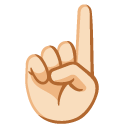


Appearance varies by platform and device. Google Noto, Twemoji, and OpenMoji are open-source.