🔣
The Emoji
Input Symbols
U+1F523 · :input_symbols:
Trend 14
Meaning layers
- interpretation
- Used to signal confusion, chaos, or a situation that feels like total gibberish — like when something is so overwhelming it literally looks like symbol soup.
- tiktok usage
- Appears in comment sections to react to something incomprehensible or absurdly complex, often paired with 'bro what' energy.
- irony level
- 6 / 10
Platform meanings
- meaning
- Represents chaos, confusion, or a situation so bizarre it transcends normal language.
- trend usage
- Used in video captions or comments when reacting to something deeply unhinged or algorithmically bizarre.
- hashtags
- #symbolsoup#whatevenhappened#chaos#inputoverload#brainglitch
- virality score
- 22 / 100
Cultural meanings
🇺🇸
Western / Gen-Z
Gen Z in Western contexts use it ironically to describe situations or conversations that are so chaotic they've transcended language entirely. It's the visual equivalent of keyboard smashing.
🇵🇰
Pakistan & India
In South Asian digital culture, it's sometimes used when someone sends a complicated instruction or a confusing message in English mixed with local script. It signals polite bewilderment.
🌍
Middle East
Used occasionally in Gulf and Levantine digital spaces to represent a confusing or overly formal text, especially in professional or bureaucratic contexts.
🌐
Global Neutral
Globally, most users recognize it neutrally as a symbol for special characters or keyboard input modes, with little emotional or cultural loading beyond its technical use.
🇧🇩
Bangladesh
In Bangladeshi online communities, it appears in tech-related groups or when users are troubleshooting phone keyboard issues, especially switching between Bangla and English inputs.
🇱🇰
Sri Lanka
Sri Lankan users occasionally use it in tech support contexts, particularly around Sinhala or Tamil input method issues on mobile devices.
🇨🇳
China
In Chinese digital spaces, it's relatively uncommon as a standalone emoji; it may appear in tech communities discussing Unicode or input method editors (IMEs) for Chinese characters.
🇯🇵
Japan
Japanese users may associate it with the kaomoji tradition of expressive text art, though it's rarely used in standard conversations — more likely in tech or design circles.
🇰🇷
South Korea
Korean users, particularly in tech and gaming communities, use it to reference menu symbols or input mode icons on Korean-English keyboard layouts.
🇹🇼
Taiwan
In Taiwan, it appears in tech discourse and among users discussing Zhuyin or Bopomofo input systems, where symbol switching is a daily digital experience.
🇭🇰
Hong Kong
Hong Kong users might use it in contrast to Cantonese input frustrations, particularly when discussing the complexity of traditional character input methods.
🇵🇭
Philippines
Filipino netizens use it humorously when reacting to overly complex instructions in English or when government forms look like a wall of incomprehensible symbols.
🇮🇩
Indonesia
In Indonesian online communities, it surfaces in tech forums and humor posts about autocorrect errors or confusing system messages on Android devices.
🇹🇭
Thailand
Thai users might invoke it when dealing with Thai-English keyboard switching issues or when encountering garbled text due to font encoding failures.
🇻🇳
Vietnam
In Vietnamese digital spaces, it relates to the complexity of diacritical marks in Vietnamese typing, often brought up humorously when input methods fail.
🇲🇾
Malaysia
Malaysian users, comfortable with multilingual digital environments, use it when Bahasa Malaysia, English, and Mandarin inputs collide in a single confusing message.
🇸🇦
Saudi Arabia
In Saudi digital culture, it occasionally appears in tech communities discussing Arabic input methods or right-to-left text rendering challenges.
🇦🇪
UAE
UAE users, operating in a highly multilingual digital environment, may use it when navigating between Arabic, English, and other language inputs on shared devices.
🇪🇬
Egypt
Egyptian internet users might drop it humorously in threads about confusing bureaucratic documents or when Arabic transliteration chat (Arabizi) gets particularly cryptic.
🇹🇷
Turkey
Turkish users associate it with keyboard symbol sets or use it ironically when discussing the complex character set differences between old Ottoman and modern Turkish script.
🇮🇷
Iran
In Iranian digital culture, it appears in tech communities discussing Farsi keyboard input issues or the challenge of special characters in Persian computing.
🇳🇬
Nigeria
Nigerian tech and social media users might use it to react to overly complex forms, confusing foreign tech interfaces, or messages that mix multiple pidgin layers.
🇿🇦
South Africa
South African users in multilingual contexts use it when code-switching between languages creates confusing messages, or in tech support threads about keyboard layouts.
🇬🇧
UK & Ireland
British and Irish users occasionally use it with dry humor to react to incomprehensible government forms, GDPR notices, or overly formal communications.
🇫🇷
France
French users might associate it with special character frustration, particularly around accented letters and the complexity of French keyboard layouts (AZERTY).
🇩🇪
Germany
German users connect it with the unique character set challenges of the German language (ä, ö, ü, ß) and the QWERTZ keyboard — often used in IT communities.
🇪🇸
Spain & Italy
Spanish and Italian users use it humorously when autocorrect removes accent marks or when navigating special character inputs on international keyboards.
🇧🇷
Brazil
Brazilian users frequently encounter special character issues with Portuguese accents and tilde characters; this emoji appears in humor about keyboard failures or confusing tech menus.
🇲🇽
Mexico
Mexican users deploy it similarly to other Latin American contexts — reacting to confusing official language, technical menus, or the chaos of ñ and accent-related autocorrect.
🌎
Latin America
Across Latin America, it broadly represents the frustration of navigating digital interfaces not optimized for Spanish or Portuguese character sets.
🇦🇺
Australia & NZ
Australian and New Zealand users employ it with laid-back irony when reacting to anything overly complicated, bureaucratic, or technologically confusing.
How its meaning shifted
- 2010
Primarily used in its literal sense — representing the symbols keyboard on early smartphones and messaging apps. Almost no cultural or emotional subtext.
- 2015
Began appearing in tech blogs and social media posts as a visual shorthand for 'special characters' or 'input settings.' Still mostly functional in meaning.
- 2020
Gained minor ironic traction in meme culture as a symbol of chaos, confusion, or digital noise — aligned with the rise of glitch aesthetics and information overload discourse.
- 2026
Niche but consistent usage in tech, cyberpunk, and digital art communities. Occasionally surfaces in meme culture for comedic chaos but remains a low-frequency, context-dependent emoji overall.
See it on every platform
Compare with
Adjacent emojis
- Often confused with
- eight pointed starsparklesdizzy
- Can replace
- keyboardabcdinput numbers
Share & embed
Frequently asked
01What does the 🔣 Input Symbols emoji mean?
The 🔣 emoji depicts a grid or cluster of symbols including @, &, %, and # characters, representing a collection of input symbols or special characters.
02What does 🔣 mean on TikTok?
Represents chaos, confusion, or a situation so bizarre it transcends normal language.
03What does 🔣 mean on WhatsApp?
Typically sent when someone receives a confusing message they don't know how to respond to.
04What does 🔣 mean in Gen-Z slang?
Used to signal confusion, chaos, or a situation that feels like total gibberish — like when something is so overwhelming it literally looks like symbol soup.
05Is the 🔣 emoji safe to use?
Entirely safe — represents a keyboard input symbol set with no harmful connotations.
06What does 🔣 mean in texting?
Psychologically represents cognitive overload — the mind encountering too many inputs at once and expressing it visually through a jumble of symbols.
07What is the shortcode for 🔣?
The shortcode for Input Symbols is :input_symbols:
08What does 🔣 mean in dating?
Rarely used in flirting; when used, it might mean 'you make me feel all kinds of things I can't even put into words.'
Safety & usage
- Safe meaning
- Entirely safe — represents a keyboard input symbol set with no harmful connotations.
- Caution
- No known toxic usage in mainstream digital culture.
No content warnings apply. This emoji has no documented use in harmful, coded, or dog-whistle communication.
How it looks across platforms
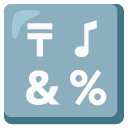


Appearance varies by platform and device. Google Noto, Twemoji, and OpenMoji are open-source.