🧑🏾❤️💋🧑🏻
The Emoji
Kiss: Person, Person, Medium-dark Skin Tone, Light Skin Tone
U+1F9D1 U+1F3FE U+200D U+2764 U+FE0F U+200D U+1F48B U+200D U+1F9D1 U+1F3FB · :kiss_person_person_mediumdark_skin_tone_light_skin_tone:
Trend 58
Meaning layers
- interpretation
- Used to celebrate interracial relationships, show affection between partners of different backgrounds, or express love without gender specification. Often used to signal openness and progressiveness.
- tiktok usage
- Appears in couple content, 'my partner and I' videos, interracial relationship TikToks, and pride-adjacent content celebrating diverse love.
- irony level
- 1 / 10
Platform meanings
- meaning
- Romantic couple representation, often used by interracial couples to identify their dynamic or celebrate their relationship in video captions.
- trend usage
- Featured in 'meet my partner' videos, interracial couple appreciation trends, and love language content.
- hashtags
- #interracialcouple#couplegoals#melaninlove#diverselove#relationshipgoals
- virality score
- 62 / 100
Cultural meanings
🇺🇸
Western / Gen-Z
Widely embraced as a progressive symbol of interracial love and inclusive romance; Gen Z uses it proudly to represent their diverse relationships without hesitation.
🇵🇰
Pakistan & India
Rarely used publicly due to conservative social norms around public displays of affection; more likely to appear in private chats or among younger, urban, liberal demographics.
🌍
Middle East
Generally avoided in public digital spaces due to cultural and religious norms around modesty and public affection; may appear in very private or expat community contexts.
🌐
Global Neutral
Universally understood as a romantic kiss between two people of different skin tones; generally interpreted as a sweet and inclusive love symbol.
🇧🇩
Bangladesh
Limited use in public social media; may appear among younger, educated urban users but generally considered too intimate for open sharing.
🇱🇰
Sri Lanka
Used sparingly and mostly privately; the interracial aspect may draw additional curiosity or commentary in a culturally homogeneous context.
🇨🇳
China
Infrequently used due to conservative attitudes toward public displays of affection online and limited emoji diversity awareness; more common in international-facing or youth communities.
🇯🇵
Japan
Occasionally used among younger, globally-aware Japanese users; the skin tone combination may draw attention as it differs from default representation norms in Japanese digital culture.
🇰🇷
South Korea
Used by K-pop fans and younger Koreans to celebrate diverse couples, especially in fan-fiction or international relationship contexts.
🇹🇼
Taiwan
More openly used than in mainland China due to Taiwan's progressive social climate; appears in LGBTQ+-adjacent and interracial couple content.
🇭🇰
Hong Kong
Used with moderate frequency among cosmopolitan Hong Kongers celebrating multicultural relationships in a diverse urban environment.
🇵🇭
Philippines
Used warmly in romantic contexts; Filipinos are expressive online and may use this to celebrate both local and international romantic relationships.
🇮🇩
Indonesia
Used cautiously due to religious conservatism; more common among urban youth who engage with global social media culture.
🇹🇭
Thailand
Used relatively openly among younger Thais, especially in contexts celebrating international couples or Thai-foreigner relationships.
🇻🇳
Vietnam
Emerging use among younger, urbanized Vietnamese social media users; traditional values mean it's less common in public posts.
🇲🇾
Malaysia
Usage varies by community; more common among non-Muslim youth; avoided in conservative Muslim contexts due to religious norms around public affection.
🇸🇦
Saudi Arabia
Very rarely used in public digital spaces; heavily restricted by cultural and religious norms; may appear only in very private exchanges.
🇦🇪
UAE
More visible than in Saudi Arabia due to the expatriate-heavy population; used among expats and internationally-minded residents celebrating diverse love.
🇪🇬
Egypt
Rarely used publicly; conservative cultural and religious norms limit its visibility, though it may appear in private messages among younger generations.
🇹🇷
Turkey
Used among younger, secular Turkish users; the interracial aspect may carry additional meaning in a country with diverse ethnic backgrounds.
🇮🇷
Iran
Extremely rare in public contexts due to strict social norms; may circulate privately among younger, globally-connected Iranians.
🇳🇬
Nigeria
Used among younger, socially liberal Nigerians; the skin tone combination resonates in a country with rich diversity and growing interracial relationship visibility.
🇿🇦
South Africa
Particularly resonant given the country's history with race and interracial relationships; used positively to celebrate love across racial lines in a post-apartheid context.
🇬🇧
UK & Ireland
Widely used and normalized; the UK's multicultural society makes this emoji feel natural and celebratory in digital conversations about diverse couples.
🇫🇷
France
Used casually in romantic contexts; France's multicultural urban demographics make the skin tone combination relatable and unremarkable in most contexts.
🇩🇪
Germany
Used among progressive and younger Germans; the interracial element may be highlighted in discussions about multiculturalism and inclusion.
🇪🇸
Spain & Italy
Used in romantic and couple contexts; the skin tone variation reflects growing multicultural demographics in major cities like Madrid and Milan.
🇧🇷
Brazil
Highly resonant in Brazil's racially diverse society; used freely to celebrate the country's multicultural romantic landscape.
🇲🇽
Mexico
Used among younger Mexicans engaging with global social media trends; celebrates love across the country's diverse ethnic tapestry.
🌎
Latin America
Broadly used across Latin America to celebrate diverse romantic relationships in regions with rich mestizo and Afro-Latinx heritage.
🇦🇺
Australia & NZ
Widely used and accepted in these multicultural societies; represents the everyday reality of interracial relationships in diverse urban environments.
How its meaning shifted
- 2010
This specific emoji combination did not exist in 2010; basic heart and kiss emojis were used without skin tone modifiers to represent romantic affection.
- 2015
Skin tone modifiers were introduced to Unicode in 2015, beginning the groundwork for diverse couple emojis; couple kiss emojis were still limited in variation.
- 2020
Multi-person emojis with mixed skin tone combinations became more widely supported; used increasingly by diverse couples seeking representation in digital communication.
- 2026
Fully normalized across major platforms; celebrated as a standard representation of interracial romance and used widely in relationship content, Pride contexts, and inclusive media campaigns.
See it on every platform
Adjacent emojis
- Often confused with
- people holding handscouple with heart person personkiss
- Can replace
- red heartkiss marktwo hearts
Share & embed
Frequently asked
01What does the 🧑🏾❤️💋🧑🏻 Kiss: Person, Person, Medium-dark Skin Tone, Light Skin Tone emoji mean?
A kiss emoji depicting two people of unspecified gender sharing a romantic kiss, with the left person having a medium-dark skin tone and the right person having a light skin tone, joined by a red heart and kiss mark.
02What does 🧑🏾❤️💋🧑🏻 mean on TikTok?
Romantic couple representation, often used by interracial couples to identify their dynamic or celebrate their relationship in video captions.
03What does 🧑🏾❤️💋🧑🏻 mean on WhatsApp?
Sending a kiss or expressing love to a romantic partner, often in private chats between couples.
04What does 🧑🏾❤️💋🧑🏻 mean in Gen-Z slang?
Used to celebrate interracial relationships, show affection between partners of different backgrounds, or express love without gender specification. Often used to signal openness and progressiveness.
05Is the 🧑🏾❤️💋🧑🏻 emoji safe to use?
A wholesome and inclusive representation of romantic love between two people of different skin tones; used to express affection, celebrate relationships, and promote diverse representation.
06What does 🧑🏾❤️💋🧑🏻 mean in texting?
The skin tone combination signals deliberate representation and pride in a diverse relationship, adding a layer of identity affirmation to the core emotion of love and intimacy.
07What is the shortcode for 🧑🏾❤️💋🧑🏻?
The shortcode for Kiss: Person, Person, Medium-dark Skin Tone, Light Skin Tone is :kiss_person_person_mediumdark_skin_tone_light_skin_tone:
08What does 🧑🏾❤️💋🧑🏻 mean in dating?
Sent between partners to express deep romantic affection, longing for physical closeness, or to say 'I love you' without words. Can be used in early-stage flirting to hint at serious romantic interest.
Safety & usage
- Safe meaning
- A wholesome and inclusive representation of romantic love between two people of different skin tones; used to express affection, celebrate relationships, and promote diverse representation.
- Caution
- Could theoretically be weaponized in racist or bigoted contexts to mock or provoke, though this is rare and not an intended use.
In highly conservative cultural or religious contexts, any public display of romantic affection via emoji may be considered inappropriate. The interracial skin tone combination may attract negative attention in spaces with systemic racial bias.
How it looks across platforms
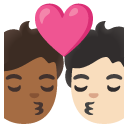
Appearance varies by platform and device. Google Noto, Twemoji, and OpenMoji are open-source.