👩🏾❤️💋👨🏾
The Emoji
Kiss: Woman, Man, Medium-dark Skin Tone
U+1F469 U+1F3FE U+200D U+2764 U+FE0F U+200D U+1F48B U+200D U+1F468 U+1F3FE · :kiss_woman_man_mediumdark_skin_tone:
Trend 68
Meaning layers
- interpretation
- Used to express deep romantic affection, 'you're my person' energy, or a passionate 'I love you' to a partner or crush. Sometimes used performatively to announce relationship status.
- tiktok usage
- Appears in couple content, 'my boyfriend/girlfriend did this' POV videos, anniversary posts, and relationship goals montages.
- irony level
- 2 / 10
Platform meanings
- meaning
- Signals romantic couple content, relationship milestones, or affectionate messages to a partner in video captions and comments.
- trend usage
- Used in couple duets, 'rate my relationship' trends, anniversary countdown videos, and 'things my partner does' POV clips.
- hashtags
- #couplegoals#relationshipcheck#anniversarypost#mybae#coupleoftiktok
- virality score
- 72 / 100
Cultural meanings
🇺🇸
Western / Gen-Z
Widely used to celebrate couple goals and representation, especially among Black and brown Gen Z communities who appreciate seeing their skin tone reflected. Used freely in social media captions and DMs without stigma.
🇵🇰
Pakistan & India
Used more privately between romantic partners due to cultural conservatism around public displays of affection; sharing openly on public social media may be seen as too bold or inappropriate in more traditional contexts.
🌍
Middle East
Largely reserved for private couple communication; publicly posting or sharing this emoji can be seen as inappropriate or overly intimate in conservative societies, though younger urban users may use it more openly.
🌐
Global Neutral
Universally recognized as a romantic kiss between a couple; the medium-dark skin tone adds inclusive representation appreciated globally by people of similar complexions.
🇧🇩
Bangladesh
Used discreetly in private messaging between couples; public display of this emoji is uncommon due to social conservatism, but younger generations in urban areas are gradually normalizing it.
🇱🇰
Sri Lanka
Treated similarly to South Asian norms — primarily used in private romantic conversations; public use is rare and may attract negative attention in traditional communities.
🇨🇳
China
Less commonly used due to cultural preference for subtler expressions of affection; younger, more Westernized users may adopt it in private chats, but public romantic displays are not typical.
🇯🇵
Japan
Used privately between partners; Japanese social media culture tends toward more reserved expressions of affection, so this emoji is less prevalent publicly but accepted in intimate digital communication.
🇰🇷
South Korea
Popular in couple culture where matching profiles and open relationship displays are common among younger Koreans; used in couple apps and social posts, though the skin tone specificity is less culturally resonant.
🇹🇼
Taiwan
Used in romantic contexts among younger users; Taiwan's progressive social values make this emoji more accepted publicly than in some neighboring regions.
🇭🇰
Hong Kong
Used in private and semi-public romantic contexts by younger, cosmopolitan users influenced by both Western and East Asian digital culture.
🇵🇭
Philippines
Widely used and accepted in romantic contexts on social media; Filipinos are expressive online and this emoji is commonly used in couple posts, anniversary captions, and affectionate messages.
🇮🇩
Indonesia
Used privately more than publicly due to Islamic cultural norms in many regions; younger urban Indonesians may post it more freely, but caution is common.
🇹🇭
Thailand
Used in romantic couple communication; Thai youth culture embraces couple emojis, and this is used in couple posts and affectionate messages, with the skin tone being somewhat relevant to darker-skinned communities.
🇻🇳
Vietnam
Used in private messaging between couples; public romantic posts are becoming more common among Vietnamese youth influenced by K-pop and Western social media culture.
🇲🇾
Malaysia
Used cautiously due to mixed cultural and religious contexts; more acceptable in non-Muslim urban communities while conservative Muslim communities may avoid it in public social media posts.
🇸🇦
Saudi Arabia
Rarely used publicly due to strict social norms around public displays of affection; used privately between married couples in personal messaging, with caution.
🇦🇪
UAE
More cosmopolitan usage among expats and younger Emiratis; privately used in romantic messaging, and expat communities use it as freely as in Western contexts.
🇪🇬
Egypt
Used privately in romantic chats; public sharing is uncommon and may be seen as inappropriate given conservative social norms, though younger Egyptians on social media are slowly normalizing it.
🇹🇷
Turkey
Used between couples in private chats; younger, urban Turks influenced by Western culture may post it publicly, but it remains moderately conservative in broader social contexts.
🇮🇷
Iran
Rarely used publicly given the cultural and political context around public displays of affection; used privately between couples as a discreet romantic expression.
🇳🇬
Nigeria
Widely embraced, especially as the medium-dark skin tone resonates with many Nigerians; used in couple posts, anniversary celebrations, and relationship content on platforms like Instagram and WhatsApp.
🇿🇦
South Africa
Well received and used openly, especially by Black South Africans who appreciate the skin tone representation; commonly used in couple social media posts and WhatsApp messages.
🇬🇧
UK & Ireland
Used straightforwardly in romantic couple contexts; appreciated in diverse communities for its skin tone representation, and used freely across social media platforms.
🇫🇷
France
Used in romantic messaging consistent with France's cultural openness about love and affection; seen as a natural expression of romance without stigma.
🇩🇪
Germany
Used sincerely in couple communication; Germans tend to be direct and this emoji is used genuinely rather than ironically in romantic contexts.
🇪🇸
Spain & Italy
Embraced enthusiastically given both cultures' expressive relationship with love and romance; commonly used in couple posts, family announcements, and affectionate messages.
🇧🇷
Brazil
Very popular due to Brazil's expressive romantic culture; used widely in couple posts, especially appreciated by Afro-Brazilian communities for the skin tone representation.
🇲🇽
Mexico
Used in couple messaging and social posts; Mexican digital culture is warm and expressive, making this emoji common in affectionate contexts among younger users.
🌎
Latin America
Broadly used across Latin America in romantic and couple contexts; the medium-dark skin tone resonates with many Latin American communities, enhancing its personal relevance.
🇦🇺
Australia & NZ
Used openly in couple contexts; diversity-conscious users appreciate the skin tone representation, and it's used freely across platforms without stigma.
How its meaning shifted
- 2010
This specific emoji did not exist in 2010; basic couple and heart emojis were used for romantic expression without skin tone or gender specification.
- 2015
Early versions of couple emojis existed but skin tone modifiers were just being introduced; representation was limited and the composite kiss couple emoji was not yet standard.
- 2020
Widely available and used by couples wanting to express their skin tone identity in romantic emoji; gained traction on Instagram and WhatsApp particularly during increased focus on diversity and representation.
- 2026
Established as a meaningful representation tool for medium-dark skinned couples; used naturally in digital communication, social media, and dating apps as both a romantic and identity expression.
See it on every platform
Adjacent emojis
- Often confused with
- kiss markface blowing a kisscouple with heart
- Can replace
- kiss markred heartface blowing a kiss
Share & embed
Frequently asked
01What does the 👩🏾❤️💋👨🏾 Kiss: Woman, Man, Medium-dark Skin Tone emoji mean?
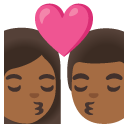
A kiss between a woman and a man both with medium-dark skin tone, depicted as two faces with a heart and lips between them.
02What does 👩🏾❤️💋👨🏾 mean on TikTok?
Signals romantic couple content, relationship milestones, or affectionate messages to a partner in video captions and comments.
03What does 👩🏾❤️💋👨🏾 mean on WhatsApp?
Sent to a romantic partner as a virtual kiss or as a strong expression of love, often closing a sweet message.
04What does 👩🏾❤️💋👨🏾 mean in Gen-Z slang?
Used to express deep romantic affection, 'you're my person' energy, or a passionate 'I love you' to a partner or crush. Sometimes used performatively to announce relationship status.
05Is the 👩🏾❤️💋👨🏾 emoji safe to use?
A wholesome romantic emoji depicting a kiss between a couple; represents love, affection, and commitment between two people.
06What does 👩🏾❤️💋👨🏾 mean in texting?
This emoji triggers associations with physical intimacy and commitment. The kiss gesture is a universally recognized expression of deep bonding, and the skin tone specificity adds a layer of personal identity and representation.
07What is the shortcode for 👩🏾❤️💋👨🏾?
The shortcode for Kiss: Woman, Man, Medium-dark Skin Tone is :kiss_woman_man_mediumdark_skin_tone:
08What does 👩🏾❤️💋👨🏾 mean in dating?
Sent when flirting has escalated to clear romantic territory — signals 'I want to kiss you' or 'you mean the world to me'.
Safety & usage
- Safe meaning
- A wholesome romantic emoji depicting a kiss between a couple; represents love, affection, and commitment between two people.
- Caution
- Could theoretically be used to mock or provoke someone in the context of jealousy, relationship drama, or to taunt an ex-partner.
Generally safe; no inherent harmful meaning. In some conservative cultural or religious contexts, public use may be considered inappropriate. Rarely weaponized but could be used to provoke jealousy.
How it looks across platforms
Appearance varies by platform and device. Google Noto, Twemoji, and OpenMoji are open-source.