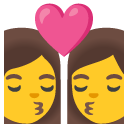
👩❤️💋👩
The Emoji
Kiss: Woman, Woman
U+1F469 U+200D U+2764 U+FE0F U+200D U+1F48B U+200D U+1F469 · :kiss_woman_woman:
Trend 72
Meaning layers
- interpretation
- Used to celebrate WLW (women loving women) relationships, sapphic love, and queer female identity. Also deployed by allies showing support.
- tiktok usage
- Appears in WLW coming-out videos, sapphic couple content, pride month posts, and 'girlfriend reveal' videos.
- irony level
- 2 / 10
Platform meanings
- meaning
- Symbol of WLW love, sapphic identity, and queer pride; central to the lesbian and bisexual TikTok community.
- trend usage
- Frequently used in 'girlfriend reveal' trends, pride month challenges, and WLW couple duet videos.
- hashtags
- #WLW#SapphicTikTok#LesbianCouple#PrideTikTok#QueerLove
- virality score
- 78 / 100
Cultural meanings
🇺🇸
Western / Gen-Z
Widely embraced as a symbol of sapphic love and queer female identity; used freely and proudly across social platforms to celebrate WLW relationships.
🇵🇰
Pakistan & India
Largely taboo due to legal and social stigma around same-sex relationships; used mainly in private by queer individuals or urban liberal communities, rarely in public discourse.
🌍
Middle East
Highly sensitive due to legal prohibitions on homosexuality in many countries; if used at all, it's confined to private, anonymous, or activist contexts.
🌐
Global Neutral
Recognized internationally as a same-sex female couple kiss emoji; reception varies widely from celebratory to controversial depending on local cultural norms.
🇧🇩
Bangladesh
Almost entirely absent from mainstream use due to social and religious conservatism; may be used very cautiously within small underground LGBTQ+ communities.
🇱🇰
Sri Lanka
Rarely used publicly due to social stigma; queer communities in urban areas like Colombo may use it in private or activist spaces.
🇨🇳
China
Use is limited and often filtered on major Chinese platforms; queer communities use it on VPN-accessed platforms or carefully within private chats.
🇯🇵
Japan
Used within the thriving yuri (WLW) fandom community and among queer women; Japan has a nuanced relationship with queer expression that allows some public use in fandom contexts.
🇰🇷
South Korea
Gaining traction in queer and K-pop fan communities; still relatively sensitive in mainstream culture but used openly in LGBTQ+ activist and fan spaces.
🇹🇼
Taiwan
Used freely and proudly, as Taiwan is the most LGBTQ+-inclusive country in Asia with legal same-sex marriage since 2019.
🇭🇰
Hong Kong
Used within active LGBTQ+ communities; political climate has added complexity, but queer identity expression remains relatively more open than mainland China.
🇵🇭
Philippines
Mixed reception — used freely in urban, younger, and online communities where WLW relationships are somewhat visible, but still controversial in conservative religious contexts.
🇮🇩
Indonesia
Rarely used publicly due to strong conservative and religious social norms; confined to private or underground LGBTQ+ spaces.
🇹🇭
Thailand
Used openly in urban areas and online communities, reflecting Thailand's relatively visible LGBTQ+ culture, though legal recognition of same-sex relationships remains limited.
🇻🇳
Vietnam
Increasingly used by younger, urban Vietnamese queer communities online; societal attitudes are slowly shifting but public expression remains cautious.
🇲🇾
Malaysia
Highly sensitive due to both civil and sharia law restrictions on homosexuality; used only in very private or diaspora/international contexts.
🇸🇦
Saudi Arabia
Essentially prohibited in public discourse; homosexuality is criminalized, making this emoji's use extremely rare and risky outside private encrypted communications.
🇦🇪
UAE
Similar to Saudi Arabia in legal restrictions; used very rarely and only in private or expat international community contexts.
🇪🇬
Egypt
Sensitive due to social conservatism and legal risks; queer Egyptians may use it in anonymous or diaspora online spaces.
🇹🇷
Turkey
Increasingly polarized; queer communities in major cities use it proudly, but rising conservatism has made public LGBTQ+ expression more fraught in recent years.
🇮🇷
Iran
Extremely sensitive given criminalization of homosexuality; used only in diaspora communities or anonymous online spaces outside Iran.
🇳🇬
Nigeria
Highly sensitive due to strong social, religious, and legal prohibitions; used only within very private or diaspora LGBTQ+ contexts.
🇿🇦
South Africa
Used openly and positively, as South Africa has constitutionally protected LGBTQ+ rights and one of Africa's most visible queer communities.
🇬🇧
UK & Ireland
Used freely and enthusiastically to celebrate WLW relationships, sapphic identity, and pride; deeply normalized across social media.
🇫🇷
France
Used openly as a symbol of romantic same-sex love; France's secular tradition and legal equality for LGBTQ+ people make it widely accepted.
🇩🇪
Germany
Embraced positively in a country with strong LGBTQ+ rights and visibility; used commonly in pride contexts and everyday queer expression.
🇪🇸
Spain & Italy
Spain uses it freely given strong LGBTQ+ legal protections; Italy's more conservative Catholic culture creates more mixed reception, though urban queer communities use it openly.
🇧🇷
Brazil
Widely used in Brazil's large and vibrant LGBTQ+ community; one of the world's biggest Pride events is held in São Paulo, making this emoji culturally prominent.
🇲🇽
Mexico
Used openly in urban queer communities and among younger generations; more conservative rural areas and religious communities remain resistant.
🌎
Latin America
Variable across the region — more accepted in Argentina, Chile, and Colombia which have LGBTQ+ legal protections; more sensitive in Honduras, Paraguay, and other more conservative nations.
🇦🇺
Australia & NZ
Used freely and celebratorily following legalization of same-sex marriage in Australia (2017) and New Zealand (2013); deeply normalized in online culture.
How its meaning shifted
- 2010
Not yet introduced as an emoji; WLW couples had no dedicated emoji representation and had to improvise with combinations of heart and person emojis.
- 2015
Recently introduced in Unicode; used primarily by LGBTQ+ advocates and queer individuals to celebrate representation, though still not mainstream.
- 2020
Significantly more widespread following years of LGBTQ+ visibility growth; used prominently during Pride Month, in TikTok's emerging WLW community, and in mainstream ally expression.
- 2026
Fully normalized in Western and progressive global digital culture; integrated into everyday relationship expression for WLW couples alongside broader queer emoji vocabulary.
See it on every platform
Adjacent emojis
- Often confused with
- kiss woman mantwo women holding handssmiling face with hearts
- Can replace
- red heartkiss markrainbow flag
Share & embed
Frequently asked
01What does the 👩❤️💋👩 Kiss: Woman, Woman emoji mean?
Represents two women sharing a romantic kiss, denoting a same-sex female couple in a loving, intimate moment.
02What does 👩❤️💋👩 mean on TikTok?
Symbol of WLW love, sapphic identity, and queer pride; central to the lesbian and bisexual TikTok community.
03What does 👩❤️💋👩 mean on WhatsApp?
Sent between female partners to express romantic affection, or used to celebrate queer relationships in group chats.
04What does 👩❤️💋👩 mean in Gen-Z slang?
Used to celebrate WLW (women loving women) relationships, sapphic love, and queer female identity. Also deployed by allies showing support.
05Is the 👩❤️💋👩 emoji safe to use?
A loving representation of a same-sex female kiss, used to celebrate WLW relationships, queer identity, and LGBTQ+ pride.
06What does 👩❤️💋👩 mean in texting?
Carries deep emotional weight for LGBTQ+ individuals as a symbol of visibility and validation; represents love that has historically been marginalized or invisible in mainstream media.
07What is the shortcode for 👩❤️💋👩?
The shortcode for Kiss: Woman, Woman is :kiss_woman_woman:
08What does 👩❤️💋👩 mean in dating?
Used between women to signal romantic interest, establish queer identity, or express affection toward a girlfriend or crush.
Safety & usage
- Safe meaning
- A loving representation of a same-sex female kiss, used to celebrate WLW relationships, queer identity, and LGBTQ+ pride.
- Caution
- May be weaponized by bad actors to harass LGBTQ+ individuals or used mockingly in homophobic contexts; also occasionally used to fetishize WLW relationships in a non-affirming way.
Use with sensitivity to cultural context — sharing this emoji in regions or communities with strong anti-LGBTQ+ sentiment may expose the sender or recipient to real social or legal risk. Avoid fetishizing or performative use that undermines genuine WLW experiences.
How it looks across platforms
Appearance varies by platform and device. Google Noto, Twemoji, and OpenMoji are open-source.