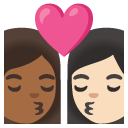
👩🏾❤️💋👩🏻
The Emoji
Kiss: Woman, Woman, Medium-dark Skin Tone, Light Skin Tone
U+1F469 U+1F3FE U+200D U+2764 U+FE0F U+200D U+1F48B U+200D U+1F469 U+1F3FB · :kiss_woman_woman_mediumdark_skin_tone_light_skin_tone:
Trend 68
Meaning layers
- interpretation
- A go-to emoji for WLW (women-loving-women) couples, sapphic pride, or simply showing intense affection between female friends. Often used unironically to celebrate queer relationships or as a soft flex about a girlfriend.
- tiktok usage
- Appears in WLW relationship videos, sapphic couple content, 'girlfriend reveal' videos, and pride-themed edits. Frequently paired with aesthetic couple footage.
- irony level
- 1 / 10
Platform meanings
- meaning
- Signals WLW relationship content, sapphic pride, or affectionate female friendship. Widely used in couple duets and 'meet my girlfriend' videos.
- trend usage
- Featured in pride month trends, sapphic couple aesthetics, 'girlfriend tag' videos, and queer visibility campaigns. Often appears in pinned bio sections of WLW creators.
- hashtags
- #WLW#SapphicTikTok#GirlsWhoLikeGirls#PrideTikTok#CoupleGoals
- virality score
- 72 / 100
Cultural meanings
🇺🇸
Western / Gen-Z
Widely celebrated and used freely as a symbol of WLW pride, relationship visibility, and sapphic identity. Normalized in digital spaces and seen as a positive representation of queer love.
🇵🇰
Pakistan & India
Extremely rare in public use due to social and legal stigma around same-sex relationships; may be used privately or covertly in urban LGBTQ+ circles or anonymous online spaces.
🌍
Middle East
Almost entirely absent from public digital use given legal and cultural prohibitions on same-sex relationships; may exist in very private or anonymous LGBTQ+ digital spaces.
🌐
Global Neutral
Recognized internationally as a same-sex female kiss emoji; reception varies widely by regional cultural and legal context regarding LGBTQ+ acceptance.
🇧🇩
Bangladesh
Rarely used publicly due to strong conservative social norms and legal restrictions on same-sex relationships; occasional private use in underground LGBTQ+ communities.
🇱🇰
Sri Lanka
Largely avoided in mainstream digital communication due to conservative social attitudes; may appear in private messages among LGBTQ+ individuals in urban areas.
🇨🇳
China
Usage is limited and often censored on domestic platforms; may appear on international platforms used by younger Chinese LGBTQ+ individuals seeking community and visibility.
🇯🇵
Japan
Used within Japan's relatively visible but socially nuanced LGBTQ+ community, particularly in online spaces; less common in mainstream casual conversation but accepted in queer digital circles.
🇰🇷
South Korea
Present in Korean LGBTQ+ online communities and queer social media spaces; less visible in mainstream Korean social media due to conservative social norms around public LGBTQ+ expression.
🇹🇼
Taiwan
Relatively normalized given Taiwan's status as the first Asian country to legalize same-sex marriage; used openly in WLW communities and by allies celebrating queer love.
🇭🇰
Hong Kong
Used within Hong Kong's active LGBTQ+ community and pride movement; more visible on international platforms than local apps, where political and social climates affect expression.
🇵🇭
Philippines
Used in Filipino LGBTQ+ communities which are relatively visible culturally, though same-sex unions lack legal recognition; appears in online queer Filipino spaces and pride content.
🇮🇩
Indonesia
Rarely used publicly due to increasing conservatism and restrictions on LGBTQ+ expression; exists primarily in private digital spaces among LGBTQ+ Indonesians.
🇹🇭
Thailand
Thailand's culturally visible 'tom-dee' (WLW) culture means this emoji sees moderate use in queer Thai digital spaces, though legal recognition of same-sex relationships is limited.
🇻🇳
Vietnam
Used in Vietnam's small but growing online LGBTQ+ community; visibility has increased with recent social media queer representation but remains niche in mainstream usage.
🇲🇾
Malaysia
Extremely rare in public digital use given strong religious and legal prohibitions on same-sex relationships; exists only in highly private LGBTQ+ digital spaces.
🇸🇦
Saudi Arabia
Not used in any mainstream or public context; same-sex relationships carry severe legal consequences, making this emoji essentially absent except in anonymous international digital spaces.
🇦🇪
UAE
Similar to Saudi Arabia, virtually absent from public digital communication; used only anonymously or in international online LGBTQ+ spaces by UAE residents.
🇪🇬
Egypt
Rarely used publicly given legal restrictions and social stigma; may appear in anonymous or private LGBTQ+ digital spaces among Egyptian users on international platforms.
🇹🇷
Turkey
Usage has declined publicly in recent years alongside increased restrictions on LGBTQ+ expression; still present in Turkish queer online communities and pride advocacy spaces.
🇮🇷
Iran
Essentially absent from public digital use due to severe legal prohibitions; may exist in highly anonymous or encrypted LGBTQ+ online communities.
🇳🇬
Nigeria
Rarely used in public digital spaces due to strict anti-LGBTQ+ legislation and strong religious/cultural norms; present only in very private or diaspora LGBTQ+ online communities.
🇿🇦
South Africa
South Africa's constitutionally protected LGBTQ+ rights make this emoji more normalized than elsewhere on the continent; used openly in South African queer communities and pride spaces.
🇬🇧
UK & Ireland
Used freely and positively in WLW communities across the UK and Ireland; common in pride content, queer dating app profiles, and general LGBTQ+ digital culture.
🇫🇷
France
Embraced in French LGBTQ+ digital culture with a characteristically understated aesthetic; used in WLW relationship content, pride events, and queer Parisian social media circles.
🇩🇪
Germany
Used openly within Germany's progressive LGBTQ+ digital spaces; common in WLW community content, pride month posts, and queer German social media.
🇪🇸
Spain & Italy
Spain's strong LGBTQ+ legal protections mean open usage in WLW digital spaces; Italian usage is more variable but present in urban queer communities and pride content.
🇧🇷
Brazil
Brazil's large and visible LGBTQ+ community, particularly in cities like São Paulo, means this emoji sees significant use in WLW spaces, pride content, and queer Brazilian social media.
🇲🇽
Mexico
Used in Mexico's growing urban LGBTQ+ digital spaces and pride communities; usage is more concentrated in metropolitan areas and queer activist or creative online spaces.
🌎
Latin America
Visibility varies by country — more common in progressive urban LGBTQ+ communities across Latin America; used in pride content, WLW community spaces, and queer advocacy online.
🇦🇺
Australia & NZ
Freely and openly used in WLW communities across Australia and New Zealand, both of which have strong legal protections and visible LGBTQ+ cultures; common in pride and couple content.
How its meaning shifted
- 2010
This specific emoji did not exist in 2010 — same-sex couple emojis with skin tone modifiers were not yet part of Unicode, and digital queer representation was extremely limited in emoji form.
- 2015
Early versions of same-sex couple emojis began appearing, but skin tone combinations were not yet available; the concept of this emoji was forming alongside growing LGBTQ+ emoji advocacy.
- 2020
Multi-skin-tone same-sex couple emojis became available and were celebrated widely in LGBTQ+ communities; usage surged during Pride Month 2020 and in WLW social media spaces.
- 2026
Fully normalized within WLW digital culture globally; used casually in relationship content, pride expression, and identity signaling across all major platforms with continued strong presence in sapphic online communities.
See it on every platform
Adjacent emojis
- Often confused with
- kiss woman manpeople huggingtwo hearts
- Can replace
- red heartkiss markrainbow flag
Share & embed
Frequently asked
01What does the 👩🏾❤️💋👩🏻 Kiss: Woman, Woman, Medium-dark Skin Tone, Light Skin Tone emoji mean?
A kiss emoji depicting two women with medium-dark and light skin tones, shown with a heart and kiss mark between them, representing romantic affection between same-sex female partners with specific skin tone representation.
02What does 👩🏾❤️💋👩🏻 mean on TikTok?
Signals WLW relationship content, sapphic pride, or affectionate female friendship. Widely used in couple duets and 'meet my girlfriend' videos.
03What does 👩🏾❤️💋👩🏻 mean on WhatsApp?
Sent between girlfriends as a kiss and affection symbol; often used in private relationship chats to express love or seal a loving message.
04What does 👩🏾❤️💋👩🏻 mean in Gen-Z slang?
A go-to emoji for WLW (women-loving-women) couples, sapphic pride, or simply showing intense affection between female friends. Often used unironically to celebrate queer relationships or as a soft flex about a girlfriend.
05Is the 👩🏾❤️💋👩🏻 emoji safe to use?
A positive, inclusive representation of romantic affection between two women of different skin tones — used to celebrate WLW love, sapphic identity, and LGBTQ+ visibility.
06What does 👩🏾❤️💋👩🏻 mean in texting?
The specific skin tone pairing signals not just romantic love but conscious visibility — users feel seen and represented. The act of using this emoji can carry emotional weight around identity validation and relationship pride.
07What is the shortcode for 👩🏾❤️💋👩🏻?
The shortcode for Kiss: Woman, Woman, Medium-dark Skin Tone, Light Skin Tone is :kiss_woman_woman_mediumdark_skin_tone_light_skin_tone:
08What does 👩🏾❤️💋👩🏻 mean in dating?
Sent between women who are flirting or in early stages of a romantic relationship, often as a bold declaration of interest or a cute affectionate gesture in texting.
Safety & usage
- Safe meaning
- A positive, inclusive representation of romantic affection between two women of different skin tones — used to celebrate WLW love, sapphic identity, and LGBTQ+ visibility.
- Caution
- In rare cases may be used mockingly or fetishistically by bad actors to sexualize same-sex female relationships rather than genuinely celebrate them.
In regions with anti-LGBTQ+ laws or social stigma, using this emoji publicly could expose users to harassment, discrimination, or legal risk — context and regional awareness are important. On mainstream platforms it is generally positive and safe.
How it looks across platforms
Appearance varies by platform and device. Google Noto, Twemoji, and OpenMoji are open-source.