🫷🏻
The Emoji
Leftwards Pushing Hand: Light Skin Tone
U+1FAF7 U+1F3FB · :leftwards_pushing_hand_light_skin_tone:
Trend 61
Meaning layers
- interpretation
- Used to say 'back off,' 'not today,' 'stay in your lane,' or to dramatically push away negativity, bad vibes, drama, or unwanted opinions. Often used humorously as a boundary-setting gesture.
- tiktok usage
- Appears in reaction videos where creators push away cringe content, toxic behavior, or bad takes — often paired with a dramatic zoom-out effect or transition.
- irony level
- 6 / 10
Platform meanings
- meaning
- Gesture of rejection, blocking bad energy, or playfully pushing away something. Used in reaction duets and transitions.
- trend usage
- Featured in 'POV: you push away ___' trend formats and used as a transition element where the hand swipes to a new scene.
- hashtags
- #pushingaway#nottoday#boundaries#badvibesonly#handgesture
- virality score
- 62 / 100
Cultural meanings
🇺🇸
Western / Gen-Z
Core part of the Gen Z digital vocabulary for setting boundaries online — used constantly in memes, comments, and reaction content to express assertive playful rejection.
🇵🇰
Pakistan & India
Used colloquially to tell someone to back off or to express 'ruk ja' (stop/hold on) vibes; also used humorously among friends when refusing a ridiculous request.
🌍
Middle East
Interpreted as a stop or warning gesture consistent with the cultural palm-out gesture meaning 'stay back'; used in casual digital conversations to signal firm disagreement.
🌐
Global Neutral
Universally understood as a hand pushing something away, making it cross-culturally legible as a gesture of refusal, stopping, or rejection.
🇧🇩
Bangladesh
Used informally to push back in online debates or tell friends to stop in messenger chats; the skin tone option adds personalization for local users.
🇱🇰
Sri Lanka
Adopted in youth social media culture to express playful refusal or to push away uncomfortable topics in group chats.
🇨🇳
China
Less commonly used compared to native Chinese emoji packs, but understood by younger netizens as a rejection or stop signal, occasionally used on Weibo for dramatic effect.
🇯🇵
Japan
Used carefully in digital communication where directness is often avoided; more likely to appear in casual friend chats than formal settings, interpreted as a gentle push rather than a hard stop.
🇰🇷
South Korea
Popular among younger Koreans on platforms like KakaoTalk and Instagram to express playful refusal or to push away embarrassment in a cute, dramatic way.
🇹🇼
Taiwan
Incorporated into casual Taiwanese internet culture as a rejection or boundary-setting emoji, often used alongside humor in LINE chats.
🇭🇰
Hong Kong
Used in Cantonese digital conversations to express 'sei lah' (dramatic rejection) moments in a humorous and hyperbolic way.
🇵🇭
Philippines
Hugely expressive culture; the emoji is used to dramatically push away secondhand embarrassment, bad luck, or a friend's cringe content in GC (group chat) conversations.
🇮🇩
Indonesia
Used in casual WhatsApp and Instagram conversations to signal 'jangan deh' (no please) or to playfully push away unwanted suggestions from friends.
🇹🇭
Thailand
Used in Thai social media to signal a cute but firm refusal — fits the Thai internet culture of wrapping disagreement in playful softness.
🇻🇳
Vietnam
Seen in Zalo and Facebook chats among Vietnamese youth to express mock-serious rejection or to push away bad news with levity.
🇲🇾
Malaysia
Used in casual Bahasa Malaysia digital conversations as a humorous emoji to reject plans, express 'tak nak' (don't want), or push away Monday morning dread.
🇸🇦
Saudi Arabia
Interpreted through the lens of the traditional hand gesture for warding off or refusing; used in youth digital spaces to push back on bad ideas or unwanted content.
🇦🇪
UAE
Used by the diverse, young, digital-savvy UAE population to express rejection or distance from something unwanted, often with self-aware humor in mixed-language chats.
🇪🇬
Egypt
Fits the Egyptian internet culture of dramatic expression; used to push away bad vibes or signal 'mesh ana' (not me, not dealing with this).
🇹🇷
Turkey
Used among Turkish youth on Twitter and Instagram to push back against a bad take or drama, consistent with the expressive Turkish digital communication style.
🇮🇷
Iran
Used in informal Telegram and Instagram conversations to express refusal or push something away humorously, fitting the expressive Persian digital culture.
🇳🇬
Nigeria
Widely used in Nigerian social media (especially Twitter/X) to push away bad energy, financial stress, or toxic behavior — often with sharp comedic delivery.
🇿🇦
South Africa
Used across South Africa's diverse digital communities to signal 'not today' energy or to push away drama in a way that resonates with local slang culture.
🇬🇧
UK & Ireland
Deployed with classic British sarcasm and dry wit — pushing away something dreadful in a very understated, funny way; 'pushing this queue away 🫷🏻'
🇫🇷
France
Used with Gallic flair to reject something distasteful or intellectually beneath the user; pairs well with French internet irony culture.
🇩🇪
Germany
Used straightforwardly to indicate refusal or a firm stop — German digital culture appreciates clear, direct signals and this emoji delivers.
🇪🇸
Spain & Italy
Embraced passionately in the expressive Mediterranean digital culture; used dramatically to push away anything from bad weather to football losses.
🇧🇷
Brazil
Used energetically in Brazilian WhatsApp groups and Twitter to push away drama, stress, or bad news — fits the high-energy, expressive Brazilian digital communication style.
🇲🇽
Mexico
Incorporated into Mexican internet slang to express 'ya no' (enough already) or to dramatically push away something annoying or cringe-worthy in group chats.
🌎
Latin America
Broadly understood across Latin America as a rejection or boundary-setting gesture; commonly used in WhatsApp and Instagram across the region.
🇦🇺
Australia & NZ
Used with classic Aussie and Kiwi self-deprecating humor to push away responsibility, bad weather, or Monday mornings — casual and light in tone.
How its meaning shifted
- 2010
Did not exist — Unicode 15.0 was not released until 2022, so there was no usage of this emoji in 2010.
- 2015
Still nonexistent as an emoji — the concept of directional pushing hand gestures had not yet been codified in Unicode standards.
- 2020
Not yet released; pushing and stopping gestures were being filled by the raised hand ✋ and stop sign 🛑 in digital communication.
- 2026
Fully integrated into mainstream digital vocabulary as a versatile boundary-setting and rejection emoji; frequently used in Gen Z meme formats, TikTok transitions, and self-care content across all major platforms.
See it on every platform
Compare with
Adjacent emojis
- Often confused with
- waving handraised back of handbackhand index pointing left
- Can replace
- raised handno entry signprohibited
Share & embed
Frequently asked
01What does the 🫷🏻 Leftwards Pushing Hand: Light Skin Tone emoji mean?
A hand with light skin tone pushing or gesturing to the left, palm facing outward in a stopping or pushing motion.
02What does 🫷🏻 mean on TikTok?
Gesture of rejection, blocking bad energy, or playfully pushing away something. Used in reaction duets and transitions.
03What does 🫷🏻 mean on WhatsApp?
Stop, back off, or I'm not interested — a casual digital hand raised in refusal or playful rejection.
04What does 🫷🏻 mean in Gen-Z slang?
Used to say 'back off,' 'not today,' 'stay in your lane,' or to dramatically push away negativity, bad vibes, drama, or unwanted opinions. Often used humorously as a boundary-setting gesture.
05Is the 🫷🏻 emoji safe to use?
Setting boundaries, playfully rejecting something, stopping or pausing, pushing away negativity or drama.
06What does 🫷🏻 mean in texting?
Reflects a need to establish personal boundaries or reject unwanted stimuli. The gesture mimics the primal protective reflex of pushing away threat, but in digital culture it is often deployed playfully rather than aggressively.
07What is the shortcode for 🫷🏻?
The shortcode for Leftwards Pushing Hand: Light Skin Tone is :leftwards_pushing_hand_light_skin_tone:
08What does 🫷🏻 mean in dating?
Used flirtatiously to 'push away' a cheesy pickup line while actually being charmed by it — a coy rejection that signals interest with plausible deniability.
Safety & usage
- Safe meaning
- Setting boundaries, playfully rejecting something, stopping or pausing, pushing away negativity or drama.
- Caution
- Could theoretically be used in a targeted harassment context to dismiss or push away a specific person or group, though this usage is rare.
Generally a safe and benign emoji. Minimal risk of misuse. Skin tone variations can occasionally be weaponized in racially charged contexts on toxic platforms, as with any skin-tone emoji.
How it looks across platforms
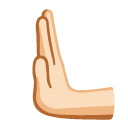

Appearance varies by platform and device. Google Noto, Twemoji, and OpenMoji are open-source.