🫷🏼
The Emoji
Leftwards Pushing Hand: Medium-light Skin Tone
U+1FAF7 U+1F3FC · :leftwards_pushing_hand_mediumlight_skin_tone:
Trend 55
Meaning layers
- interpretation
- Used to signal 'back off,' 'not my problem,' or 'I'm pushing this away from me.' Often used to reject unwanted energy, opinions, or drama. Also used playfully to 'push' a friend or idea away in a teasing way.
- tiktok usage
- Appears in comment sections to dismiss cringe content or bad takes, often paired with 🚶 to signal walking away from drama. Used in skits showing someone rejecting negativity.
- irony level
- 5 / 10
Platform meanings
- meaning
- Gesture of rejection, dismissal, or playful pushing away of content, people, or situations. Used in duets to 'push' the other video away.
- trend usage
- Appears in 'pushing away toxic traits' trend videos, POV skits, and reaction content. Used in comment wars to dismiss opposing opinions.
- hashtags
- #pushingaway#nope#boundaries#notmyproblem#vibecheck
- virality score
- 58 / 100
Cultural meanings
🇺🇸
Western / Gen-Z
Primarily used as a boundary-setting and rejection emoji in casual digital communication, memes, and self-empowerment content. Closely tied to mental health and 'protecting your peace' discourse.
🇵🇰
Pakistan & India
Used in text conversations to tell someone to back off or stop teasing, often in a playful sibling or friend dynamic. Also appears in rejection of unwanted proposals or advice in a lighthearted way.
🌍
Middle East
Can represent warding off bad energy or rejecting negativity, sometimes paralleling cultural gestures of deflection. Used carefully as it may resemble gestures considered rude in some Gulf contexts.
🌐
Global Neutral
Universally understood as a pushing or stopping gesture, making it broadly interpretable as 'stop,' 'back off,' or 'go left.' One of the more culturally transferable hand emojis.
🇧🇩
Bangladesh
Used informally among younger users to reject or dismiss situations humorously. In peer group chats, it signals 'get away' or 'not interested' without confrontation.
🇱🇰
Sri Lanka
Among younger social media users, used to signal boundaries or push away drama. Less common than in Western contexts but growing in urban digital circles.
🇨🇳
China
Used on platforms like WeChat and Weibo to signal disagreement or to 'push away' opposing opinions in debates. The skin tone modifier carries less cultural weight than in Western contexts.
🇯🇵
Japan
Interpreted as a stop or pushing gesture, fitting Japanese digital communication norms of indirect refusal. Used in LINE sticker-equivalent contexts and gaming communities.
🇰🇷
South Korea
Popular in KakaoTalk and Twitter (X) among younger Koreans to express playful rejection or to push away bad luck or negative situations. Fits well with Korean meme culture.
🇹🇼
Taiwan
Used on PTT, Dcard, and Instagram to signal disagreement or humorous rejection. Younger Taiwanese users incorporate it in relatable life-struggle content.
🇭🇰
Hong Kong
Used in LIHKG and Instagram to push back against opinions in a visually expressive, non-confrontational way. Fits the city's candid and fast-paced digital communication style.
🇵🇭
Philippines
Widely used on Facebook and TikTok to reject unsolicited advice or to playfully push away a friend's teasing. Fits Filipino humor culture of gentle ribbing and playful deflection.
🇮🇩
Indonesia
Used on Twitter (X) and Instagram by Gen Z to push away drama or toxic vibes. Pairs well with Indonesian internet slang like 'gak mau' (don't want) for emphasis.
🇹🇭
Thailand
Used in LINE and TikTok to reject bad energy or situations in a cute, non-aggressive way. Fits Thai digital culture's preference for visually expressive but non-confrontational emojis.
🇻🇳
Vietnam
Used by younger users on Facebook and TikTok to signal rejection or 'not my problem.' Vietnamese internet culture embraces expressive emojis for emotional shorthand.
🇲🇾
Malaysia
Common on Twitter (X) and TikTok among Malaysian youth to push away stress, bad grades, or relationship drama in a humorous, relatable way.
🇸🇦
Saudi Arabia
Used among younger Saudis on Snapchat and Twitter to signal rejection or to deflect unwanted situations. The pushing gesture aligns with cultural norms of polite but firm boundary-setting.
🇦🇪
UAE
In the multicultural UAE digital space, used broadly to reject negativity or signal disagreement. Common in expatriate communities as a universal boundary emoji.
🇪🇬
Egypt
Used in Egyptian social media to reject drama or bad news in a comic, meme-driven way. Appears frequently in reaction posts on Facebook and TikTok.
🇹🇷
Turkey
Among Turkish Gen Z on Twitter and Instagram, used to push away stress, bad days, or unwanted opinions. Fits Turkey's expressive and high-volume digital communication culture.
🇮🇷
Iran
Used on Instagram and Telegram — the dominant social platforms — to symbolically push away hardship or bad energy. A quiet but growing presence in Iranian youth digital expression.
🇳🇬
Nigeria
Used on Twitter (X) and WhatsApp to dismiss bad takes, toxic behavior, or to signal 'abeg, leave me' (please, leave me alone). Fits Nigerian internet culture's directness and humor.
🇿🇦
South Africa
Used across WhatsApp and Twitter to reject drama or signal 'hayi' (no way) in a visual, expressive way. Resonates with South African digital humor and directness.
🇬🇧
UK & Ireland
Used in British and Irish social media to sarcastically 'push away' cringe posts or bad opinions, often with dry humor. Fits the UK's penchant for understatement and passive dismissal.
🇫🇷
France
Used on Instagram and Twitter to express philosophical rejection or artistic 'pushing against the norm.' French users may deploy it in intellectual debate contexts.
🇩🇪
Germany
Used pragmatically in German digital communication to signal disagreement or to 'push back' logically on incorrect information. Less emotionally loaded than in other cultures.
🇪🇸
Spain & Italy
In Spain and Italy, used expressively to push away bad luck, annoying situations, or drama. Fits the Mediterranean culture of animated, gesture-rich communication.
🇧🇷
Brazil
Widely used on Twitter, TikTok, and WhatsApp to signal rejection, dismiss drama, or push away stress. Brazilian meme culture incorporates it in 'eu empurrando X para longe' (me pushing X away) formats.
🇲🇽
Mexico
Used on TikTok and Twitter to reject bad vibes, toxic relationships, or Monday mornings in a humorous way. Fits Mexican internet culture's love of relatable, self-deprecating humor.
🌎
Latin America
Across Latin America, used to push away negativity, bad news, or drama. Resonates broadly with the region's expressive digital culture and relatable stress content.
🇦🇺
Australia & NZ
Used in casual Aussie and Kiwi digital banter to tell someone to 'rack off' (go away) or push away cringe content. Fits the region's relaxed, humorous communication style.
How its meaning shifted
- 2010
Did not exist — Unicode 15.0 was released in 2022, so this emoji had no presence in 2010 digital communication.
- 2015
Still nonexistent. Hand gesture emojis were expanding but directional pushing hands had not yet been introduced to the Unicode standard.
- 2020
Still not yet introduced. The concept was being fulfilled by combinations of 🖐️ and directional emojis, but a dedicated pushing hand did not exist.
- 2026
Established as a go-to boundary-setting emoji in Gen Z communication, widely used in mental health, self-care, and boundary discourse across all major platforms. Skin tone variants add personalization depth.
See it on every platform
Adjacent emojis
- Often confused with
- backhand index pointing leftraised back of handwaving hand
- Can replace
- raised handhand with fingers splayedno entry
Share & embed
Frequently asked
01What does the 🫷🏼 Leftwards Pushing Hand: Medium-light Skin Tone emoji mean?
A hand with palm facing left, pushing outward in a leftward direction, displayed with medium-light skin tone. Introduced in Unicode 15.0 (2022).
02What does 🫷🏼 mean on TikTok?
Gesture of rejection, dismissal, or playful pushing away of content, people, or situations. Used in duets to 'push' the other video away.
03What does 🫷🏼 mean on WhatsApp?
Telling someone to back off or giving a playful shove in conversation. Used to say 'stop it' or 'get away from me' in a lighthearted way.
04What does 🫷🏼 mean in Gen-Z slang?
Used to signal 'back off,' 'not my problem,' or 'I'm pushing this away from me.' Often used to reject unwanted energy, opinions, or drama. Also used playfully to 'push' a friend or idea away in a teasing way.
05Is the 🫷🏼 emoji safe to use?
Represents a pushing or stopping gesture used for boundary-setting, playful rejection, and directional communication in everyday digital conversation.
06What does 🫷🏼 mean in texting?
Represents the human psychological need to establish personal space and boundaries. The pushing gesture activates associations with self-protection, refusal, and assertive communication without aggression.
07What is the shortcode for 🫷🏼?
The shortcode for Leftwards Pushing Hand: Medium-light Skin Tone is :leftwards_pushing_hand_mediumlight_skin_tone:
08What does 🫷🏼 mean in dating?
Can be used playfully to 'push away' a flirty comment in a teasing, faux-rejecting way — implying 'stop it, you're too much 😏.' Low-key flirty when combined with blushing emojis.
Safety & usage
- Safe meaning
- Represents a pushing or stopping gesture used for boundary-setting, playful rejection, and directional communication in everyday digital conversation.
- Caution
- Could be used aggressively in harassment contexts to repeatedly 'push away' a person, or in coordinated pile-ons to signal mass rejection of an individual.
Generally safe and low-risk. In rare cases, the skin tone specification combined with aggressive intent could be used in targeted harassment, but this is uncommon. No inherent NSFW or hate-speech associations.
How it looks across platforms
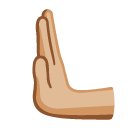

Appearance varies by platform and device. Google Noto, Twemoji, and OpenMoji are open-source.