🧎♂️
The Emoji
Man Kneeling
U+1F9CE U+200D U+2642 U+FE0F · :man_kneeling:
Trend 68
Meaning layers
- interpretation
- Used to express begging, desperation, simping, or 'I'm on my knees for you' energy. Also used ironically to mock someone who is overly devoted or desperate.
- tiktok usage
- Appears in simp culture videos, thirst traps, and 'I would do anything for you' commentary. Also used in sports hype and protest solidarity content.
- irony level
- 7 / 10
Platform meanings
- meaning
- Symbol of simping, worship, or desperate devotion. Also used in sports and prayer content.
- trend usage
- Appears in duet reactions to attractive creators, simp challenge videos, and 'this person has me weak in the knees' trending sounds.
- hashtags
- #simp#kneeling#devoted#simpcheck#foryou
- virality score
- 72 / 100
Cultural meanings
🇺🇸
Western / Gen-Z
Primarily used as the 'simp emoji' — signal of extreme devotion, attraction, or begging. Highly ironic and self-aware in usage.
🇵🇰
Pakistan & India
Used in religious contexts to represent Islamic prayer postures or Hindu devotional gestures, but increasingly adopted by younger users in simp culture memes.
🌍
Middle East
Carries strong religious connotations — represents prayer, submission to God, and humility. Secular simp usage is secondary but growing among youth.
🌐
Global Neutral
Universally understood as kneeling, representing prayer, submission, respect, or proposal depending on context.
🇧🇩
Bangladesh
Primarily associated with religious devotion and respectful gestures; younger users have adopted the simp meme culture usage from global platforms.
🇱🇰
Sri Lanka
Used in religious contexts related to Buddhist prostration or Christian prayer, with younger demographics beginning to use it in internet humor.
🇨🇳
China
Associated with bowing or kneeling in deference, a culturally significant gesture. Also used in gaming communities in its simp/submission meme sense.
🇯🇵
Japan
Connected to seiza (formal kneeling posture) or dogeza (deep bow of apology/respect). Carries significant cultural weight around respect and submission.
🇰🇷
South Korea
Used in K-pop fan communities to express extreme stan devotion. Also culturally read as deep respect or apology in formal contexts.
🇹🇼
Taiwan
Read through both traditional respect/prayer contexts and modern internet simp culture, especially among Taiwanese youth on social media.
🇭🇰
Hong Kong
Used primarily in online humor and meme culture to signal submission or admiration; also understood in traditional respect contexts.
🇵🇭
Philippines
Strong association with Catholic prayer and devotion. Also widely used in simp and hugot (heartfelt) meme culture on Facebook and TikTok.
🇮🇩
Indonesia
Carries religious significance in Muslim-majority contexts as a prayer or submission gesture. Gen Z usage has absorbed the simp meme meaning.
🇹🇭
Thailand
Associated with Buddhist reverence and respectful gestures. Also used in Thai social media humor for extreme admiration or begging.
🇻🇳
Vietnam
Interpreted as a gesture of deep respect or apology. Younger Vietnamese users use it for simp humor on TikTok and Facebook.
🇲🇾
Malaysia
Dual meaning — religious humility in Muslim contexts and internet simp culture among younger users, especially on Twitter and TikTok.
🇸🇦
Saudi Arabia
Heavily associated with Islamic prayer posture (though not precisely sujood). Used respectfully in religious conversations; secular meme usage is rare.
🇦🇪
UAE
Mixed between religious reverence for older users and internet meme culture for younger, more cosmopolitan users familiar with global trends.
🇪🇬
Egypt
Seen through an Islamic prayer lens by older generations. Younger Egyptians on TikTok and Twitter use it in simp and begging meme contexts.
🇹🇷
Turkey
Associated with prayer and humility in traditional contexts; also picked up in internet humor culture among Turkish Gen Z as a simp symbol.
🇮🇷
Iran
Primarily interpreted as a prayer or devotional gesture. Younger Iranians use it on Instagram and Telegram in ironic devotion or begging scenarios.
🇳🇬
Nigeria
Used in religious contexts (Christian prayer, reverence) and also widely in Afrobeats fan culture to express worship of artists and celebrities.
🇿🇦
South Africa
Understood as prayer or submission; also used in sports culture (rugby, soccer) to react to incredible athletic moments.
🇬🇧
UK & Ireland
Used with heavy irony and dry humor — calling someone out as a simp or mocking over-devotion. Also used in football fan contexts.
🇫🇷
France
Used more literally for prayer or respect; simp culture usage is growing among younger French users on TikTok and Twitter.
🇩🇪
Germany
Interpreted practically as kneeling for prayer or sports. Meme usage around simp culture is secondary but present in online gaming communities.
🇪🇸
Spain & Italy
Used in passionate expressions of admiration ('I kneel before you') fitting the dramatic communication style; simp meme culture also present.
🇧🇷
Brazil
Extremely popular in simp and thirst culture on Brazilian Twitter (now X) and TikTok. Also used in religious devotion contexts given strong Catholic culture.
🇲🇽
Mexico
Used in religious contexts (very Catholic country) and also heavily in meme culture to represent begging, simping, or dramatic devotion.
🌎
Latin America
Broadly understood as a prayer or devotion gesture; younger Latin American users enthusiastically use it in simp and romantic declaration contexts.
🇦🇺
Australia & NZ
Used with classic Aussie/Kiwi irony to call out simps or mock over-the-top devotion. Also used in sports fan contexts for dramatic moments.
How its meaning shifted
- 2010
Emoji did not exist yet; kneeling was represented through combinations of other emojis or text emoticons.
- 2015
Still non-existent as an emoji; the concept was expressed via 🙏 or written descriptions.
- 2020
Newly introduced (Unicode 12.0, 2019) and quickly adopted in the context of the Black Lives Matter movement (taking a knee), prayer, and early simp culture memes.
- 2026
Firmly established as the definitive simp/devotion emoji in Gen Z culture while retaining religious and sports context meanings across broader demographics.
See it on every platform
Adjacent emojis
- Often confused with
- folded handsperson bowingperson in lotus position
- Can replace
- folded handsdown arrowbroken heart
Share & embed
Frequently asked
01What does the 🧎♂️ Man Kneeling emoji mean?
A man shown in a kneeling position, on one or both knees, facing forward. Part of the Unicode 12.0 emoji set released in 2019.
02What does 🧎♂️ mean on TikTok?
Symbol of simping, worship, or desperate devotion. Also used in sports and prayer content.
03What does 🧎♂️ mean on WhatsApp?
Begging, pleading, or extreme admiration. Often sent when asking a favor dramatically.
04What does 🧎♂️ mean in Gen-Z slang?
Used to express begging, desperation, simping, or 'I'm on my knees for you' energy. Also used ironically to mock someone who is overly devoted or desperate.
05Is the 🧎♂️ emoji safe to use?
Kneeling in prayer, respect, proposal, sports celebration, or taking a knee in solidarity.
06What does 🧎♂️ mean in texting?
Kneeling is a universally understood gesture of lowering oneself before another, psychologically signaling vulnerability, deference, or deep reverence. In digital culture it amplifies emotional extremes.
07What is the shortcode for 🧎♂️?
The shortcode for Man Kneeling is :man_kneeling:
08What does 🧎♂️ mean in dating?
Used to signal extreme attraction — 'I'm literally on my knees for you.' Often sent after seeing an attractive photo or video.
Safety & usage
- Safe meaning
- Kneeling in prayer, respect, proposal, sports celebration, or taking a knee in solidarity.
- Caution
- Can be used to demean or mock someone as weak, submissive, or a 'simp.' Occasionally used in dominance-submission power dynamic conversations.
Generally safe but context-dependent. In some political discussions, 'taking a knee' imagery can be polarizing. In explicit conversations, submission connotations can veer into inappropriate territory.
How it looks across platforms
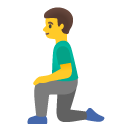
Appearance varies by platform and device. Google Noto, Twemoji, and OpenMoji are open-source.