🦹🏼♂️
The Emoji
Man Supervillain: Medium-light Skin Tone
U+1F9B9 U+1F3FC U+200D U+2642 U+FE0F · :man_supervillain_mediumlight_skin_tone:
Trend 68
Meaning layers
- interpretation
- Used to represent someone who is unapologetically chaotic, doing morally questionable but relatable things, or owning their 'villain arc' — a popular Gen Z concept of embracing selfish or petty behavior without guilt.
- tiktok usage
- Commonly appears in 'villain arc' content where creators proudly announce they've stopped being nice or have started prioritizing themselves, often with dramatic music.
- irony level
- 7 / 10
Platform meanings
- meaning
- Represents someone entering their villain era, doing chaotic or self-serving things unashamedly, often in comedic or dramatic storytelling.
- trend usage
- Paired with 'villain arc' trend videos, POV villain scenarios, and dramatic glow-up content where the creator stops caring about others' opinions.
- hashtags
- #VillainArc#VillainEra#NotTheHero#ChaoticEnergy#SupervillainMode
- virality score
- 72 / 100
Cultural meanings
🇺🇸
Western / Gen-Z
Deeply embedded in 'villain arc' culture where young people use it to announce they're done being people-pleasers and are embracing selfish or chaotic behavior. Considered ironic, empowering, and humorous.
🇵🇰
Pakistan & India
Used in social media posts about drama, being petty, or calling someone a backstabber; also popular in Bollywood-inspired content where antagonists are celebrated for their style and confidence.
🌍
Middle East
Used in Arabic social media to represent someone acting sneakily or causing drama; also appears in gaming communities where villain characters are popular.
🌐
Global Neutral
Universally understood as representing a supervillain character; used cross-culturally in gaming, pop culture, and comic-related contexts.
🇧🇩
Bangladesh
Used in online communities to refer to dramatic antagonists in popular dramas or to describe someone acting selfishly or creating conflict.
🇱🇰
Sri Lanka
Appears in social media posts about local drama and controversy; sometimes used to describe politicians or public figures acting against public interest.
🇨🇳
China
Used on Weibo and Douyin in content about 'big villain energy' (大反派气场), often paired with dramatic villain tropes from Chinese dramas (c-dramas) where villains are stylish and popular.
🇯🇵
Japan
Strongly associated with anime villain aesthetics; used by fans of characters like those from My Hero Academia or Naruto who identify with villain arcs, and in 'chuunibyou' (eighth-grade syndrome) humor.
🇰🇷
South Korea
Popular in K-drama fan communities to describe compelling antagonists; also used in K-pop fan culture when idols do something unexpected or edgy.
🇹🇼
Taiwan
Used similarly to Japan and South Korea in anime and drama contexts; also appears in gaming content on platforms like PTT when describing PvP betrayals.
🇭🇰
Hong Kong
Used in Cantonese internet culture to describe someone acting shady or duplicitous, often in commentary on local drama or entertainment.
🇵🇭
Philippines
Commonly used in hugot (emotional) content and OPM (Original Pilipino Music) communities to describe heartbreakers or antagonists in love stories.
🇮🇩
Indonesia
Used on Twitter and TikTok Indonesia in 'villain era' content, especially among younger users inspired by Western trends, and in gaming communities.
🇹🇭
Thailand
Popular in Thai social media to describe someone acting dramatically evil or stirring up conflict, often in the context of Thai dramas (lakorns) where villains are iconic.
🇻🇳
Vietnam
Used in gaming content and social media to represent someone acting as the antagonist or doing something sneaky; increasingly popular with younger Vietnamese TikTok users.
🇲🇾
Malaysia
Used similarly to Indonesia and Singapore; appears in content about drama, betrayal, and 'villain glow-up' narratives in multi-ethnic online spaces.
🇸🇦
Saudi Arabia
Used in gaming and pop culture content among younger Saudi users; sometimes appears in commentary about public figures acting against community interests.
🇦🇪
UAE
Common in multicultural UAE social media among expats and locals alike; used in gaming, pop culture, and dramatic storytelling contexts.
🇪🇬
Egypt
Used in Arabic meme culture to describe someone being crafty or underhanded; also appears in content about drama and interpersonal conflicts.
🇹🇷
Turkey
Popular in Turkish gaming communities and social media to describe villain-like behavior, often with reference to Turkish drama (dizi) antagonists who are culturally iconic.
🇮🇷
Iran
Used in Persian social media among younger users to describe cunning or manipulative behavior; appears in gaming and entertainment commentary.
🇳🇬
Nigeria
Used in Nigerian Twitter (Naija Twitter) to call out shady behavior or to celebrate someone's bold, unapologetic moves in a humorous way.
🇿🇦
South Africa
Used in South African social media to describe someone acting snake-like or being a troublemaker; also appears in local gaming communities.
🇬🇧
UK & Ireland
Used with dry British humor to self-identify as the villain of mundane situations, often understated and ironic — 'didn't hold the lift for someone 🦹🏼♂️'.
🇫🇷
France
Used in French social media to describe someone acting with selfish flair or dramatic mischief; appears in gaming and cinema-related discussions.
🇩🇪
Germany
Used in German gaming and internet culture to represent antagonistic or trolling behavior; less common in casual conversation than in English-speaking markets.
🇪🇸
Spain & Italy
Used in Mediterranean social media to describe someone acting dramatically or being a troublemaker; appears heavily in football (soccer) discussions when describing unsportsmanlike players.
🇧🇷
Brazil
Very popular in Brazilian internet culture for describing petty, dramatic, or chaotic behavior; used in 'villão da novela' (soap opera villain) comparisons and gaming streams.
🇲🇽
Mexico
Used in Mexican social media to describe someone acting like a 'malandro' (a crafty, mischievous person) or stirring up drama, often with humor.
🌎
Latin America
Broadly used across Latin America in telenovela villain comparisons, gaming contexts, and posts about personal drama and petty revenge.
🇦🇺
Australia & NZ
Used similarly to the UK with dry humor; Australians use it to describe 'larrikin' (mischievous) behavior or calling out someone acting too big for their boots.
How its meaning shifted
- 2010
This emoji did not exist in 2010; villain representation online was limited to text-based descriptions or generic Halloween emoji.
- 2015
Still not introduced; pop culture villain discourse was happening through image macros and GIFs rather than emoji.
- 2020
Introduced and immediately adopted into 'villain arc' discourse that exploded during the pandemic, as people used quarantine as a reset to redefine themselves without social obligations.
- 2026
Firmly established as a symbol of the 'villain era' mindset; used across generations to signal unapologetic self-prioritization, chaotic energy, and theatrical pettiness in everyday digital communication.
See it on every platform
Adjacent emojis
- Often confused with
- ninjaman in tuxedoman with mask
Share & embed
Frequently asked
01What does the 🦹🏼♂️ Man Supervillain: Medium-light Skin Tone emoji mean?
A man with medium-light skin tone dressed in supervillain attire, typically depicted wearing a mask or hood and a cape in dark or dramatic colors, representing an evil or antagonist character.
02What does 🦹🏼♂️ mean on TikTok?
Represents someone entering their villain era, doing chaotic or self-serving things unashamedly, often in comedic or dramatic storytelling.
03What does 🦹🏼♂️ mean on WhatsApp?
Sent when admitting to doing something sneaky, petty, or mischievous in group chats or personal conversations.
04What does 🦹🏼♂️ mean in Gen-Z slang?
Used to represent someone who is unapologetically chaotic, doing morally questionable but relatable things, or owning their 'villain arc' — a popular Gen Z concept of embracing selfish or petty behavior without guilt.
05Is the 🦹🏼♂️ emoji safe to use?
A fun, theatrical representation of fictional villainy used for humor, pop culture discussion, and self-expression around personal empowerment narratives.
06What does 🦹🏼♂️ mean in texting?
Tapping into the Jungian 'shadow self,' using this emoji allows people to safely express darker impulses, defiance, and ego through the lens of fictional villainy, reducing the social cost of admitting petty or selfish behavior.
07What is the shortcode for 🦹🏼♂️?
The shortcode for Man Supervillain: Medium-light Skin Tone is :man_supervillain_mediumlight_skin_tone:
08What does 🦹🏼♂️ mean in dating?
Used flirtatiously to suggest the sender is a 'bad boy' type or is about to do something daring or naughty, often playful teasing.
Safety & usage
- Safe meaning
- A fun, theatrical representation of fictional villainy used for humor, pop culture discussion, and self-expression around personal empowerment narratives.
- Caution
- Can be used to glorify genuinely harmful behavior, normalize manipulation or cruelty, or used in harassment contexts to threaten or intimidate while maintaining plausible deniability.
While mostly harmless, the 'villain arc' framing can sometimes normalize toxic behavior like ghosting, manipulation, or cruelty under the guise of 'self-empowerment.' Monitor use in contexts involving harassment or threats.
How it looks across platforms
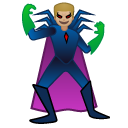
Appearance varies by platform and device. Google Noto, Twemoji, and OpenMoji are open-source.