🚇
The Emoji
Metro
U+1F687 · :metro:
Trend 38
Meaning layers
- interpretation
- Used to signal city life, commuting culture, or being a 'main character' navigating urban spaces. Also used ironically to flex living in a big city or to complain about public transit.
- tiktok usage
- Appears in city vlog aesthetics, 'day in my life' content, and urban exploration videos. Often paired with lo-fi music or city ambiance soundtracks.
- irony level
- 4 / 10
Platform meanings
- meaning
- Represents urban city living, daily commuting content, and metro/subway aesthetic videos
- trend usage
- Featured in city vlog intros, 'a day in NYC/Tokyo/Paris' content, and transit-related rants that go viral
- hashtags
- #MetroLife#CityVlog#SubwayTok#UrbanCommute#CityAesthetic
- virality score
- 45 / 100
Cultural meanings
🇺🇸
Western / Gen-Z
Used ironically and aesthetically to represent city life and the 'main character commuting through a big city' fantasy. Often paired with city vlog content and lo-fi playlists.
🇵🇰
Pakistan & India
Used practically to reference metro systems in cities like Delhi, Mumbai, Lahore, and Karachi. Signals modern urban infrastructure pride and everyday commuting.
🌍
Middle East
Represents the growing metro systems in cities like Dubai, Riyadh, Doha, and Cairo. Often signals modernity, urban development, and pride in new transit infrastructure.
🌐
Global Neutral
Universally understood as a subway or metro train. Used practically worldwide to indicate transit, commuting, or urban travel.
🇧🇩
Bangladesh
Associated with the Dhaka Metro Rail and excitement around emerging public transit. Signals urban modernization and development pride.
🇱🇰
Sri Lanka
Less commonly used as Sri Lanka lacks a metro system; mostly used in travel contexts when visiting cities abroad with metro transit.
🇨🇳
China
Highly relatable — China has some of the world's most extensive metro networks. Used constantly in everyday chat to indicate commuting in cities like Beijing, Shanghai, and Shenzhen.
🇯🇵
Japan
Extremely common and culturally resonant — Japanese train culture is iconic globally. Used to represent the efficient, punctual, and deeply integrated metro systems of Tokyo, Osaka, and beyond.
🇰🇷
South Korea
Strongly associated with the Seoul Metro and Busan transit. Used frequently in daily communication about commuting and city navigation.
🇹🇼
Taiwan
Represents the MRT (Mass Rapid Transit) systems in Taipei and Kaohsiung. Commonly used in daily chat to coordinate transit meetups.
🇭🇰
Hong Kong
Strongly associated with the MTR, one of the world's most efficient transit systems. Used proudly and practically in everyday communication.
🇵🇭
Philippines
Used to reference the LRT, MRT, and emerging transit in Metro Manila. Often accompanied by frustration emojis given congestion and reliability issues.
🇮🇩
Indonesia
Represents Jakarta's MRT and KRL Commuter Line. Used in urban commuter chats and increasingly as a symbol of Jakarta's modernization.
🇹🇭
Thailand
Associated with Bangkok's BTS Skytrain and MRT subway. Used in daily commuter communication and city lifestyle content.
🇻🇳
Vietnam
Represents emerging metro systems in Hanoi and Ho Chi Minh City. Used to signal modern urban development and infrastructure pride.
🇲🇾
Malaysia
Refers to Kuala Lumpur's MRT, LRT, and Monorail systems. Used in daily transit coordination and urban lifestyle posts.
🇸🇦
Saudi Arabia
Represents the Riyadh Metro and Mecca-Medina high-speed rail projects. Signals national modernization and Vision 2030 urban development.
🇦🇪
UAE
Associated with the Dubai Metro — a symbol of ultra-modern urban infrastructure. Used to signal luxury city living and efficient transit in Dubai.
🇪🇬
Egypt
Represents the Cairo Metro, one of Africa's first subway systems. Used practically for daily commuting and with pride as a landmark urban infrastructure.
🇹🇷
Turkey
Strongly associated with Istanbul's extensive metro and Marmaray systems. Used in daily commuter communication and city lifestyle content.
🇮🇷
Iran
Represents the Tehran Metro and metro systems in Mashhad and Isfahan. Used for everyday transit coordination and urban commuting.
🇳🇬
Nigeria
Rarely used literally as metro systems are limited; more commonly used in aspirational contexts or when referencing international cities' transit systems.
🇿🇦
South Africa
Associated with Gautrain in Johannesburg. Used in urban transit discussions, though car culture dominates, making metro less central to daily life.
🇬🇧
UK & Ireland
Strongly associated with the London Underground ('the Tube'). Used with pride, nostalgia, or sarcasm about TfL delays and tube culture.
🇫🇷
France
Heavily associated with the Paris Métro — iconic globally. Used in everyday chat, travel content, and Parisian lifestyle aesthetics.
🇩🇪
Germany
Represents the U-Bahn systems in Berlin, Munich, Hamburg, and other cities. Used practically for transit and associated with efficient German engineering pride.
🇪🇸
Spain & Italy
Associated with metro systems in Madrid, Barcelona, Rome, and Milan. Used in daily transit communication and city tourism content.
🇧🇷
Brazil
Represents metro systems in São Paulo, Rio de Janeiro, and other cities. Used practically in commuter chats but often with frustration about overcrowding.
🇲🇽
Mexico
Associated with Mexico City's Metro — one of the largest in the world. Used with both practicality and cultural pride, though often paired with crowding complaints.
🌎
Latin America
Used across Latin American cities with metro systems (Santiago, Buenos Aires, Bogotá, Lima). Signals urban modernity and public transit culture.
🇦🇺
Australia & NZ
Associated with Sydney Metro and Auckland Transit. Used in city commuter contexts, though car culture means metro is less dominant in daily life.
How its meaning shifted
- 2010
Primarily used as a literal transit indicator — telling someone you're on the subway or directing them to take the metro. Very functional, minimal creative usage.
- 2015
Began appearing in travel content and city lifestyle posts on early Instagram. Used in travel captions and city check-ins alongside location tags.
- 2020
Gained aesthetic usage in city vlog culture, urban photography, and lo-fi commute content. Ironic usage emerged around transit failures and pandemic-era empty subway imagery.
- 2026
Firmly embedded in urban lifestyle aesthetics, city content creation, and transit advocacy communities. Used in smart city discussions, sustainability content, and Gen Z city-living discourse.
See it on every platform
Compare with
Adjacent emojis
- Opposite
- cardesert islandhouse
- Often confused with
- railway carlight railtram
Share & embed
Frequently asked
01What does the 🚇 Metro emoji mean?
A metro or subway train depicted from the front, typically shown in a tunnel or on tracks. Represents underground urban rail transit systems.
02What does 🚇 mean on TikTok?
Represents urban city living, daily commuting content, and metro/subway aesthetic videos
03What does 🚇 mean on WhatsApp?
Telling someone you are on or heading to the metro/subway, or coordinating a meetup via transit
04What does 🚇 mean in Gen-Z slang?
Used to signal city life, commuting culture, or being a 'main character' navigating urban spaces. Also used ironically to flex living in a big city or to complain about public transit.
05Is the 🚇 emoji safe to use?
Subway, metro, or underground rail transit. Used in travel, commuting, city lifestyle, and urban planning contexts.
06What does 🚇 mean in texting?
The metro emoji often evokes feelings of routine and urban belonging. For some it symbolizes freedom and city independence; for others it triggers commute fatigue or transit anxiety.
07What is the shortcode for 🚇?
The shortcode for Metro is :metro:
08What does 🚇 mean in dating?
Rarely used for flirting directly, but can be used playfully to suggest meeting up in the city — 'hop on the 🚇 and come see me'.
Safety & usage
- Safe meaning
- Subway, metro, or underground rail transit. Used in travel, commuting, city lifestyle, and urban planning contexts.
- Caution
- No notable toxic or harmful usage. Extremely rare edge cases where it could be used in threatening context involving public spaces, but this is not a recognized pattern.
No significant safety concerns. This is one of the safest emojis with no coded negative or harmful meanings in any major cultural context.
How it looks across platforms
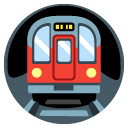


Appearance varies by platform and device. Google Noto, Twemoji, and OpenMoji are open-source.