🚭
The Emoji
No Smoking
U+1F6AD · :no_smoking:
Trend 28
Meaning layers
- interpretation
- Used literally to say 'no smoking allowed' but also adopted ironically to shut down bad vibes, toxic behavior, or unwanted drama — as in 'not entertaining that smoke.'
- tiktok usage
- Appears in comment sections to dismiss or block toxic energy, often paired with captions like 'no drama zone' or 'smoke-free household only.'
- irony level
- 6 / 10
Platform meanings
- meaning
- Primarily signals a no-drama, toxic-free zone in comments or videos; also used literally in health/wellness content.
- trend usage
- Appears in wellness TikTok, 'clean life' content, and comment wars where users want to dismiss negativity.
- hashtags
- #NoDramaZone#SmokeFree#ToxicFree#NoSmoking#CleanVibesOnly
- virality score
- 35 / 100
Cultural meanings
🇺🇸
Western / Gen-Z
Adopted both literally and as slang for 'not tolerating bad energy' — a quick, visual way to shut down drama without typing a word.
🇵🇰
Pakistan & India
Used primarily in its literal sense in urban digital spaces to enforce no-smoking rules in offices, malls, and events; younger users are beginning to adopt the 'no toxic vibes' layer.
🌍
Middle East
Heavily literal in usage, especially given strict no-smoking rules in many Middle Eastern public spaces and malls; also used in health campaigns on social media.
🌐
Global Neutral
Universally understood as a no-smoking prohibition sign; the literal interpretation dominates globally with slang layers remaining mostly Western.
🇧🇩
Bangladesh
Used literally in urban professional and health contexts; anti-tobacco NGOs and government campaigns use it regularly on social media.
🇱🇰
Sri Lanka
Appears in health awareness posts and official communications about smoke-free public spaces; limited slang adoption.
🇨🇳
China
Used in health and public policy digital content; WeChat and Weibo posts about smoke-free environments frequently feature it.
🇯🇵
Japan
Common in digital signage references and etiquette-focused social media posts; Japan's strict indoor smoking rules make this emoji a frequent and respected symbol.
🇰🇷
South Korea
Used in health campaigns and anti-smoking content; younger Koreans on platforms like KakaoTalk use it to indicate clean, health-conscious lifestyle branding.
🇹🇼
Taiwan
Appears in public health messaging and smoke-free zone announcements online; also used in youth wellness communities.
🇭🇰
Hong Kong
Frequently used in urban context posts about smoke-free zones; health advocates and government accounts use it heavily.
🇵🇭
Philippines
Used in health awareness campaigns and school-related no-smoking reminders; limited adoption of Western slang meaning.
🇮🇩
Indonesia
Appears in public health messaging and anti-tobacco campaign content on Instagram and Twitter; literal interpretation dominates.
🇹🇭
Thailand
Used in health content and tourism-related posts about Thailand's strict smoking bans in public areas and beaches.
🇻🇳
Vietnam
Appears in government health campaigns and urban lifestyle posts; growing awareness of anti-smoking rules drives its literal usage.
🇲🇾
Malaysia
Used in health and safety communications, particularly around smoke-free workplace and restaurant policies; younger users occasionally adopt the slang layer.
🇸🇦
Saudi Arabia
Used in official and semi-official capacities to communicate no-smoking rules in public spaces; strict enforcement culture makes it a serious, literal symbol.
🇦🇪
UAE
Widely used in hospitality, tourism, and official communications about smoke-free zones in malls, restaurants, and airports.
🇪🇬
Egypt
Used in health advocacy posts and public service announcements; younger Egyptian social media users sometimes use it humorously to reject drama.
🇹🇷
Turkey
Appears in anti-smoking campaigns and public space announcements; Turkey's extensive indoor smoking bans make this a culturally resonant symbol.
🇮🇷
Iran
Used in health and wellness content on Instagram and Telegram; signals clean living and public health awareness.
🇳🇬
Nigeria
Used in health campaigns and urban professional contexts; younger Nigerians on Twitter occasionally adopt the 'no toxic energy' interpretation.
🇿🇦
South Africa
Used in health communications and smoke-free workplace content; Cape Town and Johannesburg's urban Gen Z scene is beginning to adopt the slang layer.
🇬🇧
UK & Ireland
Used literally in pub culture reform discussions and public health posts; younger users adopt the drama-dismissal meaning consistent with broader Western Gen Z trends.
🇫🇷
France
France's complex relationship with smoking culture makes this emoji both a literal policy signal and sometimes an ironic comment on anti-smoking campaigns.
🇩🇪
Germany
Used in strict public health and regulatory contexts; Germans tend to interpret it very literally and use it in official or semi-official messaging.
🇪🇸
Spain & Italy
Given strong smoking cultures, this emoji is used more literally in policy and health discussions; younger users occasionally use it to signal health-conscious lifestyles.
🇧🇷
Brazil
Used in health campaigns and anti-tobacco advocacy; younger Brazilians on TikTok and Instagram are beginning to adopt the 'no toxic vibes' slang layer.
🇲🇽
Mexico
Appears in public health messaging and anti-smoking campaigns; used on social media to signal smoke-free spaces or events.
🌎
Latin America
Broadly used in health campaigns across Latin America; literal interpretation dominates with gradual adoption of the 'no negativity' slang among youth.
🇦🇺
Australia & NZ
Strong anti-smoking culture means this emoji resonates deeply and literally; also adopted by younger users for the 'no drama' meaning aligned with wellness trends.
How its meaning shifted
- 2010
Almost exclusively literal — used in early smartphone messaging to reference no-smoking signs in public places or to note rules at events.
- 2015
Still predominantly literal, appearing in health campaigns and event reminders; minimal creative or slang usage had developed.
- 2020
Began acquiring the 'no toxic energy' meaning among Gen Z on TikTok and Instagram; health campaigns during COVID amplified its public awareness usage.
- 2026
Dual-layer usage firmly established — literal in professional and health contexts, slang-layer for dismissing negativity and drama entrenched in Gen Z digital communication.
See it on every platform
Compare with
Adjacent emojis
- Often confused with
- no entry signprohibitedno one under eighteen
- Can replace
- prohibitedno entryhand with fingers splayed
Share & embed
Frequently asked
01What does the 🚭 No Smoking emoji mean?
A cigarette inside a red circle with a diagonal line through it, universally indicating that smoking is prohibited in a given area or context.
02What does 🚭 mean on TikTok?
Primarily signals a no-drama, toxic-free zone in comments or videos; also used literally in health/wellness content.
03What does 🚭 mean on WhatsApp?
Sent to remind someone not to smoke or to signal disapproval of a behavior in a lighthearted way.
04What does 🚭 mean in Gen-Z slang?
Used literally to say 'no smoking allowed' but also adopted ironically to shut down bad vibes, toxic behavior, or unwanted drama — as in 'not entertaining that smoke.'
05Is the 🚭 emoji safe to use?
A standard prohibition symbol indicating no smoking is allowed; used in health advocacy, public policy, and wellness communication.
06What does 🚭 mean in texting?
Triggers a subconscious sense of rule-following and restriction. Used to assert personal boundaries without confrontation, leveraging a universally understood prohibition symbol.
07What is the shortcode for 🚭?
The shortcode for No Smoking is :no_smoking:
08What does 🚭 mean in dating?
Rarely flirtatious; occasionally used to say 'I don't date smokers' in a breezy, non-confrontational way on dating profiles.
Safety & usage
- Safe meaning
- A standard prohibition symbol indicating no smoking is allowed; used in health advocacy, public policy, and wellness communication.
- Caution
- Extremely rare toxic usage; could theoretically be used to passive-aggressively police others' behavior or shame smokers.
Generally a very safe emoji with no NSFW connotations; mild passive-aggression risk in interpersonal contexts where boundaries are being enforced.
How it looks across platforms
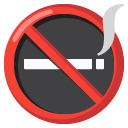


Appearance varies by platform and device. Google Noto, Twemoji, and OpenMoji are open-source.