🚱
The Emoji
Non-potable Water
U+1F6B1 · :nonpotable_water:
Trend 22
Meaning layers
- interpretation
- Used ironically to signal something is 'undrinkable' in a metaphorical sense—bad vibes, toxic situations, or people who are not worth engaging with. Also used as a quirky way to say 'do not consume this content' or 'this situation is sus.'
- tiktok usage
- Appears in comment sections to call out bad takes or trash opinions, essentially meaning 'this is not safe for consumption.' Sometimes used humorously in 'red flag' content.
- irony level
- 7 / 10
Platform meanings
- meaning
- Signals that something is metaphorically 'undrinkable'—toxic, low quality, or not worth engaging with.
- trend usage
- Used in duet and stitch videos reacting to bad advice or cringe content; also appears in environmental awareness TikToks about water access.
- hashtags
- #nonpotable#toxicvibes#redflag#drinkableornot#watercrisis
- virality score
- 28 / 100
Cultural meanings
🇺🇸
Western / Gen-Z
Widely used as a metaphor for 'toxic' or 'not worth consuming'—bad vibes, bad people, bad content. Irony and internet slang have almost entirely displaced its literal meaning for this demographic.
🇵🇰
Pakistan & India
Used both literally—especially in conversations about drinking water safety in rural or urban areas with infrastructure issues—and increasingly among younger users as a slang marker for toxic behavior or a bad situation.
🌍
Middle East
Primarily used in literal contexts about water scarcity, desalination, and public health, especially in gulf states and rural areas. Younger, connected users sometimes adopt the Western slang interpretation.
🌐
Global Neutral
Universally understood as a warning about unsafe water; the most cross-culturally stable interpretation of this emoji regardless of region or age.
🇧🇩
Bangladesh
Strongly associated with literal water safety concerns given the country's history with contaminated groundwater and arsenic poisoning issues; used in public health messaging and awareness campaigns.
🇱🇰
Sri Lanka
Used in practical travel and domestic contexts to warn about tap water quality; occasionally appears in environmental discussions about coastal water contamination.
🇨🇳
China
Mostly used in environmental and public health discussions on platforms like Weibo; younger users may occasionally adopt it as a metaphor for 'fake' or 'not genuine' content, echoing the toxic connotation.
🇯🇵
Japan
Taken very literally given Japan's high standards around water purity and safety culture; used in travel advisories and outdoor/camping communities to mark undrinkable water sources.
🇰🇷
South Korea
Used in both literal travel and environmental contexts and, increasingly among younger Koreans on platforms like KakaoTalk and Instagram, as a meme symbol for 'toxic' idols, shows, or fandoms.
🇹🇼
Taiwan
Primarily used in practical contexts around water quality and environmental awareness; occasionally deployed ironically by younger internet users to label bad content or behavior.
🇭🇰
Hong Kong
Used in travel advice and environmental discussions; given the political climate, occasionally repurposed as subtle commentary on institutions or systems deemed 'unsafe.'
🇵🇭
Philippines
Resonates strongly in literal contexts given persistent water access challenges; also adopted by younger Filipinos on TikTok and Twitter as a 'toxic person' or 'red flag' shorthand.
🇮🇩
Indonesia
Used practically in discussions about water safety across the archipelago; younger users on Twitter and TikTok use it colloquially to describe something as harmful or untrustworthy.
🇹🇭
Thailand
Common in travel contexts—Thailand frequently warns tourists not to drink tap water—so the emoji is well understood literally. Social media–savvy youth also use it metaphorically.
🇻🇳
Vietnam
Used in health and environmental awareness contexts; urban youth increasingly apply it as internet slang to describe toxic online behavior or bad advice.
🇲🇾
Malaysia
Appears in practical water safety conversations and environmental discourse; adopted by younger Malaysians on social media as slang for 'this person/content is not trustworthy.'
🇸🇦
Saudi Arabia
Used in water scarcity and desalination policy discussions; in informal digital communication, some youth use it to signal distrust or caution about a person or piece of information.
🇦🇪
UAE
Commonly associated with water sustainability and desalination topics given the arid environment; younger expat-heavy communities may use it with Western slang interpretations.
🇪🇬
Egypt
Used in literal water quality and public health discussions, especially regarding Nile water safety; occasionally used among youth on social media to flag 'contaminated' information or people.
🇹🇷
Turkey
Appears in environmental and municipal water safety discussions; younger Turkish internet users have adopted it as a slang term for toxic relationships or bad online content.
🇮🇷
Iran
Used primarily in literal contexts around water shortages and agricultural water safety; occasionally used metaphorically on Telegram channels to signal distrust or 'do not follow this advice.'
🇳🇬
Nigeria
Resonates powerfully in literal contexts given widespread water access challenges; used in public health campaigns and development discourse, and occasionally by youth to signify 'this is dangerous.'
🇿🇦
South Africa
Used in discussions about water infrastructure and the ongoing water crisis in many municipalities; younger South Africans on Twitter also deploy it as a metaphor for toxic behavior or bad policy.
🇬🇧
UK & Ireland
Mostly understood literally as a safety sign; used by travelers and environmentalists. Among younger users it has started to appear as internet slang for 'do not engage with this person.'
🇫🇷
France
Used in practical travel and environmental contexts; the French internet-savvy youth occasionally adopt it as a metaphor for 'this idea/person is dangerous or unworthy of attention.'
🇩🇪
Germany
Strongly associated with safety standards and regulation in literal use; younger Germans on social media sometimes use it to indicate that something is 'not up to standard' or metaphorically toxic.
🇪🇸
Spain & Italy
Used in travel and environmental discussions; in informal online spaces, it serves as a quick signal for 'avoid this' or 'this is bad news,' especially among younger users.
🇧🇷
Brazil
Resonates literally given water access disparities across the country; also widely used among younger Brazilians on TikTok and Twitter as a shorthand for toxic people, bad vibes, or cringe content.
🇲🇽
Mexico
Used in literal water safety contexts, as tap water safety varies by region; among youth it doubles as internet slang for toxic or untrustworthy people and situations.
🌎
Latin America
Across Latin America it carries strong literal meaning due to inconsistent water infrastructure; the younger, digitally connected population also embraces its metaphorical toxic connotation.
🇦🇺
Australia & NZ
Mostly used in travel, camping, and environmental contexts; younger Australians and New Zealanders also deploy it as internet slang to call out toxic behavior, bad advice, or misinformation.
How its meaning shifted
- 2010
Almost exclusively used in its literal sense as a digital representation of a real-world safety sign; appeared in travel forums, safety discussions, and government health communication.
- 2015
Still primarily literal but beginning to appear in early social media posts about environmental issues like the Flint water crisis; rare metaphorical use beginning to emerge.
- 2020
Metaphorical use expands significantly during the pandemic era as 'toxic' discourse dominates social media; used to label misinformation, bad takes, and toxic behavior alongside its literal meaning.
- 2026
Firmly established as dual-use: literal in environmental/health contexts and as Gen Z slang for 'toxic,' 'untrustworthy,' or 'do not consume.' Ironic and meme usage is normalized across most platforms.
See it on every platform
Compare with
Adjacent emojis
- Can replace
- warningno entry signprohibited
Share & embed
Frequently asked
01What does the 🚱 Non-potable Water emoji mean?
The Non-potable Water sign emoji depicts a faucet with a slash or prohibition symbol, indicating that water from a particular source is not safe for drinking.
02What does 🚱 mean on TikTok?
Signals that something is metaphorically 'undrinkable'—toxic, low quality, or not worth engaging with.
03What does 🚱 mean on WhatsApp?
Warning that something is not safe—used literally when discussing travel hygiene or metaphorically for 'don't trust this person/situation.'
04What does 🚱 mean in Gen-Z slang?
Used ironically to signal something is 'undrinkable' in a metaphorical sense—bad vibes, toxic situations, or people who are not worth engaging with. Also used as a quirky way to say 'do not consume this content' or 'this situation is sus.'
05Is the 🚱 emoji safe to use?
A straightforward safety and warning symbol indicating water is not safe to drink; used in travel, environmental, and public health contexts.
06What does 🚱 mean in texting?
Triggers a mild sense of caution or repulsion, tapping into primal instincts around contamination and safety. When used metaphorically, it channels feelings of distrust or rejection toward a person, idea, or situation.
07What is the shortcode for 🚱?
The shortcode for Non-potable Water is :nonpotable_water:
08What does 🚱 mean in dating?
Rarely used flirtatiously; if deployed in a DM it usually signals the sender thinks the other person or their behavior is 'toxic' or 'not worth entertaining.' Not a flirt emoji.
Safety & usage
- Safe meaning
- A straightforward safety and warning symbol indicating water is not safe to drink; used in travel, environmental, and public health contexts.
- Caution
- When used as slang, it can be deployed to call out or shame individuals by labeling them 'toxic' or 'unsafe,' which could veer into harassment if used repeatedly against a specific person.
Generally safe to use; caution should be applied when using it to target specific individuals as a 'toxic' label in harassment contexts. No inherent NSFW or dangerous meaning.
How it looks across platforms
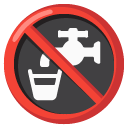


Appearance varies by platform and device. Google Noto, Twemoji, and OpenMoji are open-source.