🫳🏿
The Emoji
Palm Down Hand: Dark Skin Tone
U+1FAF3 U+1F3FF · :palm_down_hand_dark_skin_tone:
Trend 63
Meaning layers
- interpretation
- Used to signal 'calm down,' 'lower the energy,' dropping something metaphorically, or releasing/letting go. Also used to signify 'putting something down' as in dismissing drama or ending a topic.
- tiktok usage
- Frequently appears in captions like 'putting this down forever 🫳🏿' or to gesture dismissing toxic situations, bad habits, or ending beef. Also used in 'drop the act' commentary.
- irony level
- 5 / 10
Platform meanings
- meaning
- Symbolizes letting go, dropping something, or signaling 'calm down.' Used in video captions to emphasize finality or dismissal.
- trend usage
- Appears in 'things I'm dropping in 2025' trends, accountability videos, and call-out content where creators visually 'drop' toxic behaviors or people.
- hashtags
- #lettinggo#droppingit#calmdown#done#release
- virality score
- 62 / 100
Cultural meanings
🇺🇸
Western / Gen-Z
Widely understood as 'dropping it' or 'mic drop' energy, symbolizing finality, confidence, or dismissal of negativity. Embraced especially within Black Gen Z communities as an expression of unbothered energy.
🇵🇰
Pakistan & India
Interpreted as a downward gesture that may signal offering something or pressing down; the dark skin tone may resonate with South Asian communities celebrating darker complexions, though the specific gesture nuance is less culturally embedded.
🌍
Middle East
The downward palm can sometimes signal 'stop' or 'enough' in informal digital communication; skin tone diversity awareness is growing in the region, making the dark modifier increasingly visible.
🌐
Global Neutral
Broadly interpreted as a hand pressing down or releasing something; universally readable as a gesture of finality or calm.
🇧🇩
Bangladesh
Interpreted similarly to neighboring South Asian cultures as a pressing or calming gesture; the emoji's specific connotation of 'dropping' is catching on through global social media influence.
🇱🇰
Sri Lanka
Understood as a stop or calm-down gesture in digital contexts; the dark skin tone resonates as representative of South Asian and Sri Lankan complexions.
🇨🇳
China
Less culturally specific connotation; generally read as a downward hand gesture. Social media users may interpret it as 'press down' or 'silence' in online arguments.
🇯🇵
Japan
Interpreted as a formal pressing-down or restraint gesture; the concept of 'dropping' drama fits into online culture of avoiding conflict. Skin tone diversity in emoji is appreciated but less personally identified with.
🇰🇷
South Korea
Used digitally to signal calming down or ending a topic; K-pop fan communities may use it in the context of 'dropping' content or comebacks.
🇹🇼
Taiwan
Read as a dismissal or calming gesture; Taiwanese internet culture has adapted many Western emoji interpretations including the 'drop it' meaning.
🇭🇰
Hong Kong
Interpreted through a blend of Western and Chinese digital culture; used to signal dismissal or releasing tension in online debates.
🇵🇭
Philippines
Enthusiastically adopted with the Western 'drop it' meaning; Filipino social media culture embraces the mic-drop connotation in witty online exchanges.
🇮🇩
Indonesia
Used in casual digital communication to signal calming down or ending arguments; the dark skin tone is relatable and celebrated in Indonesian diversity conversations.
🇹🇭
Thailand
Interpreted as a polite pressing-down gesture; in informal contexts, the 'drop it' meaning is increasingly understood through global TikTok influence.
🇻🇳
Vietnam
Mainly understood through global social media trends; used to signal finality or letting go in younger Vietnamese internet communities.
🇲🇾
Malaysia
Resonates strongly in Malaysia's diverse digital culture; the dark skin tone is inclusive of Malay and Indian Malaysian communities, and the 'dropping it' meaning is widely adopted.
🇸🇦
Saudi Arabia
Interpreted carefully as gestures carry cultural weight; the downward palm can signal enough or stop. The dark skin tone is inclusive of diverse populations in the Kingdom.
🇦🇪
UAE
In the cosmopolitan UAE digital landscape, the emoji is widely understood with its Western connotation of dropping drama or releasing something, celebrated across its diverse expatriate communities.
🇪🇬
Egypt
Used online to signal dismissing an argument or calming tension; the dark skin tone is relatable in a country with diverse skin tones across its population.
🇹🇷
Turkey
Adopted through Western social media influence; used to dismiss bad takes or signal finality in online discussions.
🇮🇷
Iran
Less commonly used with specific cultural connotation; interpreted broadly as a downward hand gesture or calm-down signal in digital youth communication.
🇳🇬
Nigeria
Highly resonant in Nigeria, where the dark skin tone is directly representative and celebrated. Used to signal dropping heat, dismissing drama, or delivering powerful statements in Nigerian Twitter and TikTok culture.
🇿🇦
South Africa
Embraced in South African digital culture, particularly within Black communities on platforms like Twitter/X; used to signal mic-drop moments and unapologetic self-expression.
🇬🇧
UK & Ireland
Understood primarily with the 'dropping it' or mic-drop connotation; used in British and Irish social media to dismiss drama or signal a powerful statement.
🇫🇷
France
Adopted through global internet culture; used to signal dismissal or letting go, though less culturally specific than in English-speaking markets.
🇩🇪
Germany
Interpreted literally or through global social media context as dropping something or pressing down; used in online debates to signal ending a discussion.
🇪🇸
Spain & Italy
Used with expressive flair typical of Mediterranean digital culture; the 'dropping it' connotation resonates especially in dramatic online exchanges.
🇧🇷
Brazil
Very popular in Brazilian internet culture, where expressive emoji use is high; the dark skin tone is representative and celebrated, and the gesture aligns with the bold communication style of Brazilian social media.
🇲🇽
Mexico
Used in Mexican digital culture to signal dismissal, ending drama, or dropping truth; the dark skin tone resonates with Mexico's diverse Indigenous and Afro-Mexican communities.
🌎
Latin America
Across Latin America, the emoji signals confidence, dismissal of negativity, and dropping something significant; the dark skin tone is embraced as representative of Afro-Latin communities.
🇦🇺
Australia & NZ
Understood with Western connotations of dropping something or mic-drop energy; used casually in Australian and New Zealand social media for humorous dismissals.
How its meaning shifted
- 2010
The emoji did not exist in 2010; palm and hand emoji were far more limited and skin tone modifiers were not yet introduced.
- 2015
Emoji hand gestures were expanding but this specific emoji did not yet exist; skin tone modifiers were newly introduced in 2015 for existing emoji, raising awareness of representation.
- 2020
Still did not exist as Unicode 14.0 was not yet released; similar gestures like 🤚 and ✋ were used in its place for downward or stop meanings.
- 2026
Firmly established in Gen Z and millennial digital vocabulary as a 'drop it,' mic-drop, or dismissal emoji; the dark skin tone version is especially celebrated in Black digital communities for its representational value.
See it on every platform
Adjacent emojis
- Often confused with
- backhand index pointing downopen handsraised hand
- Can replace
- palm up handwaving handraised hand
Share & embed
Frequently asked
01What does the 🫳🏿 Palm Down Hand: Dark Skin Tone emoji mean?
A hand with palm facing downward, depicted with dark skin tone. Represents a downward-facing open hand gesture.
02What does 🫳🏿 mean on TikTok?
Symbolizes letting go, dropping something, or signaling 'calm down.' Used in video captions to emphasize finality or dismissal.
03What does 🫳🏿 mean on WhatsApp?
Signals 'calm down,' 'let it go,' or 'dropping the subject.' Common in group chats to de-escalate tension.
04What does 🫳🏿 mean in Gen-Z slang?
Used to signal 'calm down,' 'lower the energy,' dropping something metaphorically, or releasing/letting go. Also used to signify 'putting something down' as in dismissing drama or ending a topic.
05Is the 🫳🏿 emoji safe to use?
Gesture of releasing, calming, or dropping something; widely used for positive self-expression and dismissal of negativity.
06What does 🫳🏿 mean in texting?
The downward palm gesture psychologically signals authority, suppression of emotion, or a deliberate act of releasing tension. It can convey either peaceful resolution or cold dismissal depending on context.
07What is the shortcode for 🫳🏿?
The shortcode for Palm Down Hand: Dark Skin Tone is :palm_down_hand_dark_skin_tone:
08What does 🫳🏿 mean in dating?
Rarely used flirtatiously; however, can be playfully used as 'I'm laying my feelings down for you' or 'putting my heart on the table.'
Safety & usage
- Safe meaning
- Gesture of releasing, calming, or dropping something; widely used for positive self-expression and dismissal of negativity.
- Caution
- Can be used to dismissively 'drop' or shut down people in online arguments in a condescending manner.
Generally safe; no NSFW or hate-adjacent usage documented. In rare cases, may be combined with other emoji to form dismissive or passive-aggressive messaging.
How it looks across platforms
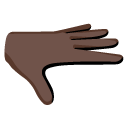


Appearance varies by platform and device. Google Noto, Twemoji, and OpenMoji are open-source.