🧑🏾🤝🧑🏾
The Emoji
People Holding Hands: Medium-dark Skin Tone
U+1F9D1 U+1F3FE U+200D U+1F91D U+200D U+1F9D1 U+1F3FE · :people_holding_hands_mediumdark_skin_tone:
Trend 68
Meaning layers
- interpretation
- Used to show squad unity, best friend energy, or romantic partnership. Often signals 'we're in this together' vibes or celebrating a close bond without specifying romantic intent.
- tiktok usage
- Appears in friendship montages, couple reveals, and 'found my person' content. Common in duet videos celebrating connections.
- irony level
- 2 / 10
Platform meanings
- meaning
- Friendship, couple energy, solidarity, or 'found my person' sentiment. Frequently used in wholesome or heartfelt content.
- trend usage
- Appears in POV videos, couple content, BFF tags, and unity-themed hashtag challenges.
- hashtags
- #friendshipgoals#couplesoftiktok#togetherwestand#mybff#holdingon
- virality score
- 72 / 100
Cultural meanings
🇺🇸
Western / Gen-Z
Widely used to celebrate inclusive friendships and relationships without gendering the pair. Frequently appears in content celebrating Black joy and melanin beauty.
🇵🇰
Pakistan & India
Interpreted as a symbol of close friendship or sibling bonds. Less commonly used for romantic contexts due to cultural norms around public displays of affection.
🌍
Middle East
Generally read as a friendship symbol. Romantic implications may be downplayed in conservative contexts, but use is growing in younger urban communities.
🌐
Global Neutral
Universally recognized as a symbol of togetherness, partnership, and human connection. The medium-dark skin tone adds a layer of representation for darker-skinned communities.
🇧🇩
Bangladesh
Used primarily to express friendship and solidarity. The skin tone representation resonates with many Bangladeshi users who see themselves reflected in the emoji.
🇱🇰
Sri Lanka
Interpreted as a close friendship or sibling symbol. Growing usage among younger generations to celebrate bonds and unity.
🇨🇳
China
Less commonly used due to preference for locally popular emoji platforms like WeChat stickers. When used, it signals friendship or international solidarity.
🇯🇵
Japan
Used in contexts of partnership and cooperation. The specific skin tone may be noted as an inclusion marker, but the gesture itself aligns with Japanese values of harmony and togetherness.
🇰🇷
South Korea
Popular among youth to express close friendships ('우정'). The holding hands gesture resonates with Korean concepts of deep platonic bonds.
🇹🇼
Taiwan
Used to celebrate diverse friendships and partnerships. Taiwan's progressive social culture means the inclusive skin tone representation is well-received.
🇭🇰
Hong Kong
Appears in solidarity and protest contexts as well as friendship messaging. The emoji carries connotations of unity and collective strength.
🇵🇭
Philippines
Commonly used to express close friendship and family-like bonds ('barkada' culture). Resonates with Filipinos' strong communal values.
🇮🇩
Indonesia
Used to signal friendship and togetherness. In religious community contexts, it may represent interfaith unity or community solidarity.
🇹🇭
Thailand
Interpreted as a symbol of close friendship or 'phi-nong' (elder-younger sibling) bonds. Used warmly in social media to celebrate meaningful relationships.
🇻🇳
Vietnam
Used to express friendship and solidarity. The younger generation embraces it in the context of international inclusivity and diverse friendships.
🇲🇾
Malaysia
Signals friendship and multicultural unity — fitting for Malaysia's multiracial national identity. Used in posts celebrating cross-cultural bonds.
🇸🇦
Saudi Arabia
Used carefully in public-facing contexts. Friendship between same-gender individuals is the primary interpretation; romantic implications are typically avoided.
🇦🇪
UAE
In the UAE's diverse, cosmopolitan environment, this emoji is used to celebrate multicultural friendships and professional partnerships.
🇪🇬
Egypt
Primarily interpreted as a friendship symbol. Growing usage among Egyptian youth on social media to express solidarity and close bonds.
🇹🇷
Turkey
Used to signal close friendship or community ties. Turkish social media users often deploy it in posts celebrating unity and togetherness.
🇮🇷
Iran
Used mostly among younger, urban social media users to express friendship and solidarity, often in private or semi-private digital spaces.
🇳🇬
Nigeria
Strongly embraced as a symbol of Afrocentric pride, Black love, and community solidarity. The medium-dark skin tone resonates deeply with Nigerian users.
🇿🇦
South Africa
Used to celebrate rainbow nation unity, friendship across communities, and solidarity. Particularly resonant in post-apartheid contexts of togetherness.
🇬🇧
UK & Ireland
Used casually for friendship and relationship announcements. The skin tone representation is celebrated in multicultural UK communities.
🇫🇷
France
Interpreted as a universal friendship or partnership symbol. France's diverse population means the medium-dark skin tone is seen as natural and inclusive.
🇩🇪
Germany
Used in inclusive friendship contexts and social solidarity messaging. Increasingly common in diversity advocacy content.
🇪🇸
Spain & Italy
Expresses warm friendship and romantic partnership. The gesture aligns with southern European cultures that value close physical affection between friends.
🇧🇷
Brazil
Widely used to celebrate Black Brazilian culture, Afro-Brazilian friendship, and romantic bonds. The skin tone resonates strongly in Brazil's diverse population.
🇲🇽
Mexico
Used to express close friendship and solidarity. In activist spaces, it signals unity among communities of color and Indigenous solidarity.
🌎
Latin America
Broadly used across Latin America to celebrate friendship, community bonds, and romantic partnerships. The skin tone representation is embraced by Afro-Latino communities.
🇦🇺
Australia & NZ
Used to signal friendship and inclusive partnerships. Particularly resonant in First Nations and Pacific Islander communities as a symbol of togetherness.
How its meaning shifted
- 2010
Emoji with skin tone modifiers did not yet exist. General holding hands emojis were limited and skin tone options were unavailable.
- 2015
Skin tone modifiers began rolling out post-Unicode 8.0. Early adoption was slow, and holding hands combinations with specific skin tones were not yet standard.
- 2020
Became widely available across major platforms. Usage surged during the Black Lives Matter movement as a symbol of solidarity and unity among communities of color.
- 2026
Firmly established as a representation of inclusive togetherness. Heavily used in Black joy content, DEI messaging, and authentic couple/friendship representation.
See it on every platform
Adjacent emojis
- Often confused with
- handshakepeople holding hands medium skin tonecouple with heart
- Can replace
- red hearttwo heartshandshake
Share & embed
Frequently asked
01What does the 🧑🏾🤝🧑🏾 People Holding Hands: Medium-dark Skin Tone emoji mean?
Two people holding hands with medium-dark skin tone applied to both figures, representing partnership, togetherness, and human connection regardless of gender.
02What does 🧑🏾🤝🧑🏾 mean on TikTok?
Friendship, couple energy, solidarity, or 'found my person' sentiment. Frequently used in wholesome or heartfelt content.
03What does 🧑🏾🤝🧑🏾 mean on WhatsApp?
Expresses solidarity, friendship, or romantic partnership in personal chats. Often sent to a close friend or partner.
04What does 🧑🏾🤝🧑🏾 mean in Gen-Z slang?
Used to show squad unity, best friend energy, or romantic partnership. Often signals 'we're in this together' vibes or celebrating a close bond without specifying romantic intent.
05Is the 🧑🏾🤝🧑🏾 emoji safe to use?
Represents friendship, partnership, solidarity, and human connection. Entirely positive and inclusive in the vast majority of contexts.
06What does 🧑🏾🤝🧑🏾 mean in texting?
Holding hands is one of the earliest human bonding gestures; this emoji taps into deep psychological needs for connection, safety, and mutual support.
07What is the shortcode for 🧑🏾🤝🧑🏾?
The shortcode for People Holding Hands: Medium-dark Skin Tone is :people_holding_hands_mediumdark_skin_tone:
08What does 🧑🏾🤝🧑🏾 mean in dating?
Subtle but meaningful — sending this to a crush signals 'I want to be close to you' without being overtly romantic. A soft confession of affection.
Safety & usage
- Safe meaning
- Represents friendship, partnership, solidarity, and human connection. Entirely positive and inclusive in the vast majority of contexts.
- Caution
- Extremely rare, but could theoretically be used ironically in contexts mocking togetherness or used alongside divisive content.
No significant safety concerns. Skin tone representation is a positive feature promoting inclusivity. No known weaponized usage patterns.
How it looks across platforms
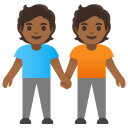


Appearance varies by platform and device. Google Noto, Twemoji, and OpenMoji are open-source.