🤦
The Emoji
Person Facepalming
U+1F926 · :person_facepalming:
Trend 72
Meaning layers
- interpretation
- Used to react to cringe, stupidity, or an obvious mistake — either someone else's or your own. Often deployed as a low-effort reaction to something unbearably dumb.
- tiktok usage
- Appears in comments when creators say something factually wrong, or in reaction videos to embarrassing fails. Also used self-deprecatingly in captions like 'me forgetting my own birthday 🤦'.
- irony level
- 6 / 10
Platform meanings
- meaning
- Reaction to cringe content, bad takes, or obvious mistakes. Used both in comments and video captions for relatable self-deprecating humor.
- trend usage
- Frequently appears in 'this is so embarrassing' content, fail compilations, and comment sections roasting creators or other commenters.
- hashtags
- #facepalm#icanteven#whydothough#embarrassing#relatable
- virality score
- 74 / 100
Cultural meanings
🇺🇸
Western / Gen-Z
Core reaction emoji for cringe, stupidity, and self-deprecating humor — used constantly across all platforms without much weight. Often the default 'I have no words' response.
🇵🇰
Pakistan & India
Widely used on WhatsApp and Instagram to express frustration with family drama, societal expectations, or relatable daily chaos. Also common in Desi meme culture for reacting to aunty behavior or absurd news.
🌍
Middle East
Used to express embarrassment or disbelief, particularly in group chats reacting to social faux pas or political absurdity. Carries similar meaning across Arabic-speaking communities.
🌐
Global Neutral
One of the most universally understood emoji gestures globally — the facepalm transcends language and culture as a recognizable human expression of 'I can't believe this.'
🇧🇩
Bangladesh
Popular on Facebook and WhatsApp to react to frustrating news, political situations, or everyday chaos. Used both humorously and genuinely.
🇱🇰
Sri Lanka
Used on social media to react to political news, traffic frustrations, or everyday inconveniences with a mix of humor and genuine exasperation.
🇨🇳
China
Less dominant than local emoji equivalents on WeChat, but used on international platforms like Instagram and Twitter by younger Chinese users to express frustration or embarrassment.
🇯🇵
Japan
Used on Twitter/X and LINE by younger users, though Japanese digital culture has its own extensive emoji vocabulary for embarrassment — this one signals a more Western-style exasperation.
🇰🇷
South Korea
Common on Twitter and KakaoTalk among younger Koreans for reacting to embarrassing idol moments, bad takes, or cringe content — often in fan community contexts.
🇹🇼
Taiwan
Used freely on Instagram and Twitter to react to political absurdity or everyday frustration, with a casual and humorous tone typical of Taiwanese internet culture.
🇭🇰
Hong Kong
Deployed on social media platforms to react to frustrating news, bureaucratic absurdity, or cringe content — carries a slightly more pointed social commentary edge given the political climate.
🇵🇭
Philippines
Extremely common on Facebook — one of the most emoji-heavy online cultures globally — used to react to everything from relatable fails to frustrating government news.
🇮🇩
Indonesia
Popular on Twitter, Instagram, and WhatsApp to express 'duh' energy or frustration with viral drama, celebrity gossip, and daily inconveniences.
🇹🇭
Thailand
Used on Twitter and LINE to react to embarrassing celebrity moments, bad takes, or frustrating social situations, often with added humor.
🇻🇳
Vietnam
Common on Facebook and Zalo to express exasperation or secondhand embarrassment, particularly reacting to viral funny or cringe content.
🇲🇾
Malaysia
Widely used across platforms in both English and Bahasa Malaysia contexts — reacts to political news, celebrity drama, and relatable everyday frustrations.
🇸🇦
Saudi Arabia
Used on Twitter (very active platform in KSA) to react to social absurdity, bad takes, or embarrassing public behavior — often paired with Arabic slang equivalents.
🇦🇪
UAE
Common in the cosmopolitan UAE social media scene — used by both locals and expats to react to traffic frustrations, workplace nonsense, or cringe content.
🇪🇬
Egypt
Popular on Facebook and Twitter to react to political chaos, social commentary, and relatable daily Egyptian life struggles — humor is central to its usage.
🇹🇷
Turkey
Used on Twitter and Instagram to react to political news, social issues, and everyday frustrations — Turkish internet culture is highly meme-driven and this fits naturally.
🇮🇷
Iran
Used on Instagram (primary social platform despite restrictions) among younger Iranians to express frustration or embarrassment, often coded in layers of irony.
🇳🇬
Nigeria
Very common across WhatsApp, Twitter, and Instagram — Nigerian internet culture is highly expressive and this emoji slots into reactions to 'wahala' (trouble), bad behavior, or cringe moments.
🇿🇦
South Africa
Used across platforms to react to load-shedding frustrations, political absurdity, and social media drama — carried with a distinctly dry South African humor.
🇬🇧
UK & Ireland
A natural fit for British and Irish culture's love of understatement and dry humor — used to react to embarrassing situations with maximum restraint and minimum words.
🇫🇷
France
Used on social media to express exasperation with bureaucracy, social faux pas, or political absurdity — the French have a natural cultural affinity for the dismissive gesture this represents.
🇩🇪
Germany
Used to react to inefficiency, logical inconsistencies, or obvious mistakes — aligns well with cultural directness and low tolerance for unnecessary stupidity.
🇪🇸
Spain & Italy
Used expressively and frequently — Mediterranean internet culture is emotionally expressive and this emoji fits naturally into reactions to drama, embarrassment, or social chaos.
🇧🇷
Brazil
Extremely popular across all platforms — Brazilian internet culture is highly meme-driven and this emoji is a staple reaction to absurd news, political drama, and everyday chaos.
🇲🇽
Mexico
Common on Twitter and Instagram for reacting to political news, social commentary, and relatable frustrations — humor and sarcasm are central to its usage.
🌎
Latin America
Widely used across Latin American social media to react to political absurdity, celebrity drama, and relatable everyday fails — humor is the dominant tone.
🇦🇺
Australia & NZ
Used with characteristic Aussie and Kiwi dry humor — a low-key reaction to stupidity, bureaucratic nonsense, or cringe content without overreacting.
How its meaning shifted
- 2010
The facepalm gesture existed only as a text emoticon or image macro (most famously the Picard Facepalm meme from Star Trek) — no official emoji existed yet.
- 2015
Still pre-emoji — the gesture was primarily communicated through the Picard meme, GIFs, and ASCII art. 'Facepalm' was established internet slang but lacked a dedicated emoji.
- 2020
Fully mainstream emoji — heavily used across all platforms during a period of global news overload. Became a go-to reaction for pandemic-era frustration and political chaos.
- 2026
An evergreen reaction emoji that has stabilized in usage — not trendy but eternally relevant. Used across all generations, though Gen Z often prefers it in ironic or understated contexts over more dramatic alternatives.
See it on every platform
Emoji combinations
Adjacent emojis
- Often confused with
- face covering eyesthinking facegrimacing face
- Can replace
- face with rolling eyesskulldisappointed face
Share & embed
Frequently asked
01What does the 🤦 Person Facepalming emoji mean?
A person pressing their palm against their face in a gesture of exasperation, disbelief, or embarrassment. The emoji depicts a face with a hand covering it.
02What does 🤦 mean on TikTok?
Reaction to cringe content, bad takes, or obvious mistakes. Used both in comments and video captions for relatable self-deprecating humor.
03What does 🤦 mean on WhatsApp?
Expressing frustration or disbelief at something someone said in a group or private chat — 'I can't believe you just did that.'
04What does 🤦 mean in Gen-Z slang?
Used to react to cringe, stupidity, or an obvious mistake — either someone else's or your own. Often deployed as a low-effort reaction to something unbearably dumb.
05Is the 🤦 emoji safe to use?
Expressing frustration, exasperation, embarrassment, or disbelief at a situation or someone's behavior — universally benign in most contexts.
06What does 🤦 mean in texting?
The facepalm gesture is a self-soothing behavior that also communicates shame or disappointment to observers. It creates social distance from the embarrassing act while acknowledging awareness of it.
07What is the shortcode for 🤦?
The shortcode for Person Facepalming is :person_facepalming:
08What does 🤦 mean in dating?
Used playfully when a crush says something cheesy or predictably awkward — signals affectionate teasing rather than genuine annoyance. 'You really just said that 🤦'.
Safety & usage
- Safe meaning
- Expressing frustration, exasperation, embarrassment, or disbelief at a situation or someone's behavior — universally benign in most contexts.
- Caution
- Can be used dismissively or condescendingly to mock someone's intelligence or invalidate their perspective, especially when directed repeatedly at a person rather than a situation.
Generally safe. Overuse in replies can come across as passive-aggressive or belittling. In professional contexts, can signal disrespect if directed at a colleague's ideas. No NSFW associations.
How it looks across platforms
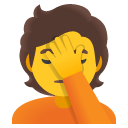


Appearance varies by platform and device. Google Noto, Twemoji, and OpenMoji are open-source.