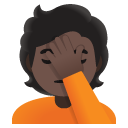
🤦🏿
The Emoji
Person Facepalming: Dark Skin Tone
U+1F926 U+1F3FF · :person_facepalming_dark_skin_tone:
Trend 72
Meaning layers
- interpretation
- Used to express 'I can't believe this is happening' energy, often deployed when someone or something is being painfully stupid, cringe, or embarrassing. The dark skin tone version is frequently used by Black Gen Z users as a form of authentic self-expression.
- tiktok usage
- Appears in comment sections under videos featuring fails, bad takes, or cringe content. Also used in duet reactions and stitch responses to call out absurdity.
- irony level
- 6 / 10
Platform meanings
- meaning
- Reaction to something painfully cringe, embarrassing, or stupid — used in comments, on-screen text overlays, and duet reactions.
- trend usage
- Appears in POV videos, reaction content, and 'things that make me facepalm' compilations. Used heavily in comment sections under controversial or misinformed videos.
- hashtags
- #facepalm#icanteven#embarrassing#noway#whywouldyoudothat
- virality score
- 74 / 100
Cultural meanings
🇺🇸
Western / Gen-Z
Core reaction emoji for absurdity and social cringe — used fluently across all platforms with strong ironic and meme connotations by English-speaking Gen Z.
🇵🇰
Pakistan & India
Used widely on WhatsApp and Instagram to express frustration with political news, family drama, or relatable daily struggle — tone is usually genuine exasperation rather than ironic.
🌍
Middle East
Employed to react to frustrating situations, political absurdity, or social faux pas — common in group chats and Twitter/X replies in Arabic-language spaces.
🌐
Global Neutral
Universally understood as 'I am frustrated/embarrassed by this situation' — one of the most cross-culturally legible reaction emojis with minimal misinterpretation risk.
🇧🇩
Bangladesh
Used in Facebook and WhatsApp contexts to react to frustrating news, political drama, or social situations where someone has done something clearly foolish.
🇱🇰
Sri Lanka
Common on Facebook and WhatsApp as a frustration or embarrassment reaction — frequently appears in comments under viral local news stories.
🇨🇳
China
Less dominant on domestic platforms (WeChat, Weibo) which have their own extensive sticker ecosystems, but used on international platforms by Chinese users to signal exasperation.
🇯🇵
Japan
Used but less common than platform-native emoticons and LINE sticker equivalents — when used, clearly signals frustration or embarrassment without the ironic layer common in Western usage.
🇰🇷
South Korea
Appears on Twitter/X and Instagram among younger users — the direct body language expression is understood but Koreans often prefer text-based or domestic platform emoticons for nuanced emotion.
🇹🇼
Taiwan
Used similarly to global neutral interpretation — reaction to frustrating or embarrassing content, common in Twitter/X and Instagram spaces.
🇭🇰
Hong Kong
Used in Cantonese social media spaces as a genuine frustration or 'this is so dumb' reaction, particularly in political commentary contexts.
🇵🇭
Philippines
Widely used across Facebook, Twitter/X, and TikTok — Filipino social media culture embraces expressive emoji use and this one fits naturally into reactions to drama and bad news.
🇮🇩
Indonesia
Common on Twitter/X (where Indonesian users are extremely active) as a reaction to viral embarrassments, political fails, and relatable everyday frustrations.
🇹🇭
Thailand
Used on Twitter/X and Facebook to react to celebrity drama, political news, and cringe-worthy content — Thai social media culture is emoji-rich and this fits naturally.
🇻🇳
Vietnam
Appears in Facebook and Zalo contexts as a genuine frustration or embarrassment signal — less ironic connotation than in Western usage.
🇲🇾
Malaysia
Used across WhatsApp, Twitter/X, and TikTok — in multilingual Malaysian social media spaces it functions as a universal frustration marker regardless of language context.
🇸🇦
Saudi Arabia
Used on Twitter/X (very active Saudi user base) to react to political absurdity, social faux pas, and frustrating situations — often accompanied by Arabic commentary.
🇦🇪
UAE
Common in cosmopolitan UAE social media spaces — used across nationalities as a universal frustration/cringe reaction, reflecting the diverse expat-heavy population.
🇪🇬
Egypt
Heavily used on Twitter/X and Facebook within Egypt's vibrant meme culture — often part of reactions to political satire, viral fails, and cultural frustrations.
🇹🇷
Turkey
Used on Twitter/X and Instagram in political commentary and everyday frustration contexts — Turkish social media culture is emoji-expressive and this fits naturally.
🇮🇷
Iran
Used on Instagram and Telegram (both popular despite restrictions) — functions as a clean, censorable frustration signal that avoids textual scrutiny.
🇳🇬
Nigeria
Deeply embedded in Nigerian Twitter/X culture alongside other expressive emojis — used in reactions to Nollywood drama, political news, and social media debates.
🇿🇦
South Africa
Common in South African Twitter/X spaces across communities — used to react to political failures, load-shedding news, and general South African 'hayibo' moments.
🇬🇧
UK & Ireland
Used with British/Irish dry humor undertones — the facepalm carries a layer of resigned exasperation that fits perfectly with British understatement culture.
🇫🇷
France
Used on Twitter/X and Instagram as a straightforward frustration marker — fits with French expressive communication style, particularly in reactions to political news.
🇩🇪
Germany
Functional and direct usage — Germans use it to clearly signal 'this is a failure or mistake' without extensive ironic layering, fits the culture's directness.
🇪🇸
Spain & Italy
Used expressively and frequently — Southern European social media culture embraces dramatic emotional expression and this emoji fits naturally into frustrated reactions.
🇧🇷
Brazil
Very widely used on Twitter/X, Instagram, and WhatsApp — Brazilian social media is emoji-rich and expressive, and facepalm energy maps perfectly onto Brazilian 'mano...' culture.
🇲🇽
Mexico
Common across Mexican social media spaces — used in reactions to political absurdity, relatable daily disasters, and the particular brand of Mexican resigned humor.
🌎
Latin America
Broadly used across Latin American social media as a universal frustration and cringe reaction — fits the expressive, community-oriented communication styles of the region.
🇦🇺
Australia & NZ
Used with characteristic Australian/NZ dry humor and irreverence — fits 'mate, what are you doing' energy and is common in reactions to cringe-worthy content.
How its meaning shifted
- 2010
The facepalm emoji did not yet exist in Unicode — the gesture was conveyed through text like '*facepalm*' or ASCII art, mostly in forums and early social media.
- 2015
The base facepalm emoji was newly introduced (Unicode 9.0 finalized in 2016, so 2015 still used workarounds) — skin tone variants were being discussed as part of Unicode's diversity push.
- 2020
Fully established as a core reaction emoji — the dark skin tone variant gained significant cultural traction during the social justice conversations of 2020, used authentically by Black users as representation.
- 2026
A staple of digital communication with deep meme lineage — used across generations with both genuine and ironic registers, the dark skin tone variant normalized as the preferred choice for dark-skinned users expressing authentic reaction.
See it on every platform
Adjacent emojis
Share & embed
Frequently asked
01What does the 🤦🏿 Person Facepalming: Dark Skin Tone emoji mean?
A person with dark skin tone placing their palm on their face, representing frustration, disbelief, embarrassment, or exasperation at something foolish or disappointing.
02What does 🤦🏿 mean on TikTok?
Reaction to something painfully cringe, embarrassing, or stupid — used in comments, on-screen text overlays, and duet reactions.
03What does 🤦🏿 mean on WhatsApp?
Expresses frustration or disbelief in private chats — often sent after someone shares bad news they caused themselves or says something obviously wrong.
04What does 🤦🏿 mean in Gen-Z slang?
Used to express 'I can't believe this is happening' energy, often deployed when someone or something is being painfully stupid, cringe, or embarrassing. The dark skin tone version is frequently used by Black Gen Z users as a form of authentic self-expression.
05Is the 🤦🏿 emoji safe to use?
A universally safe expression of frustration, exasperation, or secondhand embarrassment — no inherently harmful or offensive meaning.
06What does 🤦🏿 mean in texting?
The facepalm gesture activates recognition of the 'social cringe' response — a psychological reaction to perceived incompetence or social norm violations. Using this emoji signals both personal frustration and a performance of that frustration for an audience, reinforcing social bonding through shared disapproval.
07What is the shortcode for 🤦🏿?
The shortcode for Person Facepalming: Dark Skin Tone is :person_facepalming_dark_skin_tone:
08What does 🤦🏿 mean in dating?
Sometimes used flirtatiously when a crush says something adorably dumb or cheesy — a playful 'omg you did not just say that' reaction that softens frustration with affection.
Safety & usage
- Safe meaning
- A universally safe expression of frustration, exasperation, or secondhand embarrassment — no inherently harmful or offensive meaning.
- Caution
- Can be used dismissively or condescendingly to mock someone's genuine question or statement, functioning as a subtle put-down in bad-faith online arguments.
The dark skin tone specifically should be used respectfully — non-Black users adopting this specific variant performatively may be perceived as appropriative in some communities, though emoji tone usage norms are still evolving.
How it looks across platforms


Appearance varies by platform and device. Google Noto, Twemoji, and OpenMoji are open-source.