🙍🏿
The Emoji
Person Frowning: Dark Skin Tone
U+1F64D U+1F3FF · :person_frowning_dark_skin_tone:
Trend 38
Meaning layers
- interpretation
- Used to express mild to deep disappointment, passive dissatisfaction, or the feeling of being done with a situation. Often deployed when words fail to capture low-key frustration or sadness.
- tiktok usage
- Appears in comment sections to react to cringe or sad content, often paired with relatable captions about everyday struggles or social exhaustion.
- irony level
- 4 / 10
Platform meanings
- meaning
- Represents visible disappointment or low-key sadness in comment threads, often reacting to videos about unfair situations or personal setbacks.
- trend usage
- Frequently used in stitch and duet reactions, and in the comments of 'story time' videos involving betrayal or bad outcomes.
- hashtags
- #disappointed#relatablevibes#sadbutokay#overit#notokay
- virality score
- 42 / 100
Cultural meanings
🇺🇸
Western / Gen-Z
Used fluidly to express low-key sadness, subtle social critique, or passive disappointment, often with ironic undertones in meme culture.
🇵🇰
Pakistan & India
Used to express genuine sadness or concern in personal conversations; also deployed in social media commentary on unfair social or political situations.
🌍
Middle East
Conveys sincere emotional distress or empathy in digital messaging; culturally resonates as a polite expression of sorrow without overt dramatization.
🌐
Global Neutral
Universally understood as representing a person who is unhappy, worried, or disappointed — minimal cultural ambiguity in its core meaning.
🇧🇩
Bangladesh
Used in personal and social media contexts to express sadness or empathy, particularly in community discussions around hardship or injustice.
🇱🇰
Sri Lanka
Commonly used on WhatsApp and Facebook to signal personal sorrow or shared community grief without requiring extensive verbal explanation.
🇨🇳
China
Less commonly used compared to local emoji sets, but when used on platforms like WeChat, it signals clear dissatisfaction or emotional heaviness.
🇯🇵
Japan
Japanese users may prefer native emoticons like (´;ω;`) but recognize this emoji as a straightforward expression of sadness or discontent.
🇰🇷
South Korea
Used on KakaoTalk and Instagram to express disappointment or sadness; may be paired with K-drama-style emotional commentary.
🇹🇼
Taiwan
Used similarly to South Korea — conveys genuine emotional expression or disappointment in personal and public digital communication.
🇭🇰
Hong Kong
Appears in protest and social commentary contexts online to express collective disappointment alongside personal sadness.
🇵🇭
Philippines
Widely used on Facebook and Messenger to express genuine sadness, particularly in communal or family-related emotional discussions.
🇮🇩
Indonesia
Used across WhatsApp and Instagram to represent sadness or worry; often appears in posts about social issues or personal struggles.
🇹🇭
Thailand
Used on Line and Facebook to signal a bad mood or disappointment; culturally paired with indirect emotional expression norms.
🇻🇳
Vietnam
Appears in Zalo and Facebook posts to express quiet sadness or frustration, fitting into the culturally restrained emotional communication style.
🇲🇾
Malaysia
Used across messaging apps to express sadness or concern; often appears in mixed-language conversations about relatable everyday struggles.
🇸🇦
Saudi Arabia
Used to express personal sadness or collective disappointment, particularly in private messaging; public emotional expression remains measured.
🇦🇪
UAE
Used in multicultural digital spaces to convey sadness or concern; resonates across expat and local communities in its straightforward meaning.
🇪🇬
Egypt
Common on Facebook and WhatsApp to express sadness or frustration, often in the context of social commentary or personal venting.
🇹🇷
Turkey
Used on Twitter and Instagram to express disappointment with political or social situations, as well as personal emotional states.
🇮🇷
Iran
Used on Telegram and Instagram (despite restrictions) to convey sadness or protest sentiments; carries emotional and sometimes political weight.
🇳🇬
Nigeria
Used widely on Twitter and WhatsApp to express disappointment, often in response to social, political, or economic frustrations.
🇿🇦
South Africa
Used across platforms to express sadness or communal disappointment, particularly in conversations about social inequality or personal setbacks.
🇬🇧
UK & Ireland
Used with characteristic British/Irish understatement — often deployed sarcastically or with dry humor to signal mild to moderate upset.
🇫🇷
France
Used to express genuine emotional dissatisfaction or poetic sadness; fits into French digital culture's comfort with melancholic expression.
🇩🇪
Germany
Used straightforwardly to signal displeasure or concern; German digital communication tends toward literal rather than ironic emoji use.
🇪🇸
Spain & Italy
Used expressively to convey sadness or disappointment, often in passionate or emotionally animated conversations about personal or social matters.
🇧🇷
Brazil
Very commonly used on WhatsApp and Instagram to express sadness or empathy; fits naturally into Brazil's emotionally open digital communication style.
🇲🇽
Mexico
Used in personal and social commentary to express sadness or quiet frustration; resonates strongly in discussions of social inequity.
🌎
Latin America
Broadly used across Latin America to convey emotional distress, empathy, or disappointment in both personal and community-focused conversations.
🇦🇺
Australia & NZ
Used with a mix of sincerity and casual irony — signals real sadness but is also deployed humorously in meme-adjacent contexts.
How its meaning shifted
- 2010
Emoji were just gaining mainstream adoption; skin tone modifiers did not yet exist, and the base frowning person emoji was used literally to represent sadness or concern.
- 2015
Skin tone modifiers introduced by Unicode 8.0 allowed for diverse representation; the dark skin tone variant began appearing as users embraced more personalized emoji expression.
- 2020
Gained more cultural and social significance during increased conversations about racial representation in media and emoji; used both emotionally and in social justice commentary.
- 2026
Fully integrated into everyday digital communication across all demographics; used across ironic, sincere, and meme contexts with a strong presence in Black digital culture and Gen Z communication.
See it on every platform
Adjacent emojis
- Often confused with
- person bowingperson shruggingworried face
Share & embed
Frequently asked
01What does the 🙍🏿 Person Frowning: Dark Skin Tone emoji mean?
A person with dark skin tone displaying a frowning, concerned, or unhappy facial expression with slightly furrowed brows.
02What does 🙍🏿 mean on TikTok?
Represents visible disappointment or low-key sadness in comment threads, often reacting to videos about unfair situations or personal setbacks.
03What does 🙍🏿 mean on WhatsApp?
Expresses quiet disappointment or worry in personal chats — a softer way of showing you're not okay without starting a full conversation.
04What does 🙍🏿 mean in Gen-Z slang?
Used to express mild to deep disappointment, passive dissatisfaction, or the feeling of being done with a situation. Often deployed when words fail to capture low-key frustration or sadness.
05Is the 🙍🏿 emoji safe to use?
A person displaying sadness or disappointment — used to express emotional states, empathy, or dissatisfaction in everyday communication.
06What does 🙍🏿 mean in texting?
This emoji maps to a moderate emotional state — not full despair but a visible downturn in mood. Psychologically it signals the need for acknowledgment or empathy, and in digital communication it often invites a supportive response.
07What is the shortcode for 🙍🏿?
The shortcode for Person Frowning: Dark Skin Tone is :person_frowning_dark_skin_tone:
08What does 🙍🏿 mean in dating?
Rarely used flirtatiously; when it is, it signals playful sulking — like pouting to get attention from a crush or partner.
Safety & usage
- Safe meaning
- A person displaying sadness or disappointment — used to express emotional states, empathy, or dissatisfaction in everyday communication.
- Caution
- Could be used in harassment contexts to mock someone's emotional expression, or deployed passive-aggressively in manipulative conversations.
Generally safe. In rare cases could be used to demean or trivialize someone's emotional distress if deployed sarcastically in a targeted way.
How it looks across platforms
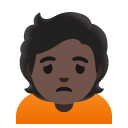


Appearance varies by platform and device. Google Noto, Twemoji, and OpenMoji are open-source.