🙆
The Emoji
Person Gesturing OK
U+1F646 · :person_gesturing_ok:
Trend 55
Meaning layers
- interpretation
- Often used ironically to signal exasperation, over-the-top enthusiasm, or as a self-deprecating 'everything is fine (it's not fine)' energy. Sometimes used genuinely to say 'I'm good' or 'this is acceptable.'
- tiktok usage
- Appears in 'this is fine' meme contexts, chaotic affirmations, or as a reaction to absurd situations where someone is pretending to be unbothered.
- irony level
- 7 / 10
Platform meanings
- meaning
- Used in comment sections to signal ironic acceptance, chaotic agreement, or performative calm in response to wild content.
- trend usage
- Appears in 'not me doing [insane thing] 🙆' captions and 'I'm so unbothered' trends that are clearly very bothered.
- hashtags
- #thisisfine#unbothered#okayvibes#chaosacceptance#imfine
- virality score
- 58 / 100
Cultural meanings
🇺🇸
Western / Gen-Z
Primarily used ironically as a 'this is fine' meme gesture, signaling performative calm in the face of chaos or absurdity.
🇵🇰
Pakistan & India
Used literally to express 'I'm okay' or 'no problem' in casual messaging; occasionally used in customer service contexts to signal readiness.
🌍
Middle East
Interpreted as an 'OK' or approval gesture in general messaging; less ironic usage, more functional affirmation.
🌐
Global Neutral
Universally understood as 'OK' or 'I'm fine,' making it a safe, cross-cultural affirmation emoji.
🇧🇩
Bangladesh
Used straightforwardly to mean 'I'm alright' or 'everything is good' in everyday digital communication.
🇱🇰
Sri Lanka
Employed in casual chats to signal agreement or wellness; sometimes used by service workers online to indicate availability.
🇨🇳
China
The raised-arm gesture resonates with 'I'm okay' culture on WeChat; used in moments of reassurance or to dismiss concern.
🇯🇵
Japan
Has strong cultural roots here — directly mirrors the real-life 'daijoubu' arm gesture; used sincerely and frequently in service and social contexts.
🇰🇷
South Korea
Used to signal enthusiasm and okayness; popular in fan communities to express excited approval or reassurance.
🇹🇼
Taiwan
Similar to Japan, used genuinely for 'I'm fine' affirmations; also appears in cute, playful messaging contexts.
🇭🇰
Hong Kong
Used casually in bilingual (Cantonese/English) chats to mean 'okay' or as a lighthearted expression of readiness.
🇵🇭
Philippines
Very commonly used in everyday chats to mean 'okay lang' (I'm just fine); fits into the culturally warm, expressive messaging style.
🇮🇩
Indonesia
Used to affirm 'baik-baik saja' (I'm fine) in casual social media and messaging; sometimes ironically among younger users.
🇹🇭
Thailand
Used alongside kaomoji-style expressions; signals 'I'm okay' or cheerful acceptance in a cute, expressive communication style.
🇻🇳
Vietnam
Employed in casual chats to mean 'ổn rồi' (it's fine now); younger users adopt the ironic Western usage via TikTok influence.
🇲🇾
Malaysia
Used in mixed-language chats (Bahasa/English) to casually say 'okay lah' — fine, no worries, moving on.
🇸🇦
Saudi Arabia
Used straightforwardly to confirm wellness or agreement; less ironic connotation, more direct affirmation.
🇦🇪
UAE
Popular in multilingual group chats as a quick 'all good' signal; used by expats with both literal and ironic intent.
🇪🇬
Egypt
Used in informal chats to mean 'tamam' (okay/fine); occasionally deployed with light sarcasm in meme-savvy circles.
🇹🇷
Turkey
Used to mean 'tamam' or 'iyi' (good/okay); younger Turkish users on TikTok have adopted the ironic Western interpretation.
🇮🇷
Iran
Used casually in Persian messaging to mean 'khubam' (I'm fine); relatively literal usage with minimal ironic layering.
🇳🇬
Nigeria
Used in casual Pidgin-English contexts to mean 'I dey okay' (I'm fine); sometimes deployed sarcastically by Nigerian Gen Z on Twitter/X.
🇿🇦
South Africa
Used across language communities to signal 'I'm lekker' (I'm fine/good); ironic usage growing among younger South African users.
🇬🇧
UK & Ireland
Used with quintessential British dry humor — arms up, clearly not okay, very okay about it. Irony level is high.
🇫🇷
France
Used with Gallic detachment — a shrug equivalent in emoji form; signals 'bof, I'm fine I suppose' energy.
🇩🇪
Germany
Interpreted more literally as a functional 'OK' signal; less ironic layering compared to Anglo contexts.
🇪🇸
Spain & Italy
Used expressively to signal enthusiasm and okayness; fits into the generally animated and warm digital communication style.
🇧🇷
Brazil
Very popular in casual messaging to mean 'tô bem' (I'm fine); also used with irony and dramatic flair by Brazilian youth online.
🇲🇽
Mexico
Used to mean 'estoy bien' (I'm fine) or as an ironic reaction to chaotic situations, fitting the culture's expressive humor.
🌎
Latin America
Broadly used across Latin America as a cheerful affirmation or ironic 'todo bien' in the face of relatable struggles.
🇦🇺
Australia & NZ
Used with classic Australasian self-deprecating humor — 'she'll be right 🙆' energy, arms up, moving on regardless.
How its meaning shifted
- 2010
Introduced as a literal 'OK gesture' emoji inspired by Japanese customer service culture; used sincerely to mean 'I'm fine' or 'no problem.'
- 2015
Gained wider adoption across messaging apps; used straightforwardly but starting to pick up playful, expressive connotations in younger user groups.
- 2020
Ironic usage exploded alongside 'this is fine' meme culture; became a staple of pandemic-era humor signaling forced acceptance of chaos.
- 2026
Firmly established as a dual-use emoji — genuine affirmation among older users and service contexts, heavy ironic/meme usage among Gen Z and younger millennials.
See it on every platform
Emoji combinations
Adjacent emojis
- Often confused with
- ok handraised handsperson raising hand
- Can replace
- ok handthumbs upwhite check mark
Share & embed
Frequently asked
01What does the 🙆 Person Gesturing OK emoji mean?
A person raising both arms above their head in a circular gesture, originally designed to signify 'OK' or agreement, approval, or that everything is fine.
02What does 🙆 mean on TikTok?
Used in comment sections to signal ironic acceptance, chaotic agreement, or performative calm in response to wild content.
03What does 🙆 mean on WhatsApp?
Means 'I'm okay' or 'no worries' in a casual group chat or one-on-one message.
04What does 🙆 mean in Gen-Z slang?
Often used ironically to signal exasperation, over-the-top enthusiasm, or as a self-deprecating 'everything is fine (it's not fine)' energy. Sometimes used genuinely to say 'I'm good' or 'this is acceptable.'
05Is the 🙆 emoji safe to use?
A universally safe affirmation gesture signaling okayness, approval, or wellness.
06What does 🙆 mean in texting?
The raised-arms pose is psychologically associated with openness and surrender. In digital communication, it signals either genuine contentment or a coping mechanism disguised as positivity.
07What is the shortcode for 🙆?
The shortcode for Person Gesturing OK is :person_gesturing_ok:
08What does 🙆 mean in dating?
Rarely used as a flirt tool directly, but can signal 'I'm available' or 'I'm easygoing' in a low-stakes flirtatious exchange.
Safety & usage
- Safe meaning
- A universally safe affirmation gesture signaling okayness, approval, or wellness.
- Caution
- In rare passive-aggressive contexts, can be weaponized as dismissive sarcasm — 'sure, whatever, totally fine 🙆' to shut down conversation.
Generally harmless. Mild risk of misread tone — sender may intend irony while receiver takes it literally, or vice versa. No NSFW associations.
How it looks across platforms
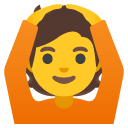


Appearance varies by platform and device. Google Noto, Twemoji, and OpenMoji are open-source.