🙆🏿
The Emoji
Person Gesturing OK: Dark Skin Tone
U+1F646 U+1F3FF · :person_gesturing_ok_dark_skin_tone:
Trend 55
Meaning layers
- interpretation
- Used to signal agreement, slay energy, 'I'm good with this,' or unbothered confidence. Often deployed as a self-affirmation or to show someone is thriving and at peace with a situation.
- tiktok usage
- Appears in 'unbothered' content, reaction videos to drama, and affirmations like 'this is fine, I'm fine' either sincerely or with ironic detachment.
- irony level
- 4 / 10
Platform meanings
- meaning
- Signals 'I'm good,' unbothered energy, or agreement. Used in comment sections to validate content or show the viewer is thriving.
- trend usage
- Appears in affirmation trends, 'soft life' content, and reaction stitches where creators are responding to drama by showing they are totally unbothered.
- hashtags
- #unbothered#softlife#blackgirlmagic#selflove#okaybestie
- virality score
- 62 / 100
Cultural meanings
🇺🇸
Western / Gen-Z
Represents unbothered confidence and self-acceptance; widely used in affirmation content and Black joy expression, appreciated for its inclusive skin tone modifier.
🇵🇰
Pakistan & India
The raised-arms OK gesture is less culturally native but understood in urban, social-media-literate circles as approval or positivity; the dark skin tone modifier is noted and appreciated for representation.
🌍
Middle East
Interpreted as a positive, agreeable gesture in modern digital communication; the skin tone representation resonates with diverse populations in the region who see themselves reflected.
🌐
Global Neutral
Broadly understood as an 'I'm okay' or approval signal across most global contexts regardless of cultural background, making it one of the more universally readable emojis.
🇧🇩
Bangladesh
Used casually among younger, social-media-active users to signal agreement or positivity; the dark skin tone is seen positively as relatable representation.
🇱🇰
Sri Lanka
In urban youth contexts, used as a chill affirmation or approval gesture online; cultural familiarity with the gesture is moderate but growing through social media influence.
🇨🇳
China
The gesture carries an OK connotation for digitally literate users but is not deeply rooted in local gesture culture; used mostly to echo Western social media trends.
🇯🇵
Japan
The original 'OK' head-circle gesture is actually rooted in Japanese culture, making this emoji particularly meaningful; used genuinely to say everything is fine or acceptable.
🇰🇷
South Korea
Understood as an approval or 'all good' signal; frequently used in K-culture fan communities on global platforms to react to positive news about artists or content.
🇹🇼
Taiwan
Used similarly to Mainland Chinese context — digital shorthand for approval, especially among younger users engaging with global social media platforms.
🇭🇰
Hong Kong
Blends Cantonese digital culture with global emoji usage; read straightforwardly as approval or contentment, especially in casual messaging apps.
🇵🇭
Philippines
Widely used as a positive, affirming emoji among the highly social-media-engaged Filipino population; the dark skin tone is appreciated for reflecting local skin diversity.
🇮🇩
Indonesia
Used in a friendly, agreeable way to confirm plans or signal positivity; dark skin tone representation resonates well given Indonesia's diverse population.
🇹🇭
Thailand
Interpreted as a lighthearted 'I'm okay' or 'all good' emoji; used in youth digital culture with the same carefree energy as global Gen Z usage.
🇻🇳
Vietnam
Used among younger Vietnamese social media users as a simple approval or 'I'm fine' signal; the specific skin tone modifier is noted but not always the focus of interpretation.
🇲🇾
Malaysia
Resonates across Malaysia's multicultural population; used as a positive, agreeable emoji in casual conversation and appreciated for inclusive skin tone representation.
🇸🇦
Saudi Arabia
Among younger, social-media-active Saudis, used as a positive affirmation emoji; the raised-arm gesture is understood digitally even if not common in traditional local gesture vocabulary.
🇦🇪
UAE
In the cosmopolitan UAE social media landscape, this emoji is widely understood and used by diverse communities as a positive, agreeable signal.
🇪🇬
Egypt
Used among Egyptian youth on social media as a sign of approval and positivity; the dark skin tone representation is seen as inclusive and relatable.
🇹🇷
Turkey
Understood as an approval or 'everything is fine' emoji; used casually in digital conversations among younger Turkish social media users.
🇮🇷
Iran
Among younger Iranians on social media platforms, interpreted as a positive or approval signal; the emoji's cultural nuance around skin tone is secondary to its basic meaning.
🇳🇬
Nigeria
Widely used and celebrated in Nigerian digital culture; the dark skin tone modifier makes this emoji particularly resonant and is actively preferred for authentic self-representation.
🇿🇦
South Africa
Embraced especially by Black South African communities as an affirmation emoji that reflects their likeness; used in celebratory and self-love digital content.
🇬🇧
UK & Ireland
Used casually as an 'I'm good' or approval signal; Gen Z users appreciate the skin tone diversity, and it appears in British Black culture digital spaces with pride.
🇫🇷
France
Understood as an approval or contentment emoji in French digital spaces; skin tone inclusivity is noted and valued in diversity-conscious communities.
🇩🇪
Germany
Read as a positive, approval-oriented emoji; German users tend to interpret it literally as 'OK' or 'all good' with less ironic layering than English-speaking contexts.
🇪🇸
Spain & Italy
Used in Southern European digital culture as a cheerful, affirmative emoji; the expressive raised-arms gesture aligns well with culturally demonstrative communication styles.
🇧🇷
Brazil
Enthusiastically used in Brazilian social media as a celebratory or affirmation emoji; the dark skin tone representation is deeply appreciated given Brazil's large Afro-Brazilian population.
🇲🇽
Mexico
Used casually among younger Mexicans as a positive, agreeable emoji; the dark skin tone inclusivity is appreciated in a country with significant skin tone diversity.
🌎
Latin America
Across Latin America, used as a cheerful affirmation emoji; communities with Afro-Latin heritage particularly embrace the dark skin tone modifier as a form of visibility.
🇦🇺
Australia & NZ
Used casually as an 'I'm good' or approval emoji; Indigenous and Melanesian communities in the region appreciate darker skin tone emoji representation.
How its meaning shifted
- 2010
Emoji was not yet available with skin tone modifiers; the base yellow version existed but saw limited usage beyond Japanese platforms and early iPhone adopters.
- 2015
Skin tone modifiers were introduced by Unicode, making this emoji newly available; early adoption was driven by discussions around emoji diversity and representation, generating significant cultural conversation.
- 2020
Became a mainstream affirmation and self-love emoji; heavily used in Black Lives Matter adjacent content, self-care culture, and unbothered aesthetic posts across platforms.
- 2026
Established as a warm, confident affirmation emoji with layered ironic potential; used in Gen Z self-love content, soft-life aesthetics, and occasionally as ironic emotional deflection.
See it on every platform
Adjacent emojis
- Often confused with
- ok handperson raising handperson shrugging
- Can replace
- ok handraised handswhite check mark
Share & embed
Frequently asked
01What does the 🙆🏿 Person Gesturing OK: Dark Skin Tone emoji mean?
A person with dark skin tone raising both arms above their head in a circle shape, representing the OK gesture or approval. Standardized as 'Person Gesturing OK: Dark Skin Tone' in Unicode.
02What does 🙆🏿 mean on TikTok?
Signals 'I'm good,' unbothered energy, or agreement. Used in comment sections to validate content or show the viewer is thriving.
03What does 🙆🏿 mean on WhatsApp?
Straightforward approval or confirmation — 'Sounds good,' 'I'm okay with that,' or 'All good on my end.'
04What does 🙆🏿 mean in Gen-Z slang?
Used to signal agreement, slay energy, 'I'm good with this,' or unbothered confidence. Often deployed as a self-affirmation or to show someone is thriving and at peace with a situation.
05Is the 🙆🏿 emoji safe to use?
A positive, affirming gesture representing approval, contentment, and self-assurance — entirely appropriate for general use.
06What does 🙆🏿 mean in texting?
Represents a grounded emotional state where the person signals they are comfortable and accepting of circumstances. The raised-arms posture psychologically conveys openness and non-defensiveness.
07What is the shortcode for 🙆🏿?
The shortcode for Person Gesturing OK: Dark Skin Tone is :person_gesturing_ok_dark_skin_tone:
08What does 🙆🏿 mean in dating?
Can be used playfully to say 'I'm available' or 'I'm totally fine with that' in response to a flirty suggestion, adding a light, carefree energy to conversation.
Safety & usage
- Safe meaning
- A positive, affirming gesture representing approval, contentment, and self-assurance — entirely appropriate for general use.
- Caution
- Rarely weaponized, though it can be used passive-aggressively to dismiss someone's concerns by performing false okayness.
No significant toxic or coded hate group associations known. The emoji is broadly safe and celebrated for its representation value.
How it looks across platforms
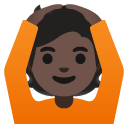


Appearance varies by platform and device. Google Noto, Twemoji, and OpenMoji are open-source.