🛌🏾
The Emoji
Person In Bed: Medium-dark Skin Tone
U+1F6CC U+1F3FE · :person_in_bed_mediumdark_skin_tone:
Trend 68
Meaning layers
- interpretation
- Used to express exhaustion, the desire to stay in bed all day, or the 'I'm not getting up' energy. Also used ironically to signal avoiding responsibilities.
- tiktok usage
- Appears in 'bed rotting' content, lazy day vlogs, and mental health awareness posts about rest culture.
- irony level
- 5 / 10
Platform meanings
- meaning
- Represents bed rotting, rest days, lazy girl lifestyle, or mental health days.
- trend usage
- Used in 'bed rot' trend videos and 'things I did today: nothing' formats.
- hashtags
- #bedrot#lazyday#selfcare#donotdisturb#restday
- virality score
- 72 / 100
Cultural meanings
🇺🇸
Western / Gen-Z
Strongly associated with the 'bed rotting' trend and the normalization of rest as resistance to hustle culture; widely embraced as a relatable symbol of burnout.
🇵🇰
Pakistan & India
Used straightforwardly to indicate sleep or rest; medium-dark skin tone resonates more naturally with South Asian users and aids in self-representation.
🌍
Middle East
Commonly used to signal rest after long days, especially during Ramadan late nights or post-iftar relaxation; the skin tone feels inclusive.
🌐
Global Neutral
Universally understood as a sleep or rest emoji; one of the more straightforward emojis across language and cultural barriers.
🇧🇩
Bangladesh
Used to indicate sleep or end-of-day fatigue; the medium-dark skin tone is appreciated for better reflecting local skin tones.
🇱🇰
Sri Lanka
Casually used in chats to indicate going to sleep or feeling tired; no significant cultural layering beyond literal meaning.
🇨🇳
China
Less commonly used compared to dedicated sleeping face emojis (😴); when used, it signals physical rest rather than emotional exhaustion.
🇯🇵
Japan
Used more literally for sleep or illness rest; Japanese digital culture tends to prefer face-based emojis to express emotional states over object-context ones.
🇰🇷
South Korea
Used in wellness and K-beauty self-care contexts; occasionally appears in idol fan communities to describe rest days for celebrities.
🇹🇼
Taiwan
Used similarly to other East Asian contexts — primarily for sleep or taking a break; sometimes appears in student culture posts about exhaustion.
🇭🇰
Hong Kong
Practical usage to indicate sleep or rest; occasionally used ironically in hustle culture commentary given Hong Kong's demanding work environment.
🇵🇭
Philippines
Very relatable in expressing 'pagod' (tiredness) culture; frequently used in late-night group chats and reflects common OFW rest narratives.
🇮🇩
Indonesia
Used casually to indicate sleep or laziness; fits into the 'rebahan' (lying down/lazy) cultural meme that is hugely popular among Indonesian youth.
🇹🇭
Thailand
Used to signal rest or going to sleep; fits into sanook (fun, easy-going) culture where rest is valued and openly communicated.
🇻🇳
Vietnam
Used straightforwardly in family and friend chats to indicate bedtime or exhaustion after work; no significant ironic usage observed.
🇲🇾
Malaysia
Heavily used in the context of 'lepak' (chill/hang out) culture; represents one extreme of the chill spectrum — complete horizontal rest.
🇸🇦
Saudi Arabia
Used to indicate rest, especially after long commutes or work hours; late-night culture in Saudi Arabia makes it a common goodnight signal.
🇦🇪
UAE
Used in expat and local communities alike to signal rest; fits the late-night social culture of the UAE where bedtime is often very late.
🇪🇬
Egypt
Commonly used in late-night chats which are culturally normal; represents unwinding after long social evenings or work days.
🇹🇷
Turkey
Used to signal going to sleep in family and friend groups; occasionally used sarcastically when someone is avoiding a topic by 'going to bed.'
🇮🇷
Iran
Used straightforwardly to indicate rest or sleep in private messaging; skin tone diversity is generally appreciated in modern digital communication.
🇳🇬
Nigeria
Resonates strongly due to skin tone representation; used to express rest after hustling, fitting into Nigerian hustle-and-grind culture narratives.
🇿🇦
South Africa
The medium-dark skin tone is highly relatable for many South African users; used casually for sleep and rest, especially in youth digital spaces.
🇬🇧
UK & Ireland
Used ironically to cope with grey weather and the desire to stay in bed; fits British self-deprecating humor about laziness and gloomy days.
🇫🇷
France
Used to signal the cultural appreciation for rest and 'la sieste' (nap) culture; French users may use it post-lunch or to indicate unwinding.
🇩🇪
Germany
Used practically to indicate sleep or rest; Germans may also use it in work-life balance discussions given the cultural emphasis on structured rest time.
🇪🇸
Spain & Italy
Strongly tied to siesta culture; used enthusiastically to signal afternoon rest or the end of a long social evening.
🇧🇷
Brazil
Used to express tiredness after lively social events or long work days; medium-dark skin tone is representationally significant for many Brazilian users.
🇲🇽
Mexico
Used casually in family and friend chats for sleep; also appears in humor about avoiding responsibility — 'ya me dormí' (I'm already asleep) energy.
🌎
Latin America
Broadly relatable across Latin America for expressing fatigue after busy family or work days; skin tone representation is positively received.
🇦🇺
Australia & NZ
Used for the classic 'can't be bothered' energy; Australians particularly appreciate it for lazy Sunday and beach-recovery-day narratives.
How its meaning shifted
- 2010
Emoji and skin tone modifiers did not exist yet; the concept would have been expressed with basic text emoticons like -_- or 'zzz'.
- 2015
Skin tone modifiers were introduced (Unicode 8.0); early adoption was mostly literal — used to say goodnight or indicate illness.
- 2020
Usage expanded into self-care and mental health conversations; 'staying in bed' as a coping mechanism became more openly discussed online.
- 2026
Core emoji of the 'bed rotting' and rest culture movements; embraced by Gen Z as a symbol of rejecting hustle culture and prioritizing rest as radical self-care.
See it on every platform
Adjacent emojis
- Often confused with
- couch and lampperson in lotus positionhospital
- Can replace
- sleeping facezzzmoon
Share & embed
Frequently asked
01What does the 🛌🏾 Person In Bed: Medium-dark Skin Tone emoji mean?
A person lying in bed, shown with medium-dark skin tone, typically representing sleep, rest, or going to bed.
02What does 🛌🏾 mean on TikTok?
Represents bed rotting, rest days, lazy girl lifestyle, or mental health days.
03What does 🛌🏾 mean on WhatsApp?
Telling someone you're in bed, going to sleep, or too tired to function.
04What does 🛌🏾 mean in Gen-Z slang?
Used to express exhaustion, the desire to stay in bed all day, or the 'I'm not getting up' energy. Also used ironically to signal avoiding responsibilities.
05Is the 🛌🏾 emoji safe to use?
Represents sleep, rest, recovery, or taking a break — entirely safe and positive in most contexts.
06What does 🛌🏾 mean in texting?
Signals a need for rest or emotional withdrawal; frequently associated with burnout culture and the growing Gen Z normalization of 'doing nothing' as self-care.
07What is the shortcode for 🛌🏾?
The shortcode for Person In Bed: Medium-dark Skin Tone is :person_in_bed_mediumdark_skin_tone:
08What does 🛌🏾 mean in dating?
Can be used flirtatiously to hint at wanting someone to come over or to sleep together, depending heavily on context.
Safety & usage
- Safe meaning
- Represents sleep, rest, recovery, or taking a break — entirely safe and positive in most contexts.
- Caution
- Can be used in unwanted flirtatious contexts to imply sexual availability or to pressure someone into a hookup scenario.
Context-dependent; when combined with certain other emojis (e.g., 👀, 😈) it can shift to a sexual implication. Generally safe in isolation.
How it looks across platforms
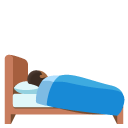


Appearance varies by platform and device. Google Noto, Twemoji, and OpenMoji are open-source.