🛀🏽
The Emoji
Person Taking Bath: Medium Skin Tone
U+1F6C0 U+1F3FD · :person_taking_bath_medium_skin_tone:
Trend 52
Meaning layers
- interpretation
- Used to signal self-care routines, 'rot days,' spa vibes, or the ritual of doing absolutely nothing productive while pretending it's wellness.
- tiktok usage
- Appears in 'soft life' content, 'that girl' aesthetic videos, and bath bomb unboxings. Also used ironically when someone is metaphorically washing their hands of drama.
- irony level
- 4 / 10
Platform meanings
- meaning
- Signals self-care content, bath routines, soft life aesthetics, or metaphorical 'washing off' negativity and drama.
- trend usage
- Featured in 'Sunday reset' videos, bath bomb reviews, 'that girl morning routine' content, and ironic unbothered POVs.
- hashtags
- #selfcare#bathtime#softlife#sundayreset#thatgirl
- virality score
- 55 / 100
Cultural meanings
🇺🇸
Western / Gen-Z
Strongly associated with self-care culture, 'that girl' aesthetics, and the reclamation of rest as a radical act. Often ironic in meme contexts.
🇵🇰
Pakistan & India
Used literally for bathing announcements in family chats or to signal unavailability. Less self-care connotation, more practical daily use.
🌍
Middle East
Primarily literal — used in family or friend groups to indicate bathing time, which is often part of religious cleanliness (tahara) routines.
🌐
Global Neutral
Universally understood as representing bathing or personal hygiene. The medium skin tone is seen as inclusive and relatable across demographics.
🇧🇩
Bangladesh
Used in everyday messaging to signal unavailability during bathing time. Practical usage dominates; wellness connotation is minimal.
🇱🇰
Sri Lanka
Literal use in personal and family chats to indicate bathing, especially in the context of daily routines after work or school.
🇨🇳
China
Used casually in messaging apps like WeChat to indicate bathing or personal hygiene time. 'Soaking culture' (泡澡) is popular, giving it some leisure context.
🇯🇵
Japan
Deeply resonant culturally — Japan's onsen (hot spring) and ofuro (home bath) culture gives this emoji a rich connotation of ritual relaxation and spiritual cleansing.
🇰🇷
South Korea
Connected to jjimjilbang (Korean spa) culture and K-beauty self-care rituals. Used in wellness and skincare content with genuine cultural depth.
🇹🇼
Taiwan
Used in daily communication for bathing updates and in wellness content. Spa culture is popular, giving it some leisure and self-care resonance.
🇭🇰
Hong Kong
Primarily practical in messaging; also used in lifestyle and wellness content among younger demographics influenced by global self-care trends.
🇵🇭
Philippines
Literal usage in everyday messaging. Among Gen Z, beginning to adopt the self-care framing influenced by Western social media trends.
🇮🇩
Indonesia
Used to signal bathing time in casual chats. Mandi (bathing) is a twice-daily ritual, making this a very relatable and frequently used emoji.
🇹🇭
Thailand
Practical daily use in messaging. Also appears in Thai wellness and spa content, given Thailand's strong spa and relaxation tourism culture.
🇻🇳
Vietnam
Primarily literal in daily messaging. Younger users influenced by K-beauty and global wellness trends are beginning to use it in self-care contexts.
🇲🇾
Malaysia
Used literally in family and friend chats. Dual usage emerging in younger demographics for self-care and wellness content.
🇸🇦
Saudi Arabia
Closely connected to Islamic cleanliness practices (taharah/ghusl). Used respectfully to indicate bathing, with a layer of religious hygiene significance.
🇦🇪
UAE
Combines Islamic cleanliness connotations with luxury spa culture. Used in both practical and aspirational wellness content given the UAE's luxury lifestyle branding.
🇪🇬
Egypt
Used practically in daily messaging to indicate bathing. Hammam (traditional bathhouse) culture gives it an additional layer of communal cleansing significance.
🇹🇷
Turkey
Strongly associated with the hamam (Turkish bath) tradition. Used in both literal and cultural pride contexts, sometimes referencing traditional wellness heritage.
🇮🇷
Iran
Used literally for daily hygiene signaling in chats. Traditional bathhouse (hammam) culture gives it subtle cultural depth beyond just modern self-care.
🇳🇬
Nigeria
Used practically to signal unavailability during bathing. Among younger urban users, self-care connotations are gaining traction through social media influence.
🇿🇦
South Africa
Practical use in everyday messaging. In township youth culture, bathing emojis sometimes appear in self-care and glow-up content on TikTok and Instagram.
🇬🇧
UK & Ireland
Used both literally and ironically. British humor deploys it to signal 'having a soak' as a solution to all of life's problems, a culturally specific comfort ritual.
🇫🇷
France
Connected to French beauty and self-care philosophy. Used in lifestyle content with a chic, understated aesthetic rather than the loud American self-care branding.
🇩🇪
Germany
Practical and efficient usage in chats. Germany's spa and wellness culture (Wellness-Oasen) lends it some leisure context among health-conscious demographics.
🇪🇸
Spain & Italy
Used casually in messaging. Italy's 'bagno' culture and Spain's relaxed lifestyle aesthetic give it warm, unhurried connotations in personal care content.
🇧🇷
Brazil
Used in daily messaging and self-care content. Brazil's beauty culture and body-care rituals make this emoji relatable in wellness and grooming contexts.
🇲🇽
Mexico
Practical daily use in family and friend messaging. Among younger users, self-care and wellness content adoption mirrors broader Latin American Gen Z trends.
🌎
Latin America
Broadly used for literal bathing announcements. Growing adoption in self-care and wellness content across Gen Z social media users in the region.
🇦🇺
Australia & NZ
Used casually with the same self-care and unbothered irony as Western Gen Z globally. 'Having a bath' is a very common relaxation signal in Aussie casual chat.
How its meaning shifted
- 2010
Barely in use — emoji were niche, and bathing emojis were largely treated as novelty with no cultural depth. Skin tone variants did not yet exist.
- 2015
Skin tone variants introduced in Unicode 8.0 added representational value. Used primarily for literal bathing announcements in messaging apps.
- 2020
Self-care culture boom during COVID-19 lockdowns massively boosted this emoji. Bath routines became mental health rituals and content gold on TikTok and Instagram.
- 2026
Embedded in the 'soft life,' slow living, and wellness aesthetics. Used both sincerely in self-care content and ironically in unbothered/detachment meme culture.
See it on every platform
Adjacent emojis
- Opposite
- flexed bicepslaptopalarm clock
- Often confused with
- hot tubswimming poolwater wave
- Can replace
- sparklesrelieved facewoman in lotus position
Share & embed
Frequently asked
01What does the 🛀🏽 Person Taking Bath: Medium Skin Tone emoji mean?
A person sitting in a bathtub taking a bath, displayed with medium skin tone. Part of the Unicode bathing sequence with skin tone modifier.
02What does 🛀🏽 mean on TikTok?
Signals self-care content, bath routines, soft life aesthetics, or metaphorical 'washing off' negativity and drama.
03What does 🛀🏽 mean on WhatsApp?
Letting someone know you're unavailable because you're bathing or relaxing. Casual shorthand for 'I'm busy/unwinding.'
04What does 🛀🏽 mean in Gen-Z slang?
Used to signal self-care routines, 'rot days,' spa vibes, or the ritual of doing absolutely nothing productive while pretending it's wellness.
05Is the 🛀🏽 emoji safe to use?
Personal hygiene, self-care routines, relaxation, wellness rituals, and taking a break from responsibilities.
06What does 🛀🏽 mean in texting?
Bathing symbolizes psychological cleansing and boundary-setting. Using this emoji often signals a conscious retreat from stress or social obligation, tapping into hygiene therapy and sensory comfort.
07What is the shortcode for 🛀🏽?
The shortcode for Person Taking Bath: Medium Skin Tone is :person_taking_bath_medium_skin_tone:
08What does 🛀🏽 mean in dating?
Can be used playfully to invite someone into a cozy, intimate setting or to hint at a relaxed evening. Sometimes used with a suggestive tone depending on context.
Safety & usage
- Safe meaning
- Personal hygiene, self-care routines, relaxation, wellness rituals, and taking a break from responsibilities.
- Caution
- Rarely weaponized, but can be used to dismiss or minimize someone's problems — implying they should just 'go take a bath and calm down.'
In rare contexts, combined with suggestive emojis, it can carry sexual undertones in direct messaging. Generally considered safe and low-risk.
How it looks across platforms
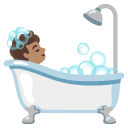


Appearance varies by platform and device. Google Noto, Twemoji, and OpenMoji are open-source.