🚶🏿
The Emoji
Person Walking: Dark Skin Tone
U+1F6B6 U+1F3FF · :person_walking_dark_skin_tone:
Trend 58
Meaning layers
- interpretation
- Used to signal casually leaving a situation, mentally checking out, unbothered energy, or simply being on the move. Often conveys 'I'm out' or 'not my problem anymore' vibes.
- tiktok usage
- Appears in POV videos about leaving toxic situations, walking away from drama, or 'main character' energy montages. Paired with trending audio about moving on.
- irony level
- 4 / 10
Platform meanings
- meaning
- Represents the 'unbothered walk,' leaving drama behind, main character energy, or a literal walk aesthetic video.
- trend usage
- Used in 'walking away from ___' trends, 'hot girl walk' culture references, and POV-style storytelling videos.
- hashtags
- #HotGirlWalk#MainCharacterEnergy#WalkingAway#UnbotheredWalk#SoloWalk
- virality score
- 62 / 100
Cultural meanings
🇺🇸
Western / Gen-Z
Primarily used as 'walking away' energy — symbolizing unbothered confidence and leaving toxic situations. Tied to 'hot girl walk' culture and main character aesthetics.
🇵🇰
Pakistan & India
Used casually to indicate physical movement or commuting. The dark skin tone modifier may be chosen for representation by users with similar complexions, and it's also used in motivational contexts about life's journey.
🌍
Middle East
Generally used to signify movement or travel. The skin tone aspect is less focused upon culturally, though representation matters to younger, more digitally active users.
🌐
Global Neutral
Universally understood as 'person walking' — used cross-culturally to represent movement, travel, or transitioning from one place or state to another.
🇧🇩
Bangladesh
Used in everyday digital communication to indicate walking, commuting, or being in transit. The skin tone resonates with many users who share a similar complexion.
🇱🇰
Sri Lanka
Casually used to indicate someone is walking somewhere or on their way. May also appear in fitness or wellness content among younger users.
🇨🇳
China
Less commonly used than in Western contexts; when used, it typically denotes literal walking or travel. Skin tone diversity features are less culturally emphasized.
🇯🇵
Japan
Used to indicate walking or movement in messages. Skin tone variations are acknowledged but the base emoji concept of movement is the primary focus.
🇰🇷
South Korea
Associated with walking culture, especially leisure walks and 'healing walks' (힐링 산책). The emoji is used in wellness and self-care content by younger Koreans.
🇹🇼
Taiwan
Used casually in conversation to indicate movement. Also appears in health and fitness content related to daily step goals.
🇭🇰
Hong Kong
Common in everyday messaging to indicate commuting or walking in the city. Urban walking culture makes this emoji relatable.
🇵🇭
Philippines
Used frequently in casual chats to show someone is on their way or out walking. Also used humorously to 'walk away' from drama.
🇮🇩
Indonesia
Used in day-to-day messaging for indicating movement or travel. Also embraced in fitness communities and wellness content.
🇹🇭
Thailand
Appears in casual digital communication to indicate walking or being on the move. Also used in tourism and travel-related content.
🇻🇳
Vietnam
Used to signal someone is walking or commuting. In younger communities, it also takes on the 'leaving drama' connotation borrowed from global internet culture.
🇲🇾
Malaysia
Used casually in WhatsApp and Telegram chats to indicate movement. The dark skin tone is relatable to many Malaysian users and is chosen for representation.
🇸🇦
Saudi Arabia
Generally used to indicate physical movement or travel. More conservative interpretation — straightforwardly about walking rather than metaphorical departure.
🇦🇪
UAE
Used in cosmopolitan digital communities to indicate walking or being on the move in a fast-paced city environment. Also embraced for representation.
🇪🇬
Egypt
Used in casual messaging to denote walking or movement. Younger Egyptians also adopt global internet meanings of 'walking away' from situations.
🇹🇷
Turkey
Used in everyday messaging to show movement. Also appears in fitness and outdoor culture content among younger Turkish social media users.
🇮🇷
Iran
Primarily used to indicate walking or travel in digital communication. Less meta-ironic usage compared to Western contexts.
🇳🇬
Nigeria
Highly relatable for representation — the dark skin tone resonates strongly with Nigerian users. Used both literally and in 'walking away from nonsense' cultural expressions.
🇿🇦
South Africa
The dark skin tone carries strong representational significance. Used in everyday communication and also in cultural contexts celebrating Black identity and movement.
🇬🇧
UK & Ireland
Used to indicate walking, commuting, or a casual stroll. The 'walking away' ironic usage is adopted from broader internet culture among younger UK users.
🇫🇷
France
Used casually for movement indication. Among Gen Z French users, the global internet meaning of 'je m'en vais' (I'm leaving) is increasingly applied.
🇩🇪
Germany
Straightforward usage for indicating walking or movement. German digital culture tends toward literal interpretation, though younger users adopt ironic usage.
🇪🇸
Spain & Italy
Used in casual messaging for movement. Also embraced culturally in contexts about walks, evening passeggiatas, and an active Mediterranean lifestyle.
🇧🇷
Brazil
Widely used both literally and figuratively. The 'walking away' meme culture is popular, and the dark skin tone holds important representational value for Afro-Brazilian users.
🇲🇽
Mexico
Used in everyday messaging to indicate movement. Also used ironically by younger users in 'walking away from drama' contexts adopted from global meme culture.
🌎
Latin America
Broadly used across Latin America to indicate walking or travel. Increasingly used in ironic and meme contexts among younger generations connected to global internet culture.
🇦🇺
Australia & NZ
Used in casual everyday chats to indicate walking or being outdoors. The 'hot girl walk' and 'unbothered' usage trends from the US are adopted by younger Australian and NZ users.
How its meaning shifted
- 2010
The base walking emoji didn't exist yet; Unicode diversity modifiers were not yet introduced. Generic human activity emojis were limited.
- 2015
Introduced as part of Unicode 8.0 skin tone diversity expansion. Used almost exclusively for literal walking or movement representation.
- 2020
Gained ironic and meme usage as internet culture evolved. 'Walking away' and 'unbothered' interpretations emerged alongside the 'hot girl walk' trend.
- 2026
Fully embedded in digital communication as both a literal movement emoji and a cultural symbol of unbothered energy, self-care walks, and graceful exits from drama or toxic situations.
See it on every platform
Adjacent emojis
Share & embed
Frequently asked
01What does the 🚶🏿 Person Walking: Dark Skin Tone emoji mean?
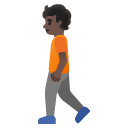
A person walking shown in profile view with dark skin tone modifier applied. Depicts a human figure in motion, mid-stride.
02What does 🚶🏿 mean on TikTok?
Represents the 'unbothered walk,' leaving drama behind, main character energy, or a literal walk aesthetic video.
03What does 🚶🏿 mean on WhatsApp?
Signals leaving a conversation, going for a walk, or physically heading somewhere. Common in casual check-ins like 'on my way 🚶🏿'.
04What does 🚶🏿 mean in Gen-Z slang?
Used to signal casually leaving a situation, mentally checking out, unbothered energy, or simply being on the move. Often conveys 'I'm out' or 'not my problem anymore' vibes.
05Is the 🚶🏿 emoji safe to use?
A person walking — used to indicate movement, travel, exercise, or an emotional metaphor for moving forward in life.
06What does 🚶🏿 mean in texting?
Walking symbolizes forward motion and agency. The dark skin tone adds a layer of cultural identity and representation, making it emotionally significant for users who identify with the tone. Psychologically conveys autonomy and self-direction.
07What is the shortcode for 🚶🏿?
The shortcode for Person Walking: Dark Skin Tone is :person_walking_dark_skin_tone:
08What does 🚶🏿 mean in dating?
Rarely used flirtatiously; may suggest 'let's take a walk together' or hint at wanting a casual date like a stroll. Sometimes used as a subtle 'walking away' threat in playful banter.
Safety & usage
- Safe meaning
- A person walking — used to indicate movement, travel, exercise, or an emotional metaphor for moving forward in life.
- Caution
- Rarely used toxically; in very limited contexts could be used to dismiss someone ('just walk away') in a condescending manner.
No significant safety concerns. The dark skin tone modifier is important for representation and should be respected as an identity choice, not mocked.
How it looks across platforms


Appearance varies by platform and device. Google Noto, Twemoji, and OpenMoji are open-source.