🤴🏾
The Emoji
Prince: Medium-dark Skin Tone
U+1F934 U+1F3FE · :prince_mediumdark_skin_tone:
Trend 58
Meaning layers
- interpretation
- Used to describe someone who acts privileged, pampered, or expects to be treated like royalty. Also used genuinely to hype up someone considered attractive or admirable.
- tiktok usage
- Appears in 'main character' energy videos, outfit checks, and hypeman comments. Often used when someone is glowing up or acting unbothered.
- irony level
- 5 / 10
Platform meanings
- meaning
- Represents main character energy, elevated status, or genuine admiration for someone's look or confidence.
- trend usage
- Used in outfit-of-the-day videos, glow-up reveals, and 'royalty treatment' trend sounds where creators show how they expect to be treated.
- hashtags
- #PrinceVibes#RoyaltyCheck#BlackRoyalty#GlowUp#MainCharacter
- virality score
- 62 / 100
Cultural meanings
🇺🇸
Western / Gen-Z
Used to celebrate Black excellence and representation, or ironically to call out entitled men acting too good for everyone.
🇵🇰
Pakistan & India
May represent a prince from historical or Bollywood contexts; used to compliment a stylish or well-dressed man, though the medium-dark skin tone adds a layer of specific ethnic pride.
🌍
Middle East
Carries strong resonance given the region's actual monarchical traditions; used genuinely to compliment young men of royal bearing or family lineage.
🌐
Global Neutral
Universally understood as a symbol of royalty or elevated status for a young male, with the skin tone signal of representation for darker-skinned communities.
🇧🇩
Bangladesh
Used to call a young man regal or special, particularly in celebratory contexts like weddings or achievements; the skin tone feels locally relevant and affirming.
🇱🇰
Sri Lanka
Associated with complimenting a stylish or accomplished young man; carries connotations of cultural pride and masculine respect.
🇨🇳
China
Less commonly used due to different monarchical references; when used, it generally signals admiration for someone with an elevated or refined status.
🇯🇵
Japan
Understood as a Western royalty reference; used occasionally in fashion or aesthetic contexts to denote a regal, princely look or attitude.
🇰🇷
South Korea
Popular in K-celebrity fandoms to describe idol members who carry a regal or prince-like visual aesthetic, especially those with darker complexions.
🇹🇼
Taiwan
Used similarly to South Korea — occasionally in idol fan contexts or to compliment someone's regal appearance and poise.
🇭🇰
Hong Kong
Carries a mix of Western royalty reference and ironic use; may appear in fashion commentary or to call someone overly princely or pampered.
🇵🇭
Philippines
Used to celebrate a man who looks or acts like royalty, with the darker skin tone resonating positively in communities embracing melanin pride.
🇮🇩
Indonesia
Used in complimenting contexts for young men with an air of elegance or achievement; the skin tone variant reflects growing appreciation for diverse representation.
🇹🇭
Thailand
Generally understood as a royalty reference; used carefully given cultural sensitivities around the monarchy, more commonly in casual fashion or entertainment contexts.
🇻🇳
Vietnam
Used to compliment a well-dressed or accomplished young man; carries a lighthearted, admiring tone in everyday social media use.
🇲🇾
Malaysia
Resonates strongly given Malaysia's own royal sultanate system; used to genuinely or playfully call someone princely, with the dark skin tone reflecting Malay complexion pride.
🇸🇦
Saudi Arabia
Highly relevant given the kingdom's culture of actual princes; used both sincerely to address young royals and culturally to express admiration for men with regal bearing.
🇦🇪
UAE
Used in a context where real royalty is common; can be a genuine reference or a social compliment toward a man of elevated status or impressive appearance.
🇪🇬
Egypt
Associated with pharaonic pride and ancient royalty; used to compliment a man's bearing or style, with the darker skin tone aligning with Nubian and Upper Egyptian identity pride.
🇹🇷
Turkey
Used to call a young man charming or dapper, occasionally with an Ottoman royal connotation in historical or cultural discussions.
🇮🇷
Iran
References Persian royal heritage; used to compliment a man's elegance, though political sensitivities around monarchy mean it's used more in diaspora contexts.
🇳🇬
Nigeria
Strongly embraced as a symbol of Black royalty and Yoruba/Igbo/Hausa royal lineage pride; widely used to celebrate accomplished or stylish young Nigerian men.
🇿🇦
South Africa
Connected to Zulu, Xhosa, and other royal lineage traditions; the medium-dark skin tone makes it especially resonant for celebrating Black South African men.
🇬🇧
UK & Ireland
Used both genuinely in reference to British royal family discourse and ironically/sarcastically when someone is acting overly posh or entitled.
🇫🇷
France
Occasionally used in fashion and culture contexts; may carry a slight ironic tone given France's republican identity, but used genuinely in Afro-French community celebrations.
🇩🇪
Germany
Primarily used in admiration or fashion contexts; the specific skin tone modifier is especially meaningful in Afro-German communities celebrating cultural visibility.
🇪🇸
Spain & Italy
Used to compliment a stylish or regal-looking man; resonates in Afro-European communities and among fashion-forward younger audiences.
🇧🇷
Brazil
Widely used in Afro-Brazilian cultural spaces to celebrate Black excellence and Yoruba heritage; strongly positive and celebratory in tone.
🇲🇽
Mexico
Used generally to compliment a man who looks sharp or carries himself with confidence; the skin tone resonates with Afro-Mexican and Indigenous Mexican representation.
🌎
Latin America
Embraced across Latin America in Afro-Latino communities as a symbol of pride and representation; used to honor stylish, accomplished, or culturally proud men.
🇦🇺
Australia & NZ
Used in hype and compliment contexts; particularly meaningful in First Nations, Pacific Islander, and Afro-Australian communities celebrating dark-skinned men.
How its meaning shifted
- 2010
Emoji did not exist yet; the concept was not yet part of Unicode's emoji vocabulary.
- 2015
Introduced with skin tone modifiers in Unicode 8.0; primarily used in literal royal or fairy-tale contexts with limited mainstream adoption.
- 2020
Gained significant traction during the Black Lives Matter movement and Black excellence cultural moment; used heavily to celebrate and affirm Black men.
- 2026
Fully established in Gen Z vocabulary for both sincere praise of stylish or accomplished men and ironic shade toward entitled behavior; deeply embedded in Afrocentric digital culture.
See it on every platform
Compare with
Adjacent emojis
- Often confused with
- man wearing turbanguardman with crown
Share & embed
Frequently asked
01What does the 🤴🏾 Prince: Medium-dark Skin Tone emoji mean?
A prince wearing a crown, depicted with medium-dark skin tone. Represents royalty, nobility, and regal status.
02What does 🤴🏾 mean on TikTok?
Represents main character energy, elevated status, or genuine admiration for someone's look or confidence.
03What does 🤴🏾 mean on WhatsApp?
Sent to hype up a friend, call someone regal, or playfully tease someone acting privileged.
04What does 🤴🏾 mean in Gen-Z slang?
Used to describe someone who acts privileged, pampered, or expects to be treated like royalty. Also used genuinely to hype up someone considered attractive or admirable.
05Is the 🤴🏾 emoji safe to use?
A positive symbol of royalty, cultural pride, and admiration for a young man's style or achievements.
06What does 🤴🏾 mean in texting?
Evokes feelings of elevated self-worth and social status. The medium-dark skin tone adds cultural representation significance, making it emotionally resonant for users who identify with that complexion.
07What is the shortcode for 🤴🏾?
The shortcode for Prince: Medium-dark Skin Tone is :prince_mediumdark_skin_tone:
08What does 🤴🏾 mean in dating?
Sent to compliment someone as 'royalty-tier' attractive or to signal they deserve to be treated like a prince. A soft, playful flirt move.
Safety & usage
- Safe meaning
- A positive symbol of royalty, cultural pride, and admiration for a young man's style or achievements.
- Caution
- Can be used sarcastically to mock entitled or arrogant men, or in rare cases deployed dismissively toward someone seen as 'acting above their station.'
Generally safe. The skin tone modifier means it carries cultural identity weight — using it carelessly in racially charged contexts could be seen as appropriative or dismissive. Otherwise low risk.
How it looks across platforms
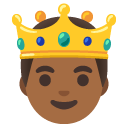


Appearance varies by platform and device. Google Noto, Twemoji, and OpenMoji are open-source.