🫡
The Emoji
Saluting Face
U+1FAE1 · :saluting_face:
Trend 85
Meaning layers
- interpretation
- Used ironically to mean 'yes sir,' 'understood,' 'I will comply,' or as a sarcastic way of acknowledging an unreasonable demand or absurd situation.
- tiktok usage
- Frequently appears in comment sections when creators post strict rules or when someone calls out bad behavior — used to mock compliance or signal solidarity with a cause sarcastically.
- irony level
- 7 / 10
Platform meanings
- meaning
- Ironic acknowledgment of a statement, used to mock authority, agree sarcastically, or show respect for a brutal truth.
- trend usage
- Appears in comment sections under videos that call out behavior, announce dramatic decisions, or make self-deprecating admissions — the salute signals 'I felt that.'
- hashtags
- #salute#yessir#foryou#understood#respectfully
- virality score
- 88 / 100
Cultural meanings
🇺🇸
Western / Gen-Z
The defining ironic emoji of the 2020s — used to mock compliance, signal 'understood' sarcastically, and acknowledge impossible or absurd demands with dark humor.
🇵🇰
Pakistan & India
Used sincerely to show respect to elders, teachers, or authority figures online; also used in cricket-related posts to salute national team performances.
🌍
Middle East
Carries genuine connotations of respect and military honor, especially in contexts involving national pride, armed forces, or responding to leaders.
🌐
Global Neutral
Universally understood as a salute gesture representing acknowledgment, respect, or compliance — one of the more cross-culturally legible emoji.
🇧🇩
Bangladesh
Used to express respect toward teachers and elders in digital communication, and appears in patriotic contexts around Liberation War remembrances.
🇱🇰
Sri Lanka
Used sincerely in professional and educational contexts to signal respect; also appears in cricket fan posts when saluting national sporting heroes.
🇨🇳
China
Relatively less common due to military salute associations with political imagery; where used, it signals discipline, respect, or gaming acknowledgment.
🇯🇵
Japan
Interpreted as a gesture of formal respect and discipline, aligning with Japanese values of hierarchy and politeness; used earnestly in most contexts.
🇰🇷
South Korea
Popular in online gaming communities and K-pop fan spaces to show respect to idols, players, or creators who delivered exceptional performances.
🇹🇼
Taiwan
Used in gaming, sports fan communities, and among youth to signal respect or 'I acknowledge this' — carries less political weight than in mainland China.
🇭🇰
Hong Kong
Used in online communities to signal solidarity, acknowledgment of bravery, or respect — carries emotional weight given recent socio-political context.
🇵🇭
Philippines
Widely used to express admiration and respect, especially in OFW (overseas worker) communities and military family pages to honor service and sacrifice.
🇮🇩
Indonesia
Used both sincerely (to salute national heroes or military) and humorously among youth to mock strict social media rules or acknowledge savage burns.
🇹🇭
Thailand
Associated with military respect given Thailand's significant armed forces culture; also used humorously among Gen Z in response to dramatic social media moments.
🇻🇳
Vietnam
Carries patriotic weight linked to military history; used sincerely in National Day and veterans' contexts, but also adopted by youth for ironic online humor.
🇲🇾
Malaysia
Used across demographics — sincerely for respect toward teachers and elders, and ironically by younger Malaysians in meme culture to say 'yes boss.'
🇸🇦
Saudi Arabia
Used to show respect toward leadership, religious figures, or military personnel; appears in national day posts and patriotic content.
🇦🇪
UAE
Appears frequently around UAE National Day and Armed Forces celebrations; also used professionally to acknowledge leadership or directives.
🇪🇬
Egypt
Used sincerely to honor military figures and national heroes, reflecting Egypt's strong culture of military respect; also adopted in youth meme culture.
🇹🇷
Turkey
Carries strong patriotic and military connotations tied to Atatürk's legacy and national pride; used sincerely in commemorative and nationalistic posts.
🇮🇷
Iran
Used cautiously online — can signal respect in neutral contexts but is avoided in politically sensitive situations due to associations with state military imagery.
🇳🇬
Nigeria
Used to show hype and admiration — when someone 'speaks facts' or does something impressive, Nigerians drop 🫡 to signal maximum respect.
🇿🇦
South Africa
Used to salute someone who tells hard truths or stands their ground — carries a 'respect, you didn't have to say that but you did' energy.
🇬🇧
UK & Ireland
Used heavily in ironic and sarcastic contexts — 'yes sir 🫡' is a staple reply to ridiculous demands or tone-deaf announcements from public figures.
🇫🇷
France
Used more sparingly but understood as a gesture of ironic compliance or genuine respect — appears in sports fan communities and political commentary.
🇩🇪
Germany
Interpreted straightforwardly as a gesture of acknowledgment or respect; used in professional online contexts and gaming communities without heavy irony.
🇪🇸
Spain & Italy
Used expressively to salute a friend's bold move, impressive roast, or stylish action — carries more warmth and admiration than irony in these cultures.
🇧🇷
Brazil
Used in gaming, football fan culture, and meme communities to salute impressive plays or devastating clapbacks — very high usage in Brazilian Twitter/X.
🇲🇽
Mexico
Appears in football and lucha libre communities to honor legendary performances; also used ironically in response to absurd government or authority statements.
🌎
Latin America
Broadly used across Latin American countries to show admiration and respect in sports, music, and political commentary — sincere usage outweighs ironic use.
🇦🇺
Australia & NZ
Used with classic dry humor to mock compliance or acknowledge a mate's ridiculous request — fits naturally into Aussie and Kiwi self-deprecating banter culture.
How its meaning shifted
- 2010
Did not exist — Unicode 14.0 was not yet released; salute gestures were conveyed through text like 'o7' in gaming communities.
- 2015
Still nonexistent as an official emoji; 'o7' remained the dominant digital salute shorthand in gaming and military online communities.
- 2020
Emoji was proposed and in development; communities still relied on 'o7', 🙏, or ✊ to convey similar sentiments of respect and acknowledgment.
- 2026
One of the most versatile and heavily used emoji of the mid-2020s — simultaneously sincere and ironic, embedded in Gen Z communication as a cultural cornerstone.
See it on every platform
Emoji combinations
Adjacent emojis
- Often confused with
- waving handraised back of handfolded hands
Share & embed
Frequently asked
01What does the 🫡 Saluting Face emoji mean?
A yellow face with a single hand raised to the forehead in a military-style salute, often with a slight smile or neutral expression.
02What does 🫡 mean on TikTok?
Ironic acknowledgment of a statement, used to mock authority, agree sarcastically, or show respect for a brutal truth.
03What does 🫡 mean on WhatsApp?
Used to say 'got it,' 'understood,' or 'on my way' in group chats or one-on-one messages, sometimes genuinely and sometimes sarcastically.
04What does 🫡 mean in Gen-Z slang?
Used ironically to mean 'yes sir,' 'understood,' 'I will comply,' or as a sarcastic way of acknowledging an unreasonable demand or absurd situation.
05Is the 🫡 emoji safe to use?
A respectful salute gesture used to acknowledge, honor, or comply — entirely safe in most contexts.
06What does 🫡 mean in texting?
The salute gesture taps into hierarchical social dynamics — it can genuinely convey admiration and loyalty, but Gen Z has recontextualized it as a coping mechanism for dealing with authority or absurd demands, signaling awareness of power imbalance with humor.
07What is the shortcode for 🫡?
The shortcode for Saluting Face is :saluting_face:
08What does 🫡 mean in dating?
Can be used flirtatiously to say 'as you wish' or 'your wish is my command,' implying playful subservience to a crush.
Safety & usage
- Safe meaning
- A respectful salute gesture used to acknowledge, honor, or comply — entirely safe in most contexts.
- Caution
- Rarely weaponized, but can be used passive-aggressively in arguments to mock someone's authority or dismiss their statement sarcastically.
In some political contexts, a salute gesture can carry unintended associations with authoritarian or nationalist imagery — context and platform matter.
How it looks across platforms
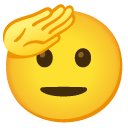


Appearance varies by platform and device. Google Noto, Twemoji, and OpenMoji are open-source.