🤘🏾
The Emoji
Sign Of The Horns: Medium-dark Skin Tone
U+1F918 U+1F3FE · :sign_of_the_horns_mediumdark_skin_tone:
Trend 74
Meaning layers
- interpretation
- Used broadly as a hype gesture signaling coolness, excitement, or rock-energy vibes. Gen Z also deploys it casually to say 'that's fire,' 'let's go,' or to express unbothered energy. The skin tone variant is celebrated as inclusive representation in digital spaces.
- tiktok usage
- Appears in hype comments, reaction videos, concert clips, and music-related content. Often paired with fire or skull emojis to amplify excitement or hyperbolic praise.
- irony level
- 3 / 10
Platform meanings
- meaning
- Hype signal used to show something is hard, cool, or fire. Common in music, gym, and gaming content.
- trend usage
- Placed in video captions and comment sections to cheer on creators or endorse bold content. Seen in concert POVs, metal edits, and lifestyle flexes.
- hashtags
- #rockvibes#metalhead#hyped#letsgoo#concert
- virality score
- 72 / 100
Cultural meanings
🇺🇸
Western / Gen-Z
Universally understood as a rock or hype gesture with no significant negative connotations; widely used across music, sports, and lifestyle content. The medium-dark skin tone is appreciated as inclusive representation.
🇵🇰
Pakistan & India
Increasingly recognized among urban youth as a rock or cool gesture due to global music and social media exposure, though older generations may associate it with evil eye protection (similar to the Hamsa gesture) or find it confusing.
🌍
Middle East
The horns gesture can be interpreted as the evil eye (nazar) ward in some contexts, but among younger social media users it is understood as the global rock symbol. Caution is advised in conservative religious contexts.
🌐
Global Neutral
Broadly recognized as a symbol of excitement, rock culture, or hype across most globally connected audiences, especially those exposed to Western music and social media.
🇧🇩
Bangladesh
Limited traditional recognition; urban, educated youth familiar with global music culture understand it as a rock or cool gesture, while older populations may be unfamiliar or associate it with superstition.
🇱🇰
Sri Lanka
Similar to South Asian neighbors, younger generations interpret it through a rock and pop culture lens, while rural or older communities may not recognize it or may associate it with superstitious gestures.
🇨🇳
China
Recognized by younger, globally connected users as a rock or cool gesture but not deeply embedded in local digital culture. Some may confuse it with the 'six' hand sign (shaka-adjacent) used in Taiwanese and Chinese social media.
🇯🇵
Japan
Understood among music fans and youth culture as a rock gesture tied to heavy metal and Western music scenes. Japan has a strong metal fanbase so the gesture is culturally familiar in those circles.
🇰🇷
South Korea
Recognized among K-pop and rock fans as a Western cool gesture. Occasionally adopted in K-metal and K-rock communities as a genre identifier, though it is less universal than heart gestures in mainstream K-pop culture.
🇹🇼
Taiwan
Known among music-literate youth as a rock symbol; occasionally blended with local internet culture in meme contexts. Generally positive connotation among younger audiences.
🇭🇰
Hong Kong
Understood by younger, globally connected residents as a rock or hype gesture. Appears in concert and music content on local social media without significant negative connotation.
🇵🇭
Philippines
Widely recognized due to the Philippines' strong rock and metal music culture. Used enthusiastically in social media posts related to concerts, bands, and OPM (Original Pilipino Music) scenes.
🇮🇩
Indonesia
Growing recognition among urban youth due to a thriving local metal scene. Used in social media among music fans, though some conservative communities may view any finger gesture with caution.
🇹🇭
Thailand
Recognized among music-savvy youth as a rock gesture. Thailand has a notable metal and rock scene so this emoji carries positive energy in those communities.
🇻🇳
Vietnam
Used by younger, urban social media users familiar with Western music. Limited older-generation recognition; generally positive among youth.
🇲🇾
Malaysia
Understood in urban, multicultural social media spaces as a rock or cool gesture. May carry different connotations in conservative Malay-Muslim communities where unusual hand gestures can be scrutinized.
🇸🇦
Saudi Arabia
Limited recognition outside of music-savvy youth. The gesture has no specific local equivalent and could be misread in traditional contexts; however, younger Saudis familiar with global music culture use it freely online.
🇦🇪
UAE
In the cosmopolitan, multicultural UAE social media environment, it is broadly understood as a rock or hype gesture, especially among expat communities and globally connected Emirati youth.
🇪🇬
Egypt
Recognized by Egyptian youth immersed in global social media and music culture. Some older or conservative populations might misinterpret it; however, Egypt's vibrant youth scene uses it casually.
🇹🇷
Turkey
Well understood among Turkish youth, especially in urban areas with a strong rock and metal music tradition. Turkey has a significant metal fanbase, making this emoji culturally resonant in those communities.
🇮🇷
Iran
Known among younger, internet-savvy Iranians who follow global music and culture. The gesture does not have a specific Iranian negative connotation, but broader social media restrictions limit its open cultural proliferation.
🇳🇬
Nigeria
Increasingly recognized among Nigerian youth via Afrobeats crossover with global culture and social media. Used to express hype and energy in music and lifestyle content, sometimes blending with Afrobeats pride.
🇿🇦
South Africa
Well recognized across South Africa's diverse youth culture, particularly in urban areas with strong local rock, metal, and hip-hop scenes. Used casually to express excitement and cool energy.
🇬🇧
UK & Ireland
Deeply familiar from decades of British rock and metal history. Used enthusiastically in music fan communities and casually in everyday hype expressions by younger generations.
🇫🇷
France
Recognized by music fans and youth culture as a rock gesture. France has a notable metal scene, so it resonates in those circles, while mainstream usage trends more casual and ironic.
🇩🇪
Germany
Strongly resonant in Germany given the country's world-renowned metal and rock culture (Wacken, Rammstein etc.). Widely used and enthusiastically received in music communities and beyond.
🇪🇸
Spain & Italy
Carries a nuance in parts of Southern Europe where the 'cornuto' gesture (horns) traditionally means cuckold or insult. Younger, globally connected users understand the rock meaning, but the dual interpretation creates occasional cultural confusion.
🇧🇷
Brazil
Brazil has a massive metal and rock fanbase (São Paulo is often cited as a top global metal city), so this emoji is enthusiastically used and widely understood as a positive hype and rock symbol.
🇲🇽
Mexico
Recognized in music communities and among youth; also note that 'cuernos' (horns) in Mexican slang can mean infidelity, creating some contextual dual meanings similar to Southern Europe. Music fans use it unambiguously for rock.
🌎
Latin America
Broadly used across Latin America in music, sports, and youth culture to signal excitement. The 'cuernos' infidelity association exists in parts of the region but is often overridden by global rock culture awareness online.
🇦🇺
Australia & NZ
Widely recognized and used without complication as a rock, hype, or cool gesture. Australia and New Zealand have strong rock and metal cultures, making this emoji a natural fit for music and lifestyle content.
How its meaning shifted
- 2010
Primarily used in rock and metal fan communities online, closely tied to the legacy of Ronnie James Dio and heavy metal culture. Skin tone variants did not yet exist; usage was niche and genre-specific.
- 2015
Expanded beyond metal fans into broader music and sports contexts as emoji culture grew. Still strongly associated with rock identity but beginning to appear in hip-hop and general hype contexts. Skin tone modifiers introduced in 2015 allowing for inclusive representation.
- 2020
Fully mainstream as a hype gesture across multiple subcultures including gaming, fitness, hip-hop, and general internet culture. TikTok amplified its reach significantly. Medium-dark skin tone variant gaining visibility in diversity-conscious social media usage.
- 2026
A universally understood hype and energy emoji that transcends any single subculture. Used ironically, earnestly, and decoratively across all platforms. The skin tone variants are normalized and celebrated as part of everyday inclusive digital expression.
See it on every platform
Adjacent emojis
- Opposite
- folded handswaveok hand
- Often confused with
- sign of the hornslove you gesturecall me hand
- Can replace
- fireraised fistflexed biceps
Share & embed
Frequently asked
01What does the 🤘🏾 Sign Of The Horns: Medium-dark Skin Tone emoji mean?
The Sign of the Horns gesture with a medium-dark skin tone modifier, depicting a hand with the index and pinky fingers raised while the middle and ring fingers are held down by the thumb.
02What does 🤘🏾 mean on TikTok?
Hype signal used to show something is hard, cool, or fire. Common in music, gym, and gaming content.
03What does 🤘🏾 mean on WhatsApp?
Sent to express excitement, agreement, or hype in a group or personal chat. Equivalent to saying 'let's go' or 'that's sick.'
04What does 🤘🏾 mean in Gen-Z slang?
Used broadly as a hype gesture signaling coolness, excitement, or rock-energy vibes. Gen Z also deploys it casually to say 'that's fire,' 'let's go,' or to express unbothered energy. The skin tone variant is celebrated as inclusive representation in digital spaces.
05Is the 🤘🏾 emoji safe to use?
Rock on gesture expressing excitement, hype, solidarity in music or general enthusiastic contexts.
06What does 🤘🏾 mean in texting?
This gesture activates feelings of belonging and tribal identity, particularly within music subcultures. The raised-horns signal communicates high arousal positive emotion and a shared 'us vs. them' mentality that fosters community bonding.
07What is the shortcode for 🤘🏾?
The shortcode for Sign Of The Horns: Medium-dark Skin Tone is :sign_of_the_horns_mediumdark_skin_tone:
08What does 🤘🏾 mean in dating?
Used to signal a edgy, cool, or adventurous personality. Often sent when sharing music taste or concert plans as a soft flirtatious personality reveal.
Safety & usage
- Safe meaning
- Rock on gesture expressing excitement, hype, solidarity in music or general enthusiastic contexts.
- Caution
- In some cultural contexts (particularly Southern Europe and Latin America) the horns gesture directed at a person implies they are being cheated on (cuckold insult). Rarely weaponized online but theoretically possible.
Be mindful of the dual cultural interpretation in Southern European and Latin American contexts where the gesture can be read as a 'cuckold' insult. In some religious or conservative Middle Eastern and South Asian communities, it may be read as a symbol associated with evil or the devil. Always consider audience cultural context.
How it looks across platforms
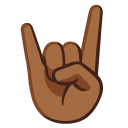


Appearance varies by platform and device. Google Noto, Twemoji, and OpenMoji are open-source.