👫🏿
The Emoji
Woman And Man Holding Hands: Dark Skin Tone
U+1F46B U+1F3FF · :woman_and_man_holding_hands_dark_skin_tone:
Trend 55
Meaning layers
- interpretation
- Used to signal being in a relationship, going on a date, or celebrating Black love and dark-skinned couples. Sometimes used ironically to mock 'couple goals' culture or heteronormativity.
- tiktok usage
- Appears in 'Black couple aesthetic' videos, relationship check-in trends, and 'day in my life' content featuring dark-skinned couples.
- irony level
- 2 / 10
Platform meanings
- meaning
- Represents Black or dark-skinned couples; used in romantic storytelling, couple challenge videos, and cultural pride content.
- trend usage
- Appears in couple POV trends, 'my partner and I' storytelling formats, and melanin celebration hashtag challenges.
- hashtags
- #BlackLove#CoupleGoals#DarkSkinned#MelaninCouple#RelationshipTok
- virality score
- 62 / 100
Cultural meanings
🇺🇸
Western / Gen-Z
Celebrated as a symbol of Black love and representation; Gen Z in Western countries use it specifically to affirm dark-skinned couples and push back against colorism.
🇵🇰
Pakistan & India
Less commonly used with cultural awareness of skin tone modifiers; may simply be read as a generic couple emoji, though younger urban users increasingly appreciate the representation nuance.
🌍
Middle East
Public display of romantic couplehood is culturally sensitive in many Middle Eastern contexts, so this emoji is used cautiously in private chats; the dark skin tone may be noted but not the primary focus.
🌐
Global Neutral
Universally readable as a heterosexual couple holding hands; the dark skin tone is seen as a representation marker for people of African, South Asian, or darker-complexioned backgrounds.
🇧🇩
Bangladesh
Generally interpreted as a romantic couple emoji without strong awareness of the skin tone modifier's cultural significance; used occasionally in private messaging.
🇱🇰
Sri Lanka
Used in personal messaging contexts to represent couples; the dark skin tone resonates with many Sri Lankans who identify with darker complexions and may use it for self-representation.
🇨🇳
China
Emoji culture in China favors platform-specific stickers over Unicode emojis; this emoji is relatively rare and may be read as a foreign couple symbol without deep cultural interpretation.
🇯🇵
Japan
Japan has strong emoji culture but favors stylized kawaii versions; this emoji is understood as a 'couple' symbol but the skin tone modifier receives less cultural emphasis compared to Western contexts.
🇰🇷
South Korea
Couple culture is prominent in South Korea; this emoji is used to signal romantic relationships, though the dark skin tone modifier carries less local cultural weight than in African or Western Black communities.
🇹🇼
Taiwan
Read straightforwardly as a romantic couple emoji; skin tone diversity awareness is growing among younger Taiwanese users who engage with global social media culture.
🇭🇰
Hong Kong
Used in casual couple contexts; awareness of skin tone modifier significance is more prominent among Hong Kong youth connected to international social media.
🇵🇭
Philippines
Widely used to represent couples; darker skin tones are common among Filipinos, and some users may consciously choose this modifier for self-representation, though colorism remains a complex cultural issue.
🇮🇩
Indonesia
Used to represent romantic partnerships; skin tone awareness in emoji selection is growing but still less prominent than in Western contexts, with many users selecting emojis casually.
🇹🇭
Thailand
Primarily read as a couple emoji; skin tone consciousness is emerging among Thai youth on international platforms, though local beauty standards historically favor lighter skin.
🇻🇳
Vietnam
Used to denote romantic couples in messaging; the skin tone modifier is rarely a deliberate cultural statement and is more often chosen for fun or casual use.
🇲🇾
Malaysia
Malaysia's diverse population means this emoji can resonate with Malay, Indian, and Orang Asli communities; dark skin tone modifiers are sometimes used for representation in multicultural contexts.
🇸🇦
Saudi Arabia
Public romantic imagery is culturally restricted; this emoji appears mostly in private chats between married or engaged couples. The dark skin tone may reflect the diverse South Asian and African expat population.
🇦🇪
UAE
Used by the UAE's diverse expat community — particularly South Asian, African, and Arab users — to represent themselves in couple contexts; the dark skin tone is relevant to a large portion of the population.
🇪🇬
Egypt
Used in casual romantic messaging; Egyptians with darker complexions may relate to this emoji, though skin tone modifier awareness is still developing in mainstream emoji culture.
🇹🇷
Turkey
Read as a couple emoji in romantic messaging; the dark skin tone modifier does not carry strong local cultural significance but is increasingly understood in the context of global representation discussions.
🇮🇷
Iran
Used cautiously in private romantic communication; the emoji is understood as a couple symbol, with the skin tone modifier carrying minimal specific cultural connotation in mainstream Iranian digital culture.
🇳🇬
Nigeria
Strongly resonates as a symbol of Black Nigerian love and pride; widely used in couple content, relationship announcements, and Afrobeats-adjacent cultural spaces.
🇿🇦
South Africa
Celebrated in the context of Black love and post-apartheid cultural pride; the dark skin tone modifier is meaningful and intentionally used by many South African couples to affirm their identity.
🇬🇧
UK & Ireland
Used by Black British and Irish communities to represent dark-skinned couples; broader Gen Z culture recognizes the representation significance and uses it in solidarity contexts.
🇫🇷
France
Used in couple contexts across France's diverse communities; particularly resonant among Afro-French communities who appreciate seeing darker skin tones represented in everyday digital communication.
🇩🇪
Germany
Used by couples of diverse backgrounds; Afro-German communities and international students use it with awareness of its representational value, while mainstream use remains casual.
🇪🇸
Spain & Italy
Used broadly as a couple emoji; communities of African and Latin descent in Spain and Italy may use it for self-representation, though skin tone modifier culture is less developed than in Anglophone countries.
🇧🇷
Brazil
Highly relevant given Brazil's large Afro-Brazilian population; used to celebrate Black love, afro-Brazilian culture, and identity, often in conjunction with Afrocentric cultural content.
🇲🇽
Mexico
Used in romantic messaging; Mexican users with darker Indigenous or Afro-Mexican heritage may connect with the dark skin tone modifier as a form of representation.
🌎
Latin America
Across Latin America, where colorism is a persistent issue, this emoji is increasingly used by Afro-Latino communities to affirm dark-skinned beauty and romantic identity.
🇦🇺
Australia & NZ
Used by Aboriginal, Torres Strait Islander, Māori, Pacific Islander, and Afro-Australian communities as a representation tool; broader Gen Z culture in ANZ recognizes its inclusive significance.
How its meaning shifted
- 2010
Skin tone modifiers did not yet exist in Unicode; only a single default yellow couple emoji existed, making dark-skinned couple representation absent from digital communication.
- 2015
Unicode 8.0 introduced skin tone modifiers, making 👫🏿 possible; early adoption was limited and awareness of its existence was low outside of tech-savvy communities.
- 2020
Significant growth in usage driven by the Black Lives Matter movement, broader representation conversations, and social media platforms fully rendering skin tone emojis consistently. Black couple content creators popularized its use.
- 2026
Mainstream usage among dark-skinned couples and their communities; recognized globally as a deliberate representation choice. Increasingly included in brand campaigns, inclusive media, and digital literacy discussions about emoji equity.
See it on every platform
Compare with
Adjacent emojis
- Often confused with
- people hugginghandshakewoman and man holding hands
- Can replace
- red heartcouple with heartkiss woman man
Share & embed
Frequently asked
01What does the 👫🏿 Woman And Man Holding Hands: Dark Skin Tone emoji mean?
Depicts a woman and a man holding hands, with both figures rendered in dark skin tone. It is part of Unicode's family of couple emojis with skin tone modifiers.
02What does 👫🏿 mean on TikTok?
Represents Black or dark-skinned couples; used in romantic storytelling, couple challenge videos, and cultural pride content.
03What does 👫🏿 mean on WhatsApp?
Indicates being in a relationship or referencing a romantic partner, often placed next to a partner's name in a contact or group chat.
04What does 👫🏿 mean in Gen-Z slang?
Used to signal being in a relationship, going on a date, or celebrating Black love and dark-skinned couples. Sometimes used ironically to mock 'couple goals' culture or heteronormativity.
05Is the 👫🏿 emoji safe to use?
Represents a heterosexual couple holding hands with dark skin tone; used for romance, relationships, cultural pride, and representation.
06What does 👫🏿 mean in texting?
Carries dual emotional weight — romantic attachment and cultural identity affirmation. For many dark-skinned individuals, this emoji provides rare visual representation, amplifying its emotional resonance beyond a generic couple symbol.
07What is the shortcode for 👫🏿?
The shortcode for Woman And Man Holding Hands: Dark Skin Tone is :woman_and_man_holding_hands_dark_skin_tone:
08What does 👫🏿 mean in dating?
Sent to hint at wanting to 'be official' or to signal romantic interest in a partner, especially when referencing shared skin tone identity.
Safety & usage
- Safe meaning
- Represents a heterosexual couple holding hands with dark skin tone; used for romance, relationships, cultural pride, and representation.
- Caution
- Rarely weaponized negatively; could theoretically appear in colorist commentary or be used mockingly in anti-Black contexts, though this is uncommon.
Generally safe and positive. In regions with strict laws around public displays of affection or same-sex relationship visibility, any couple emoji including this one should be used with contextual awareness in public-facing content.
How it looks across platforms
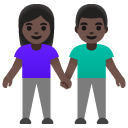


Appearance varies by platform and device. Google Noto, Twemoji, and OpenMoji are open-source.