👩⚕️
The Emoji
Woman Health Worker
U+1F469 U+200D U+2695 U+FE0F · :woman_health_worker:
Trend 65
Meaning layers
- interpretation
- Used to signal self-care, therapy culture, or mental health awareness. Also deployed humorously when someone gives unsolicited advice or 'diagnoses' a situation. Sometimes used to hype up friends studying pre-med.
- tiktok usage
- Appears in 'POV: you're a girl boss doctor' videos, pre-med student content, nursing school struggles, and mental health check-in trends.
- irony level
- 4 / 10
Platform meanings
- meaning
- Represents healthcare workers, pre-med students, nursing school life, and self-care culture. Also used in 'day in my life as a nurse' or doctor content.
- trend usage
- Heavily featured in #NurseLife, #MedTok, #PreMed, and healthcare worker appreciation trends. Also used in mental health awareness content.
- hashtags
- #MedTok#NurseLife#PreMed#HealthcareHero#FutureDoctor
- virality score
- 62 / 100
Cultural meanings
🇺🇸
Western / Gen-Z
Primarily used to celebrate female healthcare workers, signal pre-med or nursing identity, or humorously claim expertise after watching Grey's Anatomy.
🇵🇰
Pakistan & India
Represents the aspiration of becoming a female doctor, a highly prestigious career goal for women; used with great pride and family honor connotations.
🌍
Middle East
Symbolizes the growing presence of women in professional medicine, used respectfully and with national pride as female medical careers expand across the region.
🌐
Global Neutral
Universally recognized as a female healthcare professional symbol, used without cultural friction to represent medical workers and health-related content.
🇧🇩
Bangladesh
Represents the respected profession of female doctors and nurses; used to celebrate women breaking into traditionally male-dominated medical spaces.
🇱🇰
Sri Lanka
Associated with both government hospital nurses and private medical practitioners; used with admiration and respect for women in health services.
🇨🇳
China
Used to represent female doctors and nurses, professions held in high social esteem; frequently appears in health education and public wellness campaigns.
🇯🇵
Japan
Associated with dedicated female medical professionals; also tied to the cultural archetype of the caring, nurturing nurse figure in popular media.
🇰🇷
South Korea
Frequently seen in K-drama fan content involving medical dramas; also used earnestly by nursing and medical students proud of their career path.
🇹🇼
Taiwan
Used in healthcare advocacy and women's professional empowerment contexts; common in public health messaging and medical education content.
🇭🇰
Hong Kong
Associated with frontline healthcare workers who gained immense public respect; used in tributes to hospital staff and health system discussions.
🇵🇭
Philippines
Strongly resonant due to the large Filipino nurse diaspora globally; used with deep national pride and as a symbol of career aspiration and overseas work.
🇮🇩
Indonesia
Represents female health workers respected in both urban hospitals and rural health outreach programs; used in health campaign messaging.
🇹🇭
Thailand
Associated with professional medical care and the Thai healthcare tourism industry; used to signal medical expertise and wellness services.
🇻🇳
Vietnam
Symbolizes dedication and hard work in public health; used in content celebrating female medical professionals and public healthcare initiatives.
🇲🇾
Malaysia
Used across multicultural Malaysian social media to represent female healthcare workers in a broadly inclusive and professional context.
🇸🇦
Saudi Arabia
Increasingly positive connotation as Vision 2030 promotes women's workforce participation; used proudly by Saudi female medical professionals online.
🇦🇪
UAE
Associated with the UAE's world-class healthcare system; used in contexts celebrating female professionals and the country's medical tourism reputation.
🇪🇬
Egypt
Represents female doctors navigating a historically challenging professional landscape; used with admiration and as a symbol of perseverance.
🇹🇷
Turkey
Used to represent female physicians and nurses in a country with a strong tradition of women in medicine; common in health awareness campaigns.
🇮🇷
Iran
Significant symbol given Iran's high percentage of female doctors; used with professional pride and as a marker of educated women's social contribution.
🇳🇬
Nigeria
Used to celebrate female medical professionals in a healthcare sector under strain; carries aspirational weight for young women pursuing medical careers.
🇿🇦
South Africa
Represents frontline healthcare heroes in a complex public health environment; used with deep respect in both professional and community health contexts.
🇬🇧
UK & Ireland
Associated with NHS nurses and doctors; surged in use during COVID-19 clap-for-carers campaigns and remains a symbol of healthcare worker appreciation.
🇫🇷
France
Used in contexts honoring female medical professionals within the French public health system; also appears in healthcare policy and gender equality discussions.
🇩🇪
Germany
Represents the precision and dedication associated with German healthcare; used professionally and in campaigns about women in STEM and medicine.
🇪🇸
Spain & Italy
Used to honor female healthcare workers who were celebrated as heroes during the pandemic; strong positive sentiment in southern European social media.
🇧🇷
Brazil
Associated with the dedicated female professionals within Brazil's SUS public health system; used in appreciation posts and healthcare advocacy content.
🇲🇽
Mexico
Represents female doctors and nurses navigating resource-limited healthcare settings; used with admiration and as a symbol of resilience and community care.
🌎
Latin America
Broadly used across Latin America to celebrate women in healthcare, advocate for better medical conditions, and honor frontline workers across the region.
🇦🇺
Australia & NZ
Strongly associated with nursing and medical workforces celebrated post-COVID; used in appreciation campaigns and by healthcare workers to identify themselves online.
How its meaning shifted
- 2010
The emoji did not yet exist; female medical professionals were represented by the generic stethoscope or red cross symbols if at all.
- 2015
Still pre-release; gender-inclusive profession emojis were being discussed in Unicode proposals as part of a broader push for emoji diversity.
- 2020
Exploded in usage during the COVID-19 pandemic as a primary symbol of healthcare worker appreciation, appearing in tribute posts, news graphics, and viral thank-you campaigns worldwide.
- 2026
Established as a routine professional identity marker for female healthcare workers on LinkedIn and TikTok, also deeply embedded in mental health, self-care, and medical education content culture.
See it on every platform
Compare with
Adjacent emojis
- Often confused with
- woman scientistwoman teacherwoman in tuxedo
- Can replace
- stethoscopehospitalheart with ribbon
Share & embed
Frequently asked
01What does the 👩⚕️ Woman Health Worker emoji mean?
A woman depicted wearing a white lab coat or medical scrubs, often shown with a stethoscope, representing female healthcare professionals including doctors, nurses, dentists, and other medical workers.
02What does 👩⚕️ mean on TikTok?
Represents healthcare workers, pre-med students, nursing school life, and self-care culture. Also used in 'day in my life as a nurse' or doctor content.
03What does 👩⚕️ mean on WhatsApp?
Sent to indicate someone is at a doctor's appointment, is a medical professional, or to acknowledge someone in the healthcare field.
04What does 👩⚕️ mean in Gen-Z slang?
Used to signal self-care, therapy culture, or mental health awareness. Also deployed humorously when someone gives unsolicited advice or 'diagnoses' a situation. Sometimes used to hype up friends studying pre-med.
05Is the 👩⚕️ emoji safe to use?
Represents female healthcare professionals — doctors, nurses, dentists, and medical workers — in a universally positive and professional context.
06What does 👩⚕️ mean in texting?
Evokes feelings of trust, safety, and competence. Represents nurturing authority figures and triggers associations with healing, reliability, and dedication to others' wellbeing.
07What is the shortcode for 👩⚕️?
The shortcode for Woman Health Worker is :woman_health_worker:
08What does 👩⚕️ mean in dating?
Used to compliment a partner who is caring, nurturing, or in the medical field. 'You always know how to fix me 👩⚕️' type energy.
Safety & usage
- Safe meaning
- Represents female healthcare professionals — doctors, nurses, dentists, and medical workers — in a universally positive and professional context.
- Caution
- Rarely misused; could theoretically be used to demean or stereotype women in caregiving roles, though this is uncommon.
Extremely low risk emoji. No known weaponized usage or toxic community adoption. Safe for all audiences and platforms.
How it looks across platforms
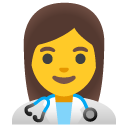
Appearance varies by platform and device. Google Noto, Twemoji, and OpenMoji are open-source.