👩🏻⚖️
The Emoji
Woman Judge: Light Skin Tone
U+1F469 U+1F3FB U+200D U+2696 U+FE0F · :woman_judge_light_skin_tone:
Trend 52
Meaning layers
- interpretation
- Used to signal judgment, calling someone out, delivering verdicts on situations, or positioning oneself as the authority on a topic. Also used ironically when someone acts like they have moral high ground.
- tiktok usage
- Appears in 'unpopular opinion' videos, hot takes, and 'let me be the judge of that' trends. Often placed at the start of a callout caption.
- irony level
- 6 / 10
Platform meanings
- meaning
- Represents someone delivering a verdict, calling someone out, or establishing themselves as an authority figure in a situation.
- trend usage
- Used in hot take videos, opinion pieces, and 'let the record show' content. Paired with trending sounds of gavels or courtroom scenes.
- hashtags
- #JudgeMe#CourtIsInSession#HotTake#Verdict#GirlBoss
- virality score
- 58 / 100
Cultural meanings
🇺🇸
Western / Gen-Z
Heavily used ironically to crown oneself or others as the final authority on a topic, especially in online debates and callout culture.
🇵🇰
Pakistan & India
Used respectfully to represent female judges or lawyers, celebrating women breaking barriers in the legal field. Also used in memes about 'mom being the judge at home'.
🌍
Middle East
Primarily used to represent legal professionals or in discussions about women's rights and increasing female representation in judiciary systems.
🌐
Global Neutral
Universally understood as representing a female judge or legal authority, used professionally and occasionally humorously across contexts.
🇧🇩
Bangladesh
Carries a progressive connotation, often used to celebrate women achieving high-ranking positions in law and government.
🇱🇰
Sri Lanka
Used in the context of admiring women in professional roles, particularly in legal and governmental positions.
🇨🇳
China
Associated with legal authority and professionalism; used in content about women breaking glass ceilings in traditionally male-dominated fields.
🇯🇵
Japan
Tends to be used in formal professional contexts or in social commentary about female representation in Japan's historically conservative legal system.
🇰🇷
South Korea
Used in content celebrating 'powerful woman' archetypes, often in the context of K-drama characters or real-life female achievers in law.
🇹🇼
Taiwan
Seen positively as a symbol of gender equality and female achievement in law, often used in feminist discourse online.
🇭🇰
Hong Kong
Associated with the legal system, frequently used in posts discussing rule of law, legal proceedings, and female representation in courts.
🇵🇭
Philippines
Used to celebrate accomplished women in law, and humorously in family contexts where the mother or grandmother is the 'final judge'.
🇮🇩
Indonesia
Represents female empowerment in professional settings; used in content about women's rights and equal representation in the judiciary.
🇹🇭
Thailand
Used to represent powerful, professional women and occasionally in humorous content about someone acting as the arbiter of a group dispute.
🇻🇳
Vietnam
Carries a respectful tone, often associated with female legal professionals or women in leadership, reflecting pride in female achievement.
🇲🇾
Malaysia
Used in professional and educational contexts to represent aspiring female lawyers and judges, and sometimes in playful 'mom as the judge' humor.
🇸🇦
Saudi Arabia
Increasingly used in the context of celebrating Saudi women entering the legal and judicial professions following recent reforms.
🇦🇪
UAE
Associated with modernity, female empowerment, and the UAE's push for gender parity in professional sectors including law.
🇪🇬
Egypt
Used to discuss women's rights and female participation in Egypt's legal system, often in activist or journalistic contexts.
🇹🇷
Turkey
Used to represent female legal professionals and in social commentary about justice and gender equality in public discourse.
🇮🇷
Iran
Carries a politically charged connotation, sometimes used in diaspora or activist contexts to discuss women's rights and justice in Iran.
🇳🇬
Nigeria
Used to celebrate Nigerian women in law, and humorously in social media content where someone positions themselves as the authority in a debate.
🇿🇦
South Africa
Represents women breaking barriers in the legal profession; also used in commentary on justice, fairness, and constitutional rights.
🇬🇧
UK & Ireland
Used both professionally and humorously, fitting into British culture's love of ironic self-importance — 'court is in session' humor is popular.
🇫🇷
France
Associated with 'la justice' and female authority figures; used in legal professional contexts and in feminist empowerment content.
🇩🇪
Germany
Used in a straightforward professional context to represent female judges or lawyers, reflecting Germany's appreciation for legal precision.
🇪🇸
Spain & Italy
Used in content about women's empowerment and legal achievements, and occasionally in dramatic humor about passing judgment on a situation.
🇧🇷
Brazil
Embraced enthusiastically in feminist content, celebrating women in law, and also used in playful contexts where someone is dramatically 'judging' others.
🇲🇽
Mexico
Used to celebrate female lawyers and judges, and humorously in memes about 'abuela giving her final verdict' at family gatherings.
🌎
Latin America
Broadly used across Latin America to represent female authority, professional achievement, and empowerment, with a warm, celebratory tone.
🇦🇺
Australia & NZ
Used casually and humorously in the 'no worries, but let me judge this' context, as well as professionally to represent women in legal careers.
How its meaning shifted
- 2010
This emoji did not exist yet; the concept was only representable through generic legal or gender-neutral symbols.
- 2015
Introduced as part of Unicode's diversity initiative; primarily used by legal professionals and advocates celebrating female representation in law.
- 2020
Gained traction in social media justice discourse, the #MeToo aftermath, and girlboss culture. Used both sincerely and ironically in callout contexts.
- 2026
Firmly embedded in internet culture as both a professional identifier for women in law and an ironic 'I am the judge' emoji in online debates and hot takes.
See it on every platform
Adjacent emojis
- Opposite
- criminalperson in jailskull
- Often confused with
- woman teacherwoman office workerwoman with crown
- Can replace
- scalesgavelwoman in suit
Share & embed
Frequently asked
01What does the 👩🏻⚖️ Woman Judge: Light Skin Tone emoji mean?
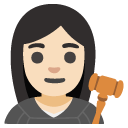
A woman with light skin tone depicted wearing a judge's wig or robe, representing a female judge or legal professional with fair complexion.
02What does 👩🏻⚖️ mean on TikTok?
Represents someone delivering a verdict, calling someone out, or establishing themselves as an authority figure in a situation.
03What does 👩🏻⚖️ mean on WhatsApp?
Signals that someone is making a final decision or passing judgment in a conversation, often used humorously.
04What does 👩🏻⚖️ mean in Gen-Z slang?
Used to signal judgment, calling someone out, delivering verdicts on situations, or positioning oneself as the authority on a topic. Also used ironically when someone acts like they have moral high ground.
05Is the 👩🏻⚖️ emoji safe to use?
Represents a female judge or legal professional; used for empowerment, professional identity, humor, and social commentary.
06What does 👩🏻⚖️ mean in texting?
Tapping into the archetype of justice and fairness, this emoji often projects a sense of empowerment and dominance. Users invoking it may seek to establish credibility or signal that they are in a position of moral or intellectual superiority.
07What is the shortcode for 👩🏻⚖️?
The shortcode for Woman Judge: Light Skin Tone is :woman_judge_light_skin_tone:
08What does 👩🏻⚖️ mean in dating?
Rarely used in direct flirting; however, someone might use it playfully to say they're evaluating a potential partner, e.g., 'case closed, you're cute 👩🏻⚖️'.
Safety & usage
- Safe meaning
- Represents a female judge or legal professional; used for empowerment, professional identity, humor, and social commentary.
- Caution
- Can be used in harassment contexts to mock someone as 'playing judge', or to belittle someone who calls out bad behavior by dismissing them as self-righteous.
Generally very safe. Minimal risk of misuse; no known associations with hate groups or NSFW content.
How it looks across platforms
Appearance varies by platform and device. Google Noto, Twemoji, and OpenMoji are open-source.