🧎🏼♀️
The Emoji
Woman Kneeling: Medium-light Skin Tone
U+1F9CE U+1F3FC U+200D U+2640 U+FE0F · :woman_kneeling_mediumlight_skin_tone:
Trend 58
Meaning layers
- interpretation
- Used to express begging, pleading, or desperation — often sarcastically or dramatically. Also deployed in worship-like admiration of someone or something (e.g., 'I am KNEELING for this look').
- tiktok usage
- Appears under videos of stunning outfits, performances, or moments that 'destroy' the viewer emotionally — signaling reverent awe or over-the-top praise.
- irony level
- 6 / 10
Platform meanings
- meaning
- Represents ultimate admiration or dramatic pleading; used to show you are completely overwhelmed by someone's talent, beauty, or content.
- trend usage
- Frequently used in comment sections under viral fashion, music, or performance videos as a gesture of total reverence.
- hashtags
- #kneeling#iamkneeling#worship#obsessed#slayed
- virality score
- 62 / 100
Cultural meanings
🇺🇸
Western / Gen-Z
Used heavily for dramatic praise or begging; a staple of online hyperbole culture — 'she ate and I am kneeling.'
🇵🇰
Pakistan & India
Interpreted primarily in religious or devotional contexts — kneeling before God or elders; also increasingly used by younger users in ironic admiration online.
🌍
Middle East
Strong association with prayer and religious humility; may be used seriously in devotional contexts but younger users also adopt it for internet humor.
🌐
Global Neutral
Broadly understood as a gesture of reverence, prayer, or supplication across most cultures without strong negative connotations.
🇧🇩
Bangladesh
Primarily read as a religious or respectful gesture; online younger demographics may use it for dramatic praise similar to South Asian internet culture.
🇱🇰
Sri Lanka
Associated with Buddhist or Hindu prayer postures and general respect; lighter ironic use emerging among urban youth.
🇨🇳
China
Kneeling carries cultural weight as a sign of deep respect or apology; the emoji can be used humorously online but is handled with some contextual care.
🇯🇵
Japan
Seiza (formal kneeling) is culturally significant; this emoji can represent formal respect, apology (dogeza-adjacent), or ironic internet reverence.
🇰🇷
South Korea
Used in fan culture (idol worship) to express absolute devotion to a K-pop idol or celebrity; also used sarcastically in online discourse.
🇹🇼
Taiwan
Similar to broader East Asian usage — respect and apology in serious contexts, fan devotion and meme culture in casual settings.
🇭🇰
Hong Kong
Used in Cantonese internet culture for ironic self-deprecation or intense fan admiration; the 跪 (kneel) concept is familiar in meme formats.
🇵🇭
Philippines
Common in religious contexts given the strong Catholic culture; also widely used online to express 'I am not worthy' admiration for celebrities.
🇮🇩
Indonesia
Connected to Islamic prayer postures and general cultural respect; humorous online usage growing among Gen Z users.
🇹🇭
Thailand
Associated with Buddhist reverence and respect for elders or royalty; casual digital use for admiration is emerging but handled carefully given cultural norms.
🇻🇳
Vietnam
Kneeling gestures are tied to ancestor worship and deep respect; online usage skews toward admiration and fan culture among younger demographics.
🇲🇾
Malaysia
Multi-cultural context means it reads differently across communities — religious (Islamic/Buddhist/Hindu) in serious tone, or humorous admiration online.
🇸🇦
Saudi Arabia
Prayer and religious submission are primary associations; used sincerely in devotional content but less common in casual digital humor.
🇦🇪
UAE
Similar to broader Gulf usage — religious respect is primary, though cosmopolitan internet culture allows for lighter ironic use in mixed online spaces.
🇪🇬
Egypt
Islamic prayer context is dominant; younger Egyptian internet users also adopt it for dramatic admiration in meme culture.
🇹🇷
Turkey
Dual usage — sincere expressions of humility or prayer, and younger online communities using it for dramatic praise or self-deprecating humor.
🇮🇷
Iran
Religious kneeling is a meaningful gesture; online usage among youth tends toward ironic admiration, often navigating cultural sensitivity.
🇳🇬
Nigeria
Used in Christian contexts for prayer and worship; also common in Naija Twitter/X culture for expressing awe — 'she dey make me kneel.'
🇿🇦
South Africa
Crosses religious and pop culture contexts; used in online fan communities and in prayer group chats with equal frequency.
🇬🇧
UK & Ireland
Used with typical British irony — genuine reverence for something exceptional or sarcastically for something embarrassingly overhyped.
🇫🇷
France
Appears in online culture for dramatic admiration; the French internet community uses it to signal someone is impressively iconic.
🇩🇪
Germany
Less commonly used for casual humor; more likely to appear in sincere contexts like fitness, prayer, or respectful acknowledgment.
🇪🇸
Spain & Italy
Emotional expressiveness in both cultures means this emoji is used freely for dramatic admiration, religious references, and romantic devotion.
🇧🇷
Brazil
Hugely popular in fan culture — Brazilian stans are known for extreme devotion, and this emoji signals you are completely owned by your fave.
🇲🇽
Mexico
Used in religious contexts (Catholic imagery) as well as in telenovela-style dramatic online expressions of devotion or begging.
🌎
Latin America
Broadly used across Latin America for religious sincerity and theatrical online admiration; fan culture communities deploy it heavily.
🇦🇺
Australia & NZ
Used casually and often ironically — 'absolutely kneeling for this' is a common turn of phrase in Australian online humor about something excellent.
How its meaning shifted
- 2010
This specific emoji did not exist in 2010; kneeling concepts were expressed through text or prayer hands emoji alternatives.
- 2015
Still not in Unicode; kneeling was represented through creative text combinations or adjacent emojis like 🙏 to convey similar meaning.
- 2020
Added to Unicode 12.0 (2019) and gaining traction; primarily used in religious, protest (taking a knee), and early ironic admiration contexts online.
- 2026
Firmly embedded in Gen Z hyperbole culture for dramatic admiration and begging; protest/solidarity connotations coexist with humor usage; skin tone variants normalized.
See it on every platform
Adjacent emojis
- Often confused with
- person kneelingwoman bowing deeplyfolded hands
- Can replace
- folded handsperson kneelingwoman bowing
Share & embed
Frequently asked
01What does the 🧎🏼♀️ Woman Kneeling: Medium-light Skin Tone emoji mean?
A woman in a kneeling position with medium-light skin tone, depicted on one or both knees facing forward or slightly angled.
02What does 🧎🏼♀️ mean on TikTok?
Represents ultimate admiration or dramatic pleading; used to show you are completely overwhelmed by someone's talent, beauty, or content.
03What does 🧎🏼♀️ mean on WhatsApp?
Sent to beg a friend for a favor, often paired with praying hands — 'Please please please 🧎🏼♀️🙏'
04What does 🧎🏼♀️ mean in Gen-Z slang?
Used to express begging, pleading, or desperation — often sarcastically or dramatically. Also deployed in worship-like admiration of someone or something (e.g., 'I am KNEELING for this look').
05Is the 🧎🏼♀️ emoji safe to use?
Prayer, reverence, admiration, humility, begging playfully, solidarity (taking a knee).
06What does 🧎🏼♀️ mean in texting?
Kneeling is a universally recognized posture of vulnerability and deference. Its emoji form amplifies emotional weight in digital communication, often used to signal a dramatic emotional state — genuine or performative.
07What is the shortcode for 🧎🏼♀️?
The shortcode for Woman Kneeling: Medium-light Skin Tone is :woman_kneeling_mediumlight_skin_tone:
08What does 🧎🏼♀️ mean in dating?
Can be used playfully to 'worship' a crush — 'I'm on my knees for you 🧎🏼♀️' — often sent as a flirtatious compliment implying total devotion.
Safety & usage
- Safe meaning
- Prayer, reverence, admiration, humility, begging playfully, solidarity (taking a knee).
- Caution
- Could be used in degrading contexts to suggest someone should submit or grovel; rarely weaponized but possible in harassment scenarios.
Generally safe. In rare cases, it could be used in a power-dynamics context that reads as demeaning, particularly in combination with other emojis. No widely documented toxic usage patterns.
How it looks across platforms
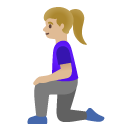
Appearance varies by platform and device. Google Noto, Twemoji, and OpenMoji are open-source.