🧎🏽♀️
The Emoji
Woman Kneeling: Medium Skin Tone
U+1F9CE U+1F3FD U+200D U+2640 U+FE0F · :woman_kneeling_medium_skin_tone:
Trend 54
Meaning layers
- interpretation
- Used to express submission, worship of someone/something (ironically or sincerely), begging, or 'I'm on my knees for this.' Also used to symbolize being humbled, defeated, or in awe.
- tiktok usage
- Appears in reaction videos and comment sections to express being completely floored by content — 'I'm literally 🧎🏽♀️ rn.' Also used in skits about begging or dramatic situations.
- irony level
- 7 / 10
Platform meanings
- meaning
- Signifies being completely in awe, humbled, or submissive — 'I'm on my knees for this content/person.' Also used in stitched reactions and duets for dramatic flair.
- trend usage
- Appears in comment sections under viral videos, outfit reveals, and impressive skill showcases. Used in trending sounds about worship or devotion.
- hashtags
- #kneeling#iworshipyou#humbled#onyourknees#fyp
- virality score
- 58 / 100
Cultural meanings
🇺🇸
Western / Gen-Z
Widely used ironically and sincerely in English-speaking Gen Z spaces online to indicate being overwhelmed with admiration, awe, or the need to beg/plead. The ironic angle is dominant.
🇵🇰
Pakistan & India
Often interpreted in the context of prayer, religious devotion, or showing deep respect to elders and spiritual figures. Also gaining ironic usage among younger, internet-savvy users.
🌍
Middle East
Primarily associated with prayer, supplication to God, and deep religious reverence. Used sincerely in religious contexts; ironic usage is rare but emerging among younger demographics.
🌐
Global Neutral
Broadly understood as representing humility, kneeling, or reverence. Context determines whether it reads as religious, romantic, or humorous.
🇧🇩
Bangladesh
Most commonly interpreted as a gesture of prayer or submission before a divine figure. Used in religious messaging and respectful contexts online.
🇱🇰
Sri Lanka
Associated with Buddhist and Hindu prayer postures, as well as cultural gestures of deep respect. Used in devotional contexts and occasionally in tribute posts.
🇨🇳
China
Less commonly used; when it appears it may reference kneeling as a form of apology or extreme respect, which carries strong cultural weight. Ironic usage is growing among younger netizens.
🇯🇵
Japan
Evokes the concept of seiza (formal kneeling posture) and deep bowing culture. Used in contexts of sincere apology, respect, or self-humbling, as well as anime fan culture references.
🇰🇷
South Korea
Associated with kneeling as a sign of deep respect or apology in Korean culture. Also heavily used in K-pop fan communities to express idol worship and devotion.
🇹🇼
Taiwan
Similar to broader East Asian interpretations — kneeling implies deep respect or apology. Also used in fan contexts inspired by Korean and Japanese pop culture.
🇭🇰
Hong Kong
Used in both traditional respectful contexts and in internet culture to express overwhelmed admiration or sarcastic capitulation.
🇵🇭
Philippines
Strongly associated with Catholic prayer and devotional kneeling, especially in religious contexts. Also used among younger Filipinos online in ironic fan worship scenarios.
🇮🇩
Indonesia
Tied to Islamic prayer postures and deep respect in social hierarchy. Used reverently in religious discussions and occasionally humorously in youth internet culture.
🇹🇭
Thailand
Connected to Buddhist prayer customs and showing deference to monks and elders. Used in devotional and spiritual contexts; ironic usage is emerging among Thai youth online.
🇻🇳
Vietnam
Kneeling represents deep filial respect and ancestor veneration in Vietnamese culture. Used seriously in cultural and religious contexts online.
🇲🇾
Malaysia
Interpreted through Islamic prayer postures and Malay cultural deference. Used in religious settings and increasingly in playful internet contexts among Malaysian youth.
🇸🇦
Saudi Arabia
Strongly associated with Islamic prayer (sujud/prostration adjacent). Used in religious contexts to signify devotion to God; secular ironic usage is culturally sensitive.
🇦🇪
UAE
Similar to Saudi Arabia — primarily religious connotations. In cosmopolitan digital spaces it may be used more broadly by younger, internationally influenced users.
🇪🇬
Egypt
Associated with Islamic prayer and historical reverence in Egyptian culture. Older users interpret it religiously; younger users may use it in ironic or fan contexts.
🇹🇷
Turkey
Used in religious contexts connected to Islamic prayer and also in secular humorous internet culture among Turkish youth to express being floored by something.
🇮🇷
Iran
Primarily interpreted in the context of Islamic prayer and deep reverence. In online Persian youth culture, ironic usage for expressing awe is growing.
🇳🇬
Nigeria
Used in religious contexts (Christian and Muslim) to represent prayer and supplication. Also used humorously in Nigerian internet culture to beg or express dramatic admiration.
🇿🇦
South Africa
Interpreted in both religious contexts and in contemporary youth culture online. Ironic use to express admiration or comedic begging is common in SA digital spaces.
🇬🇧
UK & Ireland
Used predominantly in ironic and humorous contexts — 'I'm literally 🧎🏽♀️.' Sincere religious usage exists but is less dominant in digital culture.
🇫🇷
France
Used with ironic flair in French internet culture to mock over-submission or express exaggerated admiration. Less tied to religious connotation in digital use.
🇩🇪
Germany
Used sparingly in German online spaces. May appear in sports fan contexts or ironic admiration. Direct religious interpretation is less common.
🇪🇸
Spain & Italy
In Catholic cultural traditions, kneeling has strong religious significance. Online it appears in devotional content and increasingly in humorous, dramatic admiration posts.
🇧🇷
Brazil
Used in religious contexts tied to Brazilian Catholic and evangelical culture, as well as in Kardashian-era fan worship and ironic internet humor.
🇲🇽
Mexico
Strong Catholic devotional resonance — kneeling is a visible part of Mexican religious practice. Also used in fan and internet culture among younger Mexicans.
🌎
Latin America
Across Latin America, interpreted through Catholic traditions of prayer and reverence. Younger users adapt it for ironic admiration and fan devotion.
🇦🇺
Australia & NZ
Used primarily in casual, ironic internet humor — 'I'm kneeling for this meal/outfit/song.' Religious connotation is present but less dominant in digital use.
How its meaning shifted
- 2010
Emoji did not exist in this form. Kneeling and skin tone modifier emojis had not yet been introduced to Unicode.
- 2015
Kneeling emoji variants were not yet widely available. The concept was expressed through text combinations or other emojis.
- 2020
Gained significant cultural resonance during the Black Lives Matter movement, where kneeling became a powerful political symbol. The emoji was used in solidarity posts and protest content globally.
- 2026
Predominantly used in ironic Gen Z internet culture to express awe, admiration, or dramatic submission. Religious and respectful sincere usage coexists, but the playful ironic register dominates digital spaces.
See it on every platform
Adjacent emojis
- Often confused with
- person in lotus positionprostration emojifolded hands
- Can replace
- folded handsbowing personraised hands
Share & embed
Frequently asked
01What does the 🧎🏽♀️ Woman Kneeling: Medium Skin Tone emoji mean?
A woman kneeling on one or both knees, depicted with a medium skin tone. Part of the Unicode kneeling person emoji set with gender and skin tone modifiers.
02What does 🧎🏽♀️ mean on TikTok?
Signifies being completely in awe, humbled, or submissive — 'I'm on my knees for this content/person.' Also used in stitched reactions and duets for dramatic flair.
03What does 🧎🏽♀️ mean on WhatsApp?
Sent to express begging, pleading, or desperation — 'Please 🧎🏽♀️🧎🏽♀️ I'm begging you.' Also used sincerely to show deep gratitude.
04What does 🧎🏽♀️ mean in Gen-Z slang?
Used to express submission, worship of someone/something (ironically or sincerely), begging, or 'I'm on my knees for this.' Also used to symbolize being humbled, defeated, or in awe.
05Is the 🧎🏽♀️ emoji safe to use?
Represents kneeling as a gesture of prayer, reverence, humility, admiration, or dramatic begging. Widely used in positive, respectful, or humorous contexts.
06What does 🧎🏽♀️ mean in texting?
Kneeling is a universally recognized posture of deference and vulnerability. Using this emoji taps into deep social and cultural associations with surrender, worship, and supplication, making it emotionally loaded depending on context.
07What is the shortcode for 🧎🏽♀️?
The shortcode for Woman Kneeling: Medium Skin Tone is :woman_kneeling_medium_skin_tone:
08What does 🧎🏽♀️ mean in dating?
Can be used flirtatiously to say 'I worship you' or 'you bring me to my knees,' implying deep attraction or being overwhelmed by someone's looks or personality.
Safety & usage
- Safe meaning
- Represents kneeling as a gesture of prayer, reverence, humility, admiration, or dramatic begging. Widely used in positive, respectful, or humorous contexts.
- Caution
- In rare cases, could be used to demean or humiliate someone by implying forced submission. Could be weaponized in harassment contexts to mock capitulation.
Generally safe. During politically charged moments (e.g., protest movements, debates about kneeling as political protest) the emoji can become polarizing. Monitor context in political discussions.
How it looks across platforms
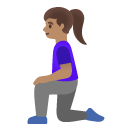
Appearance varies by platform and device. Google Noto, Twemoji, and OpenMoji are open-source.