🏋🏻♀️
The Emoji
Woman Lifting Weights: Light Skin Tone
U+1F3CB U+1F3FB U+200D U+2640 U+FE0F · :woman_lifting_weights_light_skin_tone:
Trend 72
Meaning layers
- interpretation
- Represents grind culture, gym dedication, female empowerment, and 'that girl' aesthetic. Used to signal a healthy, disciplined lifestyle or ironically to hype up any small effort as if it were an Olympic feat.
- tiktok usage
- Heavily used in 'that girl' morning routine videos, fitness transformation content, and gym motivation reels. Also used sarcastically when someone does the bare minimum.
- irony level
- 5 / 10
Platform meanings
- meaning
- Core symbol of the 'that girl' and gym-tok aesthetic; represents fitness dedication, female strength, and hustle culture.
- trend usage
- Used in transformation videos, morning routine content, PR (personal record) celebration clips, and 'get ready with me' gym content.
- hashtags
- #GymTok#ThatGirl#WomenWhoLift#FitnessMotivation#LiftingGirls
- virality score
- 78 / 100
Cultural meanings
🇺🇸
Western / Gen-Z
Core emoji in 'that girl' and gym-tok subcultures, representing female empowerment, discipline, and the grind aesthetic. Also used ironically for minor everyday efforts.
🇵🇰
Pakistan & India
Increasingly used among urban youth and fitness influencers to celebrate women breaking traditional gender norms around physical strength. Carries a progressive, modern connotation.
🌍
Middle East
Used primarily in private fitness communities and among younger women; carries significance in the context of women's growing access to gyms and public sports spaces in countries like Saudi Arabia.
🌐
Global Neutral
Universally recognized as a woman exercising with weights; broadly positive and associated with health, strength, and fitness regardless of cultural context.
🇧🇩
Bangladesh
Emerging in urban digital spaces among young women interested in fitness; still relatively novel but growing in use among health-conscious social media users.
🇱🇰
Sri Lanka
Used in fitness communities and among younger women on Instagram and TikTok who follow global wellness trends; symbolizes modern, health-positive identity.
🇨🇳
China
Popular among female fitness influencers on Weibo and Xiaohongshu (Little Red Book); associated with the '健身女孩' (fitness girl) aesthetic and self-improvement culture.
🇯🇵
Japan
Used in fitness and wellness content, aligning with growing interest in women's strength training; also connects to concepts of self-discipline and perseverance (ganbaru culture).
🇰🇷
South Korea
Tied to 'healfie' (health selfie) culture and the growing trend of women doing weight training ('헬스녀'); widely used in fitness content on Instagram and Naver.
🇹🇼
Taiwan
Common in fitness lifestyle content and among young women participating in gym culture; carries positive connotations of health and independence.
🇭🇰
Hong Kong
Used in active lifestyle and wellness content; reflects the city's health-conscious urban culture and growing acceptance of women in strength sports.
🇵🇭
Philippines
Appearing more frequently in fitness content as gym culture grows among young women; used to celebrate physical achievement and female strength.
🇮🇩
Indonesia
Used in fitness communities on Instagram and TikTok; resonates with growing female gym culture, sometimes placed alongside modest fitness content.
🇹🇭
Thailand
Common in fitness influencer content and gym-related posts; associated with discipline and the aesthetic of strong, healthy women.
🇻🇳
Vietnam
Emerging in younger generations' fitness content; used to celebrate women's physical empowerment and modern healthy lifestyles.
🇲🇾
Malaysia
Used in fitness and wellness communities; carries progressive connotations of women's empowerment in physical spaces, growing alongside gym culture.
🇸🇦
Saudi Arabia
Gained new significance after women were allowed into gyms and sports facilities; used to celebrate this cultural shift and women's growing athletic participation.
🇦🇪
UAE
Common in cosmopolitan fitness communities; represents the active, wellness-oriented lifestyle popular in Dubai and Abu Dhabi's diverse social media scene.
🇪🇬
Egypt
Used among urban youth and fitness enthusiasts; symbolizes modern female empowerment and is more common in progressive digital spaces.
🇹🇷
Turkey
Popular in fitness content among younger women; represents strength and independence, aligning with both modern secular values and growing gym culture.
🇮🇷
Iran
Used cautiously but present in women's fitness content; carries additional weight as a symbol of women asserting physical autonomy in a restrictive context.
🇳🇬
Nigeria
Growing in use among urban fitness communities and female influencers; represents ambition, strength, and the hustle mentality common in Nigerian pop culture.
🇿🇦
South Africa
Used in fitness and wellness content; associated with empowerment narratives and the growing women's health movement across urban South Africa.
🇬🇧
UK & Ireland
Common in gym content and used with typical British irony — both sincerely for fitness posts and sarcastically for dramatic complaints about daily tasks.
🇫🇷
France
Used in fitness content with a slightly more aesthetic, lifestyle-oriented framing; associated with the 'bien dans sa peau' (comfortable in one's skin) philosophy.
🇩🇪
Germany
Used straightforwardly in fitness and wellness contexts; aligns with German cultural values of discipline, health, and efficiency.
🇪🇸
Spain & Italy
Used in fitness content and among women celebrating physical achievement; also appears in playful or ironic contexts about doing heavy emotional or physical lifting.
🇧🇷
Brazil
Widely used in fitness culture, which is highly prominent; associated with female body confidence and the celebratory Brazilian approach to health and aesthetics.
🇲🇽
Mexico
Used in fitness communities and empowerment content; increasingly popular as women's gym culture grows and intersects with broader feminist movements.
🌎
Latin America
Broadly represents female strength and fitness across Latin America; used in motivational content and increasingly tied to feminist empowerment narratives.
🇦🇺
Australia & NZ
Common in fitness content and used both sincerely and with self-deprecating humor; aligns with the outdoor-active lifestyle culture and tall poppy dynamic.
How its meaning shifted
- 2010
Emoji did not exist yet; weightlifting emojis were not part of the Unicode standard, and skin tone modifiers for gendered sport emoji were years away.
- 2015
The base weightlifter emoji existed but the woman/light skin variant was not yet available; fitness emoji use was mostly generic and not gendered.
- 2020
Widely adopted in the rise of 'that girl' aesthetic, pandemic home workout culture, and female empowerment fitness content across Instagram and TikTok.
- 2026
Established staple in fitness, wellness, and empowerment content; used both sincerely and ironically across generations, deeply embedded in gym-tok and hustle culture discourse.
See it on every platform
Adjacent emojis
- Often confused with
- man lifting weightsperson lifting weightswoman running
- Can replace
- flexed bicepsfiretrophy
Share & embed
Frequently asked
01What does the 🏋🏻♀️ Woman Lifting Weights: Light Skin Tone emoji mean?
A woman with light skin tone performing a weightlifting exercise, holding a barbell overhead in a clean-and-jerk or snatch position.
02What does 🏋🏻♀️ mean on TikTok?
Core symbol of the 'that girl' and gym-tok aesthetic; represents fitness dedication, female strength, and hustle culture.
03What does 🏋🏻♀️ mean on WhatsApp?
Telling a friend you're at or heading to the gym, celebrating a workout milestone, or expressing that you're pushing through something hard.
04What does 🏋🏻♀️ mean in Gen-Z slang?
Represents grind culture, gym dedication, female empowerment, and 'that girl' aesthetic. Used to signal a healthy, disciplined lifestyle or ironically to hype up any small effort as if it were an Olympic feat.
05Is the 🏋🏻♀️ emoji safe to use?
Represents women's fitness, strength, empowerment, and athletic dedication in a universally positive way.
06What does 🏋🏻♀️ mean in texting?
Taps into feelings of agency and physical autonomy, particularly resonant for women reclaiming strength as a form of self-expression rather than purely aesthetics. Linked to confidence and resilience.
07What is the shortcode for 🏋🏻♀️?
The shortcode for Woman Lifting Weights: Light Skin Tone is :woman_lifting_weights_light_skin_tone:
08What does 🏋🏻♀️ mean in dating?
Used by women to signal they are independent, fit, and self-sufficient — sometimes as a subtle flex or to attract partners who value an active lifestyle.
Safety & usage
- Safe meaning
- Represents women's fitness, strength, empowerment, and athletic dedication in a universally positive way.
- Caution
- Rarely weaponized negatively, but can appear in body-shaming contexts or be used dismissively to mock women's athletic achievements as insufficiently impressive.
Generally very safe; minimal risk of misuse. In rare cases may appear in content promoting unhealthy fitness obsession or diet culture, but the emoji itself carries no inherent harm.
How it looks across platforms
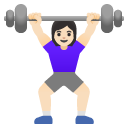
Appearance varies by platform and device. Google Noto, Twemoji, and OpenMoji are open-source.