🏋🏼♀️
The Emoji
Woman Lifting Weights: Medium-light Skin Tone
U+1F3CB U+1F3FC U+200D U+2640 U+FE0F · :woman_lifting_weights_mediumlight_skin_tone:
Trend 72
Meaning layers
- interpretation
- Symbol of grind culture, gym motivation, 'that girl' aesthetic, self-improvement, and unbothered energy. Used to signal discipline, physical empowerment, or hyping someone's effort.
- tiktok usage
- Appears in gym check-ins, 'that girl' morning routine videos, body transformation content, and motivational captions. Often paired with workout montages or accountability posts.
- irony level
- 3 / 10
Platform meanings
- meaning
- Gym girl energy, discipline, fitness grind, and 'that girl' aspirational content marker
- trend usage
- Used in gym transformation videos, 5am workout routines, 'get ready with me' fitness content, and accountability challenges
- hashtags
- #gymgirlthatgirl#morningroutine#liftingwomen#girlswholift
- virality score
- 74 / 100
Cultural meanings
🇺🇸
Western / Gen-Z
Core symbol of the 'that girl' aesthetic and self-improvement culture. Used widely to signal gym dedication, female empowerment, and grind mentality across social media.
🇵🇰
Pakistan & India
Increasingly popular as women's gym culture grows in urban areas. Used by fitness-forward young women on Instagram and YouTube to normalize female strength training.
🌍
Middle East
Gaining usage among younger urban women, especially in Gulf countries where female gym culture is expanding. Represents breaking traditional norms around women and physical fitness.
🌐
Global Neutral
Universally understood as representing a woman engaged in weightlifting or strength training. Broadly used without cultural friction in fitness contexts worldwide.
🇧🇩
Bangladesh
Relatively niche usage, primarily among urban fitness communities and younger social media users. Represents aspirational fitness culture in growing gym communities.
🇱🇰
Sri Lanka
Used in emerging fitness communities, particularly among urban youth and women breaking into gym culture. Symbolizes modernity and health consciousness.
🇨🇳
China
Used in fitness-focused content on platforms like WeChat and Weibo. Associated with 'self-discipline girl' aesthetics that are trending in Chinese wellness culture.
🇯🇵
Japan
Represents dedicated fitness culture and the growing trend of women's strength training. Often associated with the concept of 'jibunmigaki' (polishing oneself through discipline).
🇰🇷
South Korea
Tied to 'healthy is the new skinny' cultural shifts in Korean beauty and wellness standards. Used heavily in fitness content alongside idol diet-and-exercise culture.
🇹🇼
Taiwan
Popular in fitness and wellness communities, especially as gym culture becomes mainstream for young Taiwanese women. Signals health-conscious modern identity.
🇭🇰
Hong Kong
Used in fast-paced urban fitness culture where gym membership is a lifestyle status marker. Represents a busy professional staying disciplined.
🇵🇭
Philippines
Used in fitness influencer content and growing gym communities. Associated with body positivity movements and women's empowerment in health spaces.
🇮🇩
Indonesia
Growing usage in Muslim-majority fitness communities where women's strength training content is increasingly visible. Represents modern active Muslim women.
🇹🇭
Thailand
Used in fitness and wellness contexts, tied to Thailand's strong gym and Muay Thai culture. Also linked to beauty-fitness crossover content popular among Thai influencers.
🇻🇳
Vietnam
Appears in fitness content among urban Vietnamese youth embracing gym culture. Signals a modern, health-first lifestyle approach.
🇲🇾
Malaysia
Used across fitness communities inclusive of diverse ethnicities. Represents women reclaiming fitness spaces and the growing popularity of gym culture.
🇸🇦
Saudi Arabia
Particularly meaningful after 2017 when women's gyms were officially permitted. Symbolizes newfound freedom and women's empowerment in fitness contexts.
🇦🇪
UAE
Common in Dubai's highly active fitness influencer culture. Represents the trendy, wellness-obsessed expat and local lifestyle in the Emirates.
🇪🇬
Egypt
Used among urban fitness communities and youth gym culture. Represents women challenging traditional expectations through physical strength and self-care.
🇹🇷
Turkey
Popular in Istanbul's growing urban fitness scene. Used by women who are part of the expanding gym culture and wellness movement in modern Turkish cities.
🇮🇷
Iran
Used carefully in women's fitness content, often in private or semi-public settings due to social restrictions. Represents quiet resistance and personal empowerment through fitness.
🇳🇬
Nigeria
Used in Lagos and Abuja's fitness communities and by Afro-fitness influencers. Tied to the booming African wellness industry and female body empowerment narratives.
🇿🇦
South Africa
Common in Johannesburg and Cape Town fitness cultures. Used across wellness campaigns promoting women's strength training and body positivity.
🇬🇧
UK & Ireland
Standard gym emoji used in fitness content. Also used humorously in British slang contexts like 'carrying this entire situation 🏋🏼♀️' with dry wit.
🇫🇷
France
Used in fitness and wellness contexts with French minimalism. Less ironic than Anglo usage, more aligned with genuine sporty or healthy lifestyle signaling.
🇩🇪
Germany
Straightforwardly used in fitness and sports contexts. Germans tend to use it literally in gym-related posts without heavy ironic layering.
🇪🇸
Spain & Italy
Used in vibrant fitness and health content. Also appears in motivational posts and self-improvement discourse popular among Mediterranean social media users.
🇧🇷
Brazil
Heavily used in Brazil's massive gym culture. Associated with body-positive fitness content and the culturally celebrated combination of strength and femininity.
🇲🇽
Mexico
Used in growing fitness communities and wellness influencer content. Represents modern Mexican women embracing strength training and self-improvement.
🌎
Latin America
Broadly used across Latin American fitness communities where gym culture is booming. Represents female strength, beauty standards evolving toward fitness, and self-care.
🇦🇺
Australia & NZ
Used casually in fitness content and ironically in self-deprecating humor. Tied to Australia's active outdoor-and-gym culture and the 'tradie-gym' dual lifestyle.
How its meaning shifted
- 2010
This specific emoji did not exist yet. General fitness emoji were limited and gender-neutral options were rare. Women in sports were barely represented in the emoji keyboard.
- 2015
Emoji with skin tone modifiers were just introduced. The base weightlifting emoji existed but gender-specific versions were new. Usage was primarily literal and niche.
- 2020
Became a staple of female fitness content on Instagram and TikTok. The rise of 'that girl' aesthetic and pandemic home-workout culture boosted its usage significantly.
- 2026
Deeply embedded in self-improvement, wellness, and female empowerment discourse. Used both sincerely in fitness content and ironically to describe emotional or professional labor.
See it on every platform
Adjacent emojis
- Often confused with
- man lifting weightsperson lifting weightswoman doing cartwheel
- Can replace
- flexed bicepsperson runningfire
Share & embed
Frequently asked
01What does the 🏋🏼♀️ Woman Lifting Weights: Medium-light Skin Tone emoji mean?
A woman with medium-light skin tone performing a weightlifting exercise, holding a barbell overhead in a clean-and-jerk or overhead press position.
02What does 🏋🏼♀️ mean on TikTok?
Gym girl energy, discipline, fitness grind, and 'that girl' aspirational content marker
03What does 🏋🏼♀️ mean on WhatsApp?
Telling someone you're going to the gym or just finished a workout. Casual fitness check-in.
04What does 🏋🏼♀️ mean in Gen-Z slang?
Symbol of grind culture, gym motivation, 'that girl' aesthetic, self-improvement, and unbothered energy. Used to signal discipline, physical empowerment, or hyping someone's effort.
05Is the 🏋🏼♀️ emoji safe to use?
A woman lifting weights — universally positive symbol of fitness, strength, empowerment, and discipline.
06What does 🏋🏼♀️ mean in texting?
This emoji taps into themes of agency and physical mastery. For women especially, it signals reclaiming strength narratives and challenging gender norms around fitness. Psychologically linked to self-efficacy and achievement motivation.
07What is the shortcode for 🏋🏼♀️?
The shortcode for Woman Lifting Weights: Medium-light Skin Tone is :woman_lifting_weights_mediumlight_skin_tone:
08What does 🏋🏼♀️ mean in dating?
Used by someone showcasing their gym lifestyle to attract fitness-minded partners. Can signal 'I take care of myself' or 'I'm strong and confident' as a subtle flex in dating bios or messages.
Safety & usage
- Safe meaning
- A woman lifting weights — universally positive symbol of fitness, strength, empowerment, and discipline.
- Caution
- Can be used in body-shaming contexts to mock women's physiques or sarcastically target women who don't meet certain body standards. Rarely weaponized but possible.
Generally very safe. In rare cases used in toxic fitness communities to gatekeep or shame. The skin tone specificity can occasionally draw race-related commentary in polarized spaces.
How it looks across platforms
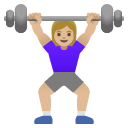
Appearance varies by platform and device. Google Noto, Twemoji, and OpenMoji are open-source.