🤷🏾♀️
The Emoji
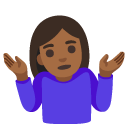
Woman Shrugging: Medium-dark Skin Tone
U+1F937 U+1F3FE U+200D U+2640 U+FE0F · :woman_shrugging_mediumdark_skin_tone:
Trend 80
Meaning layers
- interpretation
- Classic 'I don't know, I don't care, not my problem' energy. Used to signal unbothered detachment, plausible deniability, or casual dismissal of drama.
- tiktok usage
- Appears in comment sections and captions when creators respond to criticism or controversy with deliberate nonchalance; often paired with 'bestie idk 🤷🏾♀️'.
- irony level
- 7 / 10
Platform meanings
- meaning
- Represents unbothered, carefree energy; used to shut down drama or respond to haters without engaging.
- trend usage
- Common in comment replies to hate comments, POV videos about not caring what people think, and 'girl math' explanation endings.
- hashtags
- #unbothered#notmyproblem#idk#girllogic#shrug
- virality score
- 82 / 100
Cultural meanings
🇺🇸
Western / Gen-Z
Core emoji in the 'unbothered' lexicon — signals cool detachment from drama, often used ironically to show someone actually cares deeply but won't admit it.
🇵🇰
Pakistan & India
Used by younger urban women to express 'I don't know' or dismissiveness, especially in Hinglish texting culture; skin tone representation resonates with South Asian users.
🌍
Middle East
Used by younger women in Gulf and Levant regions to express nonchalance on social media, though cultural norms around female expression add subtle layers of reclamation to the gesture.
🌐
Global Neutral
Universally understood as 'I don't know' or 'whatever' across all demographics; one of the most cross-culturally legible emoji in existence.
🇧🇩
Bangladesh
Gaining popularity among urban youth on Facebook and WhatsApp to casually dismiss questions or express uncertainty in a playful way.
🇱🇰
Sri Lanka
Used similarly to neighboring South Asian cultures — a light dismissal or 'who knows' reaction in casual digital conversation.
🇨🇳
China
Less culturally familiar as a gesture but understood through global internet context; WeChat users may prefer local equivalents, but it appears in Weibo and Xiaohongshu among internationally connected youth.
🇯🇵
Japan
The shrug gesture is not a traditional Japanese expression, so it reads as a Western-imported expression of indifference; used primarily by younger, globally-connected users on Twitter/X.
🇰🇷
South Korea
Appears in KakaoTalk and Instagram among younger users influenced by Western pop culture; associated with a 'chill girl' persona in Korean social media.
🇹🇼
Taiwan
Used casually among youth on PTT, Instagram, and Dcard to signal not knowing or not caring, often in a lighthearted tone.
🇭🇰
Hong Kong
Common in bilingual digital communication to signal indifference or confusion, fitting naturally into the casual code-switching style of Hong Kong online culture.
🇵🇭
Philippines
Widely used on Facebook and TikTok — Filipinos embrace it wholeheartedly to express 'hindi ko alam' (I don't know) with humorous energy.
🇮🇩
Indonesia
Popular among younger Indonesian users on TikTok and Instagram; the medium-dark skin tone is particularly relatable and appreciated for representation.
🇹🇭
Thailand
Used on Twitter and TikTok among Thai youth to signal carefree indifference; pairs well with Thai internet culture's love of soft humor and face-saving deflection.
🇻🇳
Vietnam
Emerging use among younger Vietnamese on Facebook and TikTok to express confusion or dismissal in a casual, non-confrontational way.
🇲🇾
Malaysia
Frequently used in WhatsApp group chats and Instagram among Malaysian youth; the skin tone resonates with Malay and Indian Malaysian communities.
🇸🇦
Saudi Arabia
Used by Saudi women on Snapchat and Twitter/X to express independence and nonchalance; carries subtle empowerment undertones given evolving social dynamics.
🇦🇪
UAE
Common in the cosmopolitan social media landscape of the UAE; used across nationalities to signal unbothered confidence in both Arabic and English conversations.
🇪🇬
Egypt
Popular among Egyptian youth on Facebook and TikTok to humorously deflect responsibility or signal confusion about chaotic situations.
🇹🇷
Turkey
Used on Twitter and Instagram by younger Turkish users as a direct equivalent of 'bilmiyorum' (I don't know) energy with added sass.
🇮🇷
Iran
Circulates on Instagram and Telegram among younger Iranians as a symbol of quiet defiance and casual indifference, sometimes carrying feminist undertones.
🇳🇬
Nigeria
Hugely popular in Nigerian Twitter (now X) culture; used as a sassy, feminine power move to dismiss drama or announce unbothered confidence.
🇿🇦
South Africa
Frequently used across South African social media platforms; the medium-dark skin tone makes it particularly popular among Black South African users for self-expression.
🇬🇧
UK & Ireland
British and Irish users deploy it with characteristic dry humor to signal 'not bovvered' energy, fitting neatly into the cultural love of understatement.
🇫🇷
France
Used to digital express the quintessential French 'bof' (whatever/meh) attitude; seen as a natural emoji equivalent of the Gallic shrug.
🇩🇪
Germany
Less common than in Anglo-American contexts but used by younger Germans to signal pragmatic indifference; appreciated for its directness.
🇪🇸
Spain & Italy
Embraced enthusiastically given the cultural familiarity with expressive gestures; used to add dramatic flair to indifference or confusion.
🇧🇷
Brazil
Beloved in Brazilian internet culture — used constantly on Twitter and Instagram to signal 'sei lá' (who knows) with confident feminine energy.
🇲🇽
Mexico
Very popular in Mexican social media; pairs well with the cultural love of humor and layered meaning, often used to deflect confrontation gracefully.
🌎
Latin America
Across Latin America, used to express casual indifference, confusion, or the culturally valued ability to not take things too seriously.
🇦🇺
Australia & NZ
Used with classic Aussie and Kiwi 'she'll be right' nonchalance; fits naturally into a culture that prizes not being overly dramatic.
How its meaning shifted
- 2010
Emoji did not exist yet; the concept was conveyed through text emoticons like '¯\_(ツ)_/¯' or typed phrases like 'idk lol'.
- 2015
The base shrugging emoji was introduced; skin tone modifiers and gender variants followed shortly after, quickly becoming popular among millennial women on Twitter and Tumblr.
- 2020
Firmly established as a staple emoji for expressing unbothered energy; surged in usage during COVID lockdowns as people embraced helpless uncertainty about the world.
- 2026
A cornerstone of Gen Z digital communication; the medium-dark skin tone variant specifically gained prominence as diversity in emoji representation became culturally valued and actively chosen.
See it on every platform
Compare with
Adjacent emojis
Share & embed
Frequently asked
01What does the 🤷🏾♀️ Woman Shrugging: Medium-dark Skin Tone emoji mean?
A woman with medium-dark skin tone raising both hands in a shrug gesture, indicating uncertainty, indifference, or a lack of knowledge.
02What does 🤷🏾♀️ mean on TikTok?
Represents unbothered, carefree energy; used to shut down drama or respond to haters without engaging.
03What does 🤷🏾♀️ mean on WhatsApp?
A casual 'I have no idea' or 'whatever you say' in personal chats.
04What does 🤷🏾♀️ mean in Gen-Z slang?
Classic 'I don't know, I don't care, not my problem' energy. Used to signal unbothered detachment, plausible deniability, or casual dismissal of drama.
05Is the 🤷🏾♀️ emoji safe to use?
A harmless expression of uncertainty, indifference, or casual dismissal used across all age groups.
06What does 🤷🏾♀️ mean in texting?
Psychologically signals emotional detachment as a protective mechanism; can indicate genuine ignorance, boundary-setting, or suppressed frustration masked as nonchalance.
07What is the shortcode for 🤷🏾♀️?
The shortcode for Woman Shrugging: Medium-dark Skin Tone is :woman_shrugging_mediumdark_skin_tone:
08What does 🤷🏾♀️ mean in dating?
Used flirtatiously to play hard-to-get or to seem effortlessly cool, e.g., 'Maybe I'll text back… maybe I won't 🤷🏾♀️'.
Safety & usage
- Safe meaning
- A harmless expression of uncertainty, indifference, or casual dismissal used across all age groups.
- Caution
- Can be weaponized as passive-aggressive dismissal in conflicts, gaslighting scenarios ('I don't know what you're talking about 🤷🏾♀️'), or to invalidate someone's concerns.
Generally safe; context-dependent toxicity is low but possible in targeted harassment or dismissive bullying contexts.
How it looks across platforms
Appearance varies by platform and device. Google Noto, Twemoji, and OpenMoji are open-source.