🤷🏼♀️
The Emoji
Woman Shrugging: Medium-light Skin Tone
U+1F937 U+1F3FC U+200D U+2640 U+FE0F · :woman_shrugging_mediumlight_skin_tone:
Trend 78
Meaning layers
- interpretation
- The ultimate 'not my problem' or 'I literally could not care less' energy. Used to signal unbothered detachment, plausible deniability, or chaotic neutrality.
- tiktok usage
- Appears in comment sections to dismiss drama, paired with 'idk she said what she said' or used as a standalone reaction to unhinged content.
- irony level
- 7 / 10
Platform meanings
- meaning
- Signals dramatic indifference or confident ignorance, often used as a reaction to exposé videos or controversial takes.
- trend usage
- Appears in 'POV: you don't care anymore' trends, breakup healing content, and 'life goes on' transition videos.
- hashtags
- #unbothered#idk#girlmath#notmyproblem#maincharacter
- virality score
- 82 / 100
Cultural meanings
🇺🇸
Western / Gen-Z
The definitive Gen Z punctuation mark — a badge of unbothered confidence and performative nonchalance used daily across all platforms.
🇵🇰
Pakistan & India
Used among younger urban demographics to signal a modern, carefree attitude; sometimes perceived as too flippant or dismissive in more conservative family chats.
🌍
Middle East
Gaining traction among young Arabic-speaking social media users to express 'wallah I don't know' energy; less common among older generations who prefer text.
🌐
Global Neutral
Universally understood as a 'don't know / don't care' gesture across cultures due to the cross-cultural recognition of the shrug body language.
🇧🇩
Bangladesh
Used primarily by younger, urban, English-influenced social media users; in traditional family contexts it can seem disrespectful or dismissive.
🇱🇰
Sri Lanka
Adopted by younger Sri Lankan users on Instagram and WhatsApp to express confusion or casual indifference, especially in English-language conversations.
🇨🇳
China
Less commonly used on domestic platforms like WeChat or Weibo where local sticker packs dominate; seen more among users of international platforms as a borrowed Western expression.
🇯🇵
Japan
The shrug gesture isn't a traditional Japanese expression, so this emoji reads as a Western import; used among younger Japanese users fluent in global internet culture.
🇰🇷
South Korea
Popular among Korean Gen Z on Instagram and Twitter/X to signal 모르겠어 (I don't know) with a chic, unbothered flair influenced by K-culture's 'cool girl' aesthetic.
🇹🇼
Taiwan
Widely used in casual Taiwanese youth online communication as a borrowed global internet expression; pairs well with local slang for indifference.
🇭🇰
Hong Kong
Common in bilingual (Cantonese-English) digital conversations among younger Hong Kongers as a quick visual for 唔知 (don't know) without typing it out.
🇵🇭
Philippines
Heavily used in Filipino social media and group chats — fits naturally with the local culture of humor and self-deprecation in uncertain situations.
🇮🇩
Indonesia
Popular among Indonesian youth on TikTok and Instagram to express 'terserah' (whatever/up to you) energy — a culturally resonant sentiment.
🇹🇭
Thailand
Used by Thai Gen Z especially in English-language posts to signal chill indifference; the feminine form aligns with Thailand's rich culture of expressive digital communication.
🇻🇳
Vietnam
Adopted by younger Vietnamese users, especially those active on global platforms; conveys a relaxed attitude that blends with local meme culture.
🇲🇾
Malaysia
Widely used in Malaysia's multilingual digital space across Malay, Chinese, and English conversations as a universal non-verbal 'dunno lah'.
🇸🇦
Saudi Arabia
Used by younger Saudi women especially — the female figure with a skin tone modifier makes it personally relatable for self-expression in increasingly open digital spaces.
🇦🇪
UAE
Common among the UAE's cosmopolitan, multi-cultural youth demographic across Arabic and English social media posts to signal casual indifference.
🇪🇬
Egypt
Used by Egyptian youth on Twitter and TikTok to punctuate sass or feigned ignorance, blending well with Egyptian humor's love of deadpan delivery.
🇹🇷
Turkey
Popular among Turkish Gen Z on Twitter and Instagram, often used to signal 'ne bileyim' (how would I know) with an attitude-forward flair.
🇮🇷
Iran
Used discreetly by younger Iranian users on Instagram and Telegram to express non-conformist indifference or coded commentary on absurd situations.
🇳🇬
Nigeria
A staple of Nigerian Twitter (now X) culture, used to punctuate bold statements or sarcastic observations with effortless confidence.
🇿🇦
South Africa
Used across South African social media communities — fits well with local youth slang culture and the 'eish, I don't know' energy.
🇬🇧
UK & Ireland
Very natural fit for British and Irish communication styles where understatement and sardonic detachment are cultural defaults; widely used.
🇫🇷
France
The Gallic shrug is a cultural institution in France, making this emoji feel almost hyperlocal — a digital expression of classic French nonchalance.
🇩🇪
Germany
Used by younger German users in casual digital settings; the directness of the gesture aligns with German communication values, though ironic use is growing.
🇪🇸
Spain & Italy
Deeply resonant in Mediterranean cultures where expressive physical gestures including the shrug are part of everyday communication DNA.
🇧🇷
Brazil
Extremely popular on Brazilian Twitter and Instagram, used to deliver sarcasm, humor, or unbothered confidence in a culture that prizes expressive digital communication.
🇲🇽
Mexico
Used widely among Mexican youth to signal 'ni modo' (oh well) vibes — pairs naturally with Mexico's rich tradition of dark humor and cheerful resignation.
🌎
Latin America
Broadly adopted across Latin America as a versatile emoji that captures the 'qué se yo' (what do I know) or 'como sea' (whatever) cultural attitudes.
🇦🇺
Australia & NZ
Very common in Australian and New Zealand digital communication — the casual, anti-pretentious tone matches the cultural value of not taking yourself too seriously.
How its meaning shifted
- 2010
The emoji did not yet exist; shrug sentiment was expressed via the classic ASCII art ¯\_(ツ)_/¯ which carried similar cultural weight.
- 2015
The base shrugging emoji was newly introduced; early adoption was casual and literal — simply meaning 'I don't know' without strong ironic layers.
- 2020
Fully embedded in Gen Z communication with skin tone and gender modifiers widely used; ironic and passive-aggressive uses became dominant over literal meaning.
- 2026
A timeless staple of digital communication — so deeply embedded that its ironic and sincere meanings coexist fluidly; the medium-light skin tone version is among the most-used variants globally.
See it on every platform
Adjacent emojis
Share & embed
Frequently asked
01What does the 🤷🏼♀️ Woman Shrugging: Medium-light Skin Tone emoji mean?
A woman with medium-light skin tone raising both shoulders and turning palms upward, expressing uncertainty, indifference, or lack of knowledge.
02What does 🤷🏼♀️ mean on TikTok?
Signals dramatic indifference or confident ignorance, often used as a reaction to exposé videos or controversial takes.
03What does 🤷🏼♀️ mean on WhatsApp?
A casual 'I don't know' or 'whatever happens, happens' in group chats and DMs, lower stakes than on public platforms.
04What does 🤷🏼♀️ mean in Gen-Z slang?
The ultimate 'not my problem' or 'I literally could not care less' energy. Used to signal unbothered detachment, plausible deniability, or chaotic neutrality.
05Is the 🤷🏼♀️ emoji safe to use?
A harmless expression of uncertainty, indifference, or playful dismissal with no inherently negative connotation.
06What does 🤷🏼♀️ mean in texting?
The shrug is a universal gesture of epistemic humility or emotional disengagement. When paired with a feminine figure it often carries a culturally coded 'unbothered woman' archetype, signaling self-protection through nonchalance.
07What is the shortcode for 🤷🏼♀️?
The shortcode for Woman Shrugging: Medium-light Skin Tone is :woman_shrugging_mediumlight_skin_tone:
08What does 🤷🏼♀️ mean in dating?
Used to play coy or feign disinterest as a flirting tactic — 'I mean, if you want to take me out, 🤷🏼♀️' implies interest while maintaining plausible deniability.
Safety & usage
- Safe meaning
- A harmless expression of uncertainty, indifference, or playful dismissal with no inherently negative connotation.
- Caution
- Can be weaponized as a dismissive response in conflicts, gaslighting scenarios, or to trivialize someone's concerns with performative nonchalance.
When used repeatedly in serious conversations, it may signal emotional avoidance or passive aggression. In professional contexts it can appear dismissive or unprofessional if overused.
How it looks across platforms
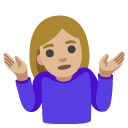
Appearance varies by platform and device. Google Noto, Twemoji, and OpenMoji are open-source.