🧕🏿
The Emoji
Woman With Headscarf: Dark Skin Tone
U+1F9D5 U+1F3FF · :woman_with_headscarf_dark_skin_tone:
Trend 58
Meaning layers
- interpretation
- Used to represent Muslim identity, South Asian or Middle Eastern heritage, and religious pride. Also used in solidarity contexts or when discussing diversity and inclusion.
- tiktok usage
- Appears in videos about Muslim lifestyle, modest fashion, hijabi beauty, cultural pride, and Ramadan content. Also used in 'POV: being a hijabi' style videos.
- irony level
- 2 / 10
Platform meanings
- meaning
- Represents hijabi identity, Muslim lifestyle content, and cultural pride. Core symbol for the 'MuslimTok' and 'HijabiTok' communities.
- trend usage
- Used in Ramadan content, modest fashion hauls, 'day in the life of a hijabi' videos, and cultural diaspora storytelling.
- hashtags
- #HijabiTok#MuslimTok#ModestFashion#Ramadan#HijabStyle
- virality score
- 62 / 100
Cultural meanings
🇺🇸
Western / Gen-Z
Recognized as a symbol of Muslim identity and hijabi culture; used positively in diversity conversations and by Muslim Gen Z creators to assert pride in their identity.
🇵🇰
Pakistan & India
Deeply meaningful as a representation of Muslim women's faith and modesty; widely used by Pakistani Muslim women on social media and in digital communication.
🌍
Middle East
A natural and common self-identifier for Muslim women across Arab countries; used casually in everyday digital communication without special significance beyond normal identity expression.
🌐
Global Neutral
Internationally understood as representing a Muslim woman or a woman wearing a headscarf; one of the more culturally specific emoji with clear religious connotation.
🇧🇩
Bangladesh
Widely embraced by Bangladeshi Muslim women as a digital self-representation; used heavily during religious occasions like Eid and Ramadan on social media.
🇱🇰
Sri Lanka
Used by Sri Lankan Muslim women, particularly in the Eastern Province communities, as a cultural and religious identity marker online.
🇨🇳
China
Primarily associated with Uyghur and Hui Muslim minority communities; usage is politically sensitive given human rights discourse around Muslim minorities in China.
🇯🇵
Japan
Used by the small but growing Japanese Muslim community and in content about Islam in Japan; also appears in intercultural education contexts.
🇰🇷
South Korea
Appears in content about Islam in Korea and multicultural society discussions; used by Muslim immigrant communities and Korean converts to Islam.
🇹🇼
Taiwan
Used within Taiwan's Muslim community, particularly among Southeast Asian migrant workers and students; also in interfaith dialogue content.
🇭🇰
Hong Kong
Appears in content related to the South Asian Muslim community in Hong Kong; used in interfaith and multicultural community spaces.
🇵🇭
Philippines
Used by Filipino Muslim women, particularly from Mindanao and the BARMM region, as a proud identifier of Moro Muslim identity.
🇮🇩
Indonesia
Extremely common and positive; Indonesia has the world's largest Muslim population and hijab culture is mainstream, making this emoji widely relatable and frequently used.
🇹🇭
Thailand
Used by Thai Muslim women, primarily in the southern provinces; carries cultural significance for the Malay-Muslim minority community in Thailand.
🇻🇳
Vietnam
Used by the Cham Muslim minority community and Vietnamese Muslims; relatively niche but meaningful for those communities.
🇲🇾
Malaysia
Very commonly used given Malaysia's significant Muslim population; paired with Malay cultural pride and Islamic identity, especially during festive seasons like Hari Raya.
🇸🇦
Saudi Arabia
Used as a standard representation of Muslim women; the dark skin tone variant may specifically resonate with the diverse expatriate Muslim community in Saudi Arabia.
🇦🇪
UAE
Widely used in the diverse UAE Muslim community, resonating with both Emirati women and the large South Asian and African Muslim diaspora in the country.
🇪🇬
Egypt
Common digital identifier for Egyptian Muslim women; used in lifestyle content, religious posts, and cultural discussions on Egyptian social media.
🇹🇷
Turkey
Used by Turkish Muslim women especially in conservative and religious communities; carries additional political connotation given Turkey's history of hijab debates.
🇮🇷
Iran
Usage is complex and politically charged; can be used by Iranian women in diaspora to signal identity, and domestically the headscarf carries contested political meaning.
🇳🇬
Nigeria
Very commonly used by Northern Nigerian Muslim women and across Nigeria's Muslim communities as a proud religious and cultural identifier.
🇿🇦
South Africa
Used by Cape Malay and South African Muslim women communities; represents a visible and proud Muslim identity in a diverse, multicultural context.
🇬🇧
UK & Ireland
Common among British and Irish Muslim women, particularly in cities like London, Birmingham, and Bradford; used in Muslim lifestyle content and diaspora community discourse.
🇫🇷
France
Usage carries particular political weight given France's controversial hijab ban debates; frequently appears in discussions about secularism, religious freedom, and Muslim identity.
🇩🇪
Germany
Used by the large Turkish-German and Arab-German Muslim communities; appears in integration debates and cultural identity discussions.
🇪🇸
Spain & Italy
Used by Muslim immigrant communities in both countries; appears in cultural diversity content and discussions about Islam in Southern Europe.
🇧🇷
Brazil
Used by Brazil's small but growing Muslim community, largely composed of Arab and South Asian immigrants; a niche but meaningful identifier.
🇲🇽
Mexico
Appears in content about Mexico's small Muslim community; also used in interfaith and multicultural dialogue contexts.
🌎
Latin America
Used by Muslim communities across Latin America, a growing demographic; associated with reversion stories and cultural fusion of Islamic and Latin identities.
🇦🇺
Australia & NZ
Used by Australian and New Zealand Muslim women communities; commonly appears in multicultural content and hijabi lifestyle content in the Oceania region.
How its meaning shifted
- 2010
This emoji did not exist in 2010; the concept of a headscarf-wearing woman emoji was not part of the Unicode set, leaving Muslim women unrepresented in emoji form.
- 2015
Still not yet in Unicode; Muslim women and advocates were actively campaigning for representation in emoji sets, noting the absence of hijab-wearing figures.
- 2020
Well-established and widely used across Muslim communities globally; adopted enthusiastically by hijabi influencers and became a staple of Muslim social media identity.
- 2026
A mainstream emoji firmly embedded in Muslim digital culture; used naturally across generations of Muslim users and recognized globally as a symbol of Muslim women's identity and visibility.
See it on every platform
Compare with
Adjacent emojis
- Often confused with
- person with headscarfwrapped giftdress
Share & embed
Frequently asked
01What does the 🧕🏿 Woman With Headscarf: Dark Skin Tone emoji mean?
A woman wearing a hijab or headscarf, shown with dark skin tone. Represents Muslim women, modesty in dress, or religious identity.
02What does 🧕🏿 mean on TikTok?
Represents hijabi identity, Muslim lifestyle content, and cultural pride. Core symbol for the 'MuslimTok' and 'HijabiTok' communities.
03What does 🧕🏿 mean on WhatsApp?
Used to refer to a hijab-wearing woman in conversation, often as a self-identifier or to describe someone. Common in family group chats in Muslim households.
04What does 🧕🏿 mean in Gen-Z slang?
Used to represent Muslim identity, South Asian or Middle Eastern heritage, and religious pride. Also used in solidarity contexts or when discussing diversity and inclusion.
05Is the 🧕🏿 emoji safe to use?
A positive representation of Muslim women and hijab-wearing individuals; used for identity expression, cultural pride, and religious representation.
06What does 🧕🏿 mean in texting?
For many users, this emoji carries deep personal and spiritual significance, representing self-expression, faith identity, and community belonging. It can evoke strong positive emotions of representation for Muslim women who rarely saw themselves in digital spaces.
07What is the shortcode for 🧕🏿?
The shortcode for Woman With Headscarf: Dark Skin Tone is :woman_with_headscarf_dark_skin_tone:
08What does 🧕🏿 mean in dating?
Generally not used in flirtatious contexts; when used in dating apps it typically signals religious values, modesty, and cultural background as important parts of identity.
Safety & usage
- Safe meaning
- A positive representation of Muslim women and hijab-wearing individuals; used for identity expression, cultural pride, and religious representation.
- Caution
- Can be weaponized in Islamophobic comments or used mockingly by bad-faith actors to demean Muslim women; also sometimes used in recruitment messaging by extremist groups.
Context is critical — the emoji is overwhelmingly used positively but can appear in hate speech directed at Muslim women or in politically charged Islamophobic content. Platforms should monitor contextual use.
How it looks across platforms
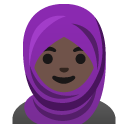


Appearance varies by platform and device. Google Noto, Twemoji, and OpenMoji are open-source.