👭
The Emoji
Women Holding Hands
U+1F46D · :women_holding_hands:
Trend 68
Meaning layers
- interpretation
- Used to celebrate female friendships, lesbian relationships, or sapphic vibes. Often signals a close bestie bond or queer identity without needing explicit labels.
- tiktok usage
- Appears in 'girls supporting girls' content, sapphic TikTok, WLW (women loving women) videos, and friendship appreciation posts.
- irony level
- 2 / 10
Platform meanings
- meaning
- Represents female friendship, WLW relationships, and sapphic content. A staple in queer TikTok.
- trend usage
- Used in 'POV: your best friend is also your girlfriend' trends, girl dinner videos, and pride storytimes.
- hashtags
- #girlsupportgirl#wlw#sapphic#bestfriends#pridemonth
- virality score
- 72 / 100
Cultural meanings
🇺🇸
Western / Gen-Z
Widely used to express both platonic female friendship and WLW romantic relationships; a staple in sapphic and queer online spaces.
🇵🇰
Pakistan & India
Primarily interpreted as close female friendship or sisterly bond; LGBTQ+ connotations are less commonly acknowledged publicly due to cultural and legal sensitivities.
🌍
Middle East
Generally understood as female friendship or sisterhood; romantic same-sex interpretation is largely avoided due to social and legal norms in most countries.
🌐
Global Neutral
Universally readable as two women sharing a close bond, whether platonic or romantic depending on context.
🇧🇩
Bangladesh
Interpreted almost exclusively as close female friendship or sisterly affection; same-sex romantic connotations are not commonly expressed publicly.
🇱🇰
Sri Lanka
Used to represent female friendship and solidarity; LGBTQ+ interpretations exist in progressive urban circles but are not mainstream.
🇨🇳
China
Primarily understood as close female friendship (闺蜜 energy); while queer culture exists online, romantic connotations are less openly expressed due to platform censorship.
🇯🇵
Japan
Can represent close female friendship or a yuri (百合) romantic vibe; both interpretations coexist comfortably in Japanese internet culture.
🇰🇷
South Korea
Used for female friendship and occasionally for openly queer expression in younger, progressive communities; K-pop fan culture also uses it for female idol ships.
🇹🇼
Taiwan
Freely used for both female friendship and same-sex relationships given Taiwan's more open LGBTQ+ culture and legal recognition of same-sex marriage.
🇭🇰
Hong Kong
Used similarly to Taiwan — both friendship and romantic connotations are recognized, with growing visibility in LGBTQ+ communities.
🇵🇭
Philippines
Primarily signals close female friendship; queer interpretation is growing in visibility especially among younger, urban, and online communities.
🇮🇩
Indonesia
Strongly interpreted as female friendship; same-sex romantic meaning is largely avoided in public due to conservative social and religious norms.
🇹🇭
Thailand
Comfortably used for both female friendship and sapphic relationships given Thailand's relatively open attitude toward LGBTQ+ identities in popular culture.
🇻🇳
Vietnam
Mainly used for female friendship; LGBTQ+ visibility is growing but same-sex romantic use of the emoji remains relatively cautious in public spaces.
🇲🇾
Malaysia
Used predominantly for female friendship; LGBTQ+ connotations are largely suppressed publicly due to legal and religious restrictions.
🇸🇦
Saudi Arabia
Interpreted strictly as female friendship or sisterhood; any romantic same-sex connotation would be considered highly inappropriate and is avoided.
🇦🇪
UAE
Used to represent female friendship; same-sex romantic interpretation is not publicly expressed due to legal prohibitions.
🇪🇬
Egypt
Understood as close female friendship or sisterly bond; LGBTQ+ interpretation is socially and legally sensitive and largely absent in mainstream use.
🇹🇷
Turkey
Used for female friendship; queer communities in urban areas like Istanbul use it for WLW expression, though mainstream use remains platonic.
🇮🇷
Iran
Interpreted strictly as female friendship; any LGBTQ+ connotation is highly sensitive due to legal restrictions and social norms.
🇳🇬
Nigeria
Primarily used for female friendship and sisterhood; LGBTQ+ romantic connotations are rarely expressed publicly given strong social and legal stigmas.
🇿🇦
South Africa
Used for both female friendship and same-sex relationships, particularly in Cape Town and Johannesburg where LGBTQ+ communities are more visible and legally protected.
🇬🇧
UK & Ireland
Used freely for both female friendship and lesbian/WLW relationships; widely accepted in mainstream and queer online culture.
🇫🇷
France
Used for female friendship and same-sex relationships with relatively little controversy; French culture is generally open toward LGBTQ+ expression.
🇩🇪
Germany
Comfortably used for female friendship and sapphic relationships; Germany's progressive stance on LGBTQ+ rights makes both interpretations mainstream.
🇪🇸
Spain & Italy
In Spain, used openly for friendship and LGBTQ+ expression; in Italy, predominantly used for friendship with growing but more cautious LGBTQ+ use.
🇧🇷
Brazil
Widely used for female friendship and lesbian relationships; Brazil has a large and visible LGBTQ+ community that embraces this emoji enthusiastically.
🇲🇽
Mexico
Used for female friendship broadly; LGBTQ+ use is growing especially among younger generations and in urban centers like Mexico City.
🌎
Latin America
Across Latin America, primarily used for close female friendship with LGBTQ+ use increasing in younger, urban, and online communities.
🇦🇺
Australia & NZ
Used freely and openly for both female friendship and WLW romantic relationships; both countries have strong LGBTQ+ visibility and acceptance.
How its meaning shifted
- 2010
This specific emoji did not exist yet; female friendship was expressed with generic heart emojis or the older 👫 (man and woman holding hands) was the only couple option available.
- 2015
Still not available as a standalone emoji; users improvised with combinations like 👩👩 or relied on text-based expressions for female friendship and same-sex couples.
- 2020
Newly introduced (Unicode 12.0, 2019), rapidly adopted by LGBTQ+ communities and female friend groups; became a symbol of sapphic visibility and female solidarity online.
- 2026
Firmly established as a symbol of both female friendship and WLW relationships; widely used across all platforms with skin tone customization, especially prevalent in pride content and feminist discourse.
See it on every platform
Compare with
Emoji combinations
Adjacent emojis
- Often confused with
- two heartspeople hugginghandshake
- Can replace
- red heartrainbow flagsparkling heart
Share & embed
Frequently asked
01What does the 👭 Women Holding Hands emoji mean?
Two women standing side by side holding hands, representing female friendship, solidarity, partnership, or same-sex relationships.
02What does 👭 mean on TikTok?
Represents female friendship, WLW relationships, and sapphic content. A staple in queer TikTok.
03What does 👭 mean on WhatsApp?
Sent between close female friends to express affection or celebrate their friendship bond.
04What does 👭 mean in Gen-Z slang?
Used to celebrate female friendships, lesbian relationships, or sapphic vibes. Often signals a close bestie bond or queer identity without needing explicit labels.
05Is the 👭 emoji safe to use?
Female friendship, sisterhood, solidarity, lesbian or WLW romantic partnership, girl power.
06What does 👭 mean in texting?
Evokes warmth, security, and community. The visual of two women holding hands psychologically signals trust and mutual support, tapping into deep social bonding instincts.
07What is the shortcode for 👭?
The shortcode for Women Holding Hands is :women_holding_hands:
08What does 👭 mean in dating?
WLW or sapphic individuals use this to signal romantic interest or to indicate they are in or seeking a same-sex female relationship.
Safety & usage
- Safe meaning
- Female friendship, sisterhood, solidarity, lesbian or WLW romantic partnership, girl power.
- Caution
- Rarely used toxically; could be weaponized in homophobic mockery or used to out someone without consent.
In contexts where LGBTQ+ expression is criminalized or heavily stigmatized, using this emoji publicly could expose individuals to real-world harm. Always consider cultural and legal context.
How it looks across platforms
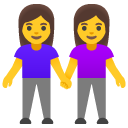


Appearance varies by platform and device. Google Noto, Twemoji, and OpenMoji are open-source.