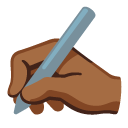
✍🏾
The Emoji
Writing Hand: Medium-dark Skin Tone
U+270D U+1F3FE · :writing_hand_mediumdark_skin_tone:
Trend 58
Meaning layers
- interpretation
- Used to signal that someone is 'taking notes,' calling out important information, emphasizing a point worth remembering, or ironically noting that someone just said something embarrassing or quotable. Also used to claim authorship or credit for content.
- tiktok usage
- Appears in comment sections when someone drops a life hack, unpopular opinion, or hot take — signaling 'I'm writing this down.' Also used to flex creative output or journaling aesthetic.
- irony level
- 4 / 10
Platform meanings
- meaning
- Signals note-taking, endorsing content as important or quotable, claiming authorship of a video or trend, or flexing a writing/journaling lifestyle.
- trend usage
- Used under life advice videos, poetry readings, writing vlogs, and 'this is your sign' content. Appears in journaling aesthetics and dark academia niches.
- hashtags
- #writingtok#journaling#darkaesthetics#notesapp#creativewriting
- virality score
- 62 / 100
Cultural meanings
🇺🇸
Western / Gen-Z
A multi-purpose emoji signaling note-taking, creative identity, or ironic documentation of quotable moments. Central to the journaling and dark academia aesthetics popular with Gen Z.
🇵🇰
Pakistan & India
Widely used by students and professionals to signal studying, academic effort, or note-taking. Also used by Urdu, Hindi, and English writers on social media to claim their creative identity.
🌍
Middle East
Commonly used to indicate writing, studying, or scholarly work — resonates in cultures with high reverence for written knowledge and literature. The medium-dark skin tone is particularly relatable across the region.
🌐
Global Neutral
Universally understood as representing writing or note-taking. The skin tone variation is recognized globally as a diversity-inclusive version of the standard writing hand emoji.
🇧🇩
Bangladesh
Frequently used by students to represent studying and academic work. Writers and bloggers in Bengali use it to identify themselves and their craft online.
🇱🇰
Sri Lanka
Used in academic and professional contexts to signal diligence and writing. Social media users adopt it to show creative writing or journaling habits.
🇨🇳
China
Used primarily in academic and professional WeChat or Weibo contexts to signal note-taking or signing documents. Less common on Chinese-native platforms where platform-specific stickers dominate.
🇯🇵
Japan
Associated with studious effort and academic diligence — fits into the 'benkyou' (study) culture aesthetic. Used by writers and students on Twitter Japan and note-sharing platforms.
🇰🇷
South Korea
Popular among students on KakaoTalk and Twitter for study motivation posts. Tied to the intense study culture and also used by K-pop fan writers creating fan fiction.
🇹🇼
Taiwan
Used similarly to broader East Asian patterns — signals academic effort, writing, or creative expression. Common in student communities and writing circles on PTT and Instagram.
🇭🇰
Hong Kong
Mixed English-Cantonese digital culture means this emoji is used both literally (writing/studying) and with some ironic Gen Z sensibility imported from Western platforms.
🇵🇭
Philippines
Very common in academic and creative communities — Filipino writers, bloggers, and students widely use it. Carries warm, aspirational energy tied to storytelling traditions.
🇮🇩
Indonesia
Frequently used by students and content creators to signal productivity and writing. The skin tone is especially relatable given Indonesian diversity, and the emoji appears often in academic motivation posts.
🇹🇭
Thailand
Used in educational and creative contexts. Popular among Thai students sharing study content on Twitter and Instagram. Also used by authors and content creators.
🇻🇳
Vietnam
Signals academic effort and writing in Vietnamese digital culture. Common in student Facebook groups and used by bloggers and writers to mark their creative identity.
🇲🇾
Malaysia
Used across English and Malay digital conversations to signal writing, studying, or taking notes. The skin tone resonates with Malaysian diversity and inclusivity values.
🇸🇦
Saudi Arabia
Associated with scholarship, authorship, and religious or academic texts — writing holds deep cultural significance. Used by students, professionals, and social media content creators.
🇦🇪
UAE
In a multicultural digital environment, this emoji is used broadly to signal professionalism, creativity, and academic effort. Popular across expat and local communities alike.
🇪🇬
Egypt
Resonates deeply given Egypt's strong literary and intellectual heritage. Used by writers, students, and public intellectuals to signal engagement with the written word.
🇹🇷
Turkey
Used by students and writers in a culture with rich literary traditions. Common in academic motivation posts and among Turkish authors or bloggers establishing their creative identity.
🇮🇷
Iran
Significant in a culture with an exceptionally rich poetic and literary history. Used by writers, students, and intellectuals to signal authorship, scholarship, or the act of preserving knowledge.
🇳🇬
Nigeria
Widely used with the medium-dark skin tone as a culturally affirming choice. Popular among Nigerian writers, students, and the booming Afro-literary community online.
🇿🇦
South Africa
Used across diverse communities to signal writing, studying, or creative expression. The medium-dark skin tone carries positive representation for Black South African users.
🇬🇧
UK & Ireland
Standard use for writers, students, and professionals. The ironic 'taking notes' usage is popular in British humor culture — dry and deadpan use is common on X (Twitter UK).
🇫🇷
France
Used by writers, students, and intellectuals in a culture that prizes literary achievement. Appears frequently in academic and literary social media contexts with genuine sincerity.
🇩🇪
Germany
Used in precise, professional, and academic contexts — signals diligence and thoroughness. Less ironic usage; more genuine note-taking or authorship signaling.
🇪🇸
Spain & Italy
Popular in creative and academic communities. In Spain and Italy, used to signal passion for writing and storytelling — emotionally warmer connotation than in northern Europe.
🇧🇷
Brazil
Widely used by Brazilian students, writers, and content creators. The medium-dark skin tone has particular cultural resonance in Brazil's predominantly mixed-race population. Also used ironically in meme culture.
🇲🇽
Mexico
Used by students and writers to signal academic work or creative output. Ironic 'noted' usage is popular in Mexican meme and humor culture online.
🌎
Latin America
Broadly used across Latin America to signal writing, studying, or authorship. The medium-dark skin tone is embraced as representative across many Latin American demographics.
🇦🇺
Australia & NZ
Standard Gen Z usage — ironic note-taking reactions are popular, as is genuine use by writers and students. The skin tone diversity is positively received in multicultural Australian and New Zealand digital spaces.
How its meaning shifted
- 2010
Emoji was not yet widely used; skin tone modifiers did not exist. The base writing hand emoji was used almost exclusively to literally mean 'writing' or 'signing a document.'
- 2015
Skin tone modifiers introduced in Unicode 8.0 (2015) made this variant available. Early adoption was primarily by users excited about representation. Usage remained fairly literal — writing, signing, note-taking.
- 2020
Expanded significantly into ironic and meme usage — the 'taking notes on this chaotic information' reaction became popular. Journaling aesthetics on TikTok and Instagram drove creative identity usage. Representation conversations boosted appreciation for the skin tone variant.
- 2026
Fully integrated into Gen Z irony toolkit and creative identity signaling. The medium-dark skin tone is actively chosen for its representational value. Used across serious writing culture, academic aesthetics, meme reactions, and professional content creation contexts simultaneously.
See it on every platform
Adjacent emojis
Share & embed
Frequently asked
01What does the ✍🏾 Writing Hand: Medium-dark Skin Tone emoji mean?
A hand holding a pen or pencil in a writing position, displayed with a medium-dark skin tone modifier (Fitzpatrick scale type V). Represents the act of writing, signing, authorship, or creative expression.
02What does ✍🏾 mean on TikTok?
Signals note-taking, endorsing content as important or quotable, claiming authorship of a video or trend, or flexing a writing/journaling lifestyle.
03What does ✍🏾 mean on WhatsApp?
Indicates the sender is writing something, working on a document, or studying. Also used to say 'noted' in a conversation.
04What does ✍🏾 mean in Gen-Z slang?
Used to signal that someone is 'taking notes,' calling out important information, emphasizing a point worth remembering, or ironically noting that someone just said something embarrassing or quotable. Also used to claim authorship or credit for content.
05Is the ✍🏾 emoji safe to use?
Represents writing, authorship, note-taking, studying, signing, journaling, or creative expression. Entirely benign and widely used positively.
06What does ✍🏾 mean in texting?
The writing hand evokes agency and self-expression — psychologically linked to ownership of one's narrative. The medium-dark skin tone adds a layer of identity affirmation and representation, which can carry emotional weight for users who rarely see their skin tone reflected in digital communication.
07What is the shortcode for ✍🏾?
The shortcode for Writing Hand: Medium-dark Skin Tone is :writing_hand_mediumdark_skin_tone:
08What does ✍🏾 mean in dating?
Occasionally used flirtatiously to suggest 'I'm writing your name in my heart' or 'noted — I like you.' Can appear when someone says something charming and the other person uses this to imply they're memorizing it.
Safety & usage
- Safe meaning
- Represents writing, authorship, note-taking, studying, signing, journaling, or creative expression. Entirely benign and widely used positively.
- Caution
- Can occasionally carry a subtle threatening subtext in context — 'I'm writing down what you said to use against you later.' Used passive-aggressively to imply surveillance or receipts-keeping in conflict situations.
Generally very safe. In rare passive-aggressive contexts it can imply 'I'm documenting your behavior' as a soft threat — but this requires significant contextual framing to read that way. No NSFW or hate-related usages documented.
How it looks across platforms


Appearance varies by platform and device. Google Noto, Twemoji, and OpenMoji are open-source.