👶🏿
The Emoji
Baby: Dark Skin Tone
U+1F476 U+1F3FF · :baby_dark_skin_tone:
Trend 55
Meaning layers
- interpretation
- Used to call someone out for acting childish, naive, or inexperienced — 'you're such a baby about this.' Also used affectionately for new starters, beginners, or someone being cute and helpless.
- tiktok usage
- Appears in 'you're a baby at this' commentary, reaction videos to cringe content, or ironically when someone does something embarrassingly amateur.
- irony level
- 5 / 10
Platform meanings
- meaning
- Represents inexperience, new beginnings, or calling someone immature; also used genuinely in baby announcement and parenting content.
- trend usage
- Appears in duets mocking amateur attempts at trending challenges, and in heartwarming newborn reveal videos.
- hashtags
- #babyannouncement#newborn#babyvibes#skillissue#babymom
- virality score
- 62 / 100
Cultural meanings
🇺🇸
Western / Gen-Z
Primarily used to call out immaturity or celebrate new babies; the skin tone modifier is seen as a positive representation of diversity and Black family identity.
🇵🇰
Pakistan & India
Used in family WhatsApp groups to announce or celebrate newborns; the dark skin tone may carry neutral-to-positive connotations in some communities but can occasionally reflect colorism sensitivities.
🌍
Middle East
Used in family celebration contexts for new births; skin tone modifiers are generally used to match one's own complexion or that of the child being referenced.
🌐
Global Neutral
Universally understood as representing a baby or infant; the dark skin tone modifier is seen as an inclusive representation across most international contexts.
🇧🇩
Bangladesh
Used in family and social media contexts to celebrate births; skin tone diversity in emoji is increasingly normalized among younger users.
🇱🇰
Sri Lanka
Appears in birth announcements and family group chats; younger Sri Lankan users appreciate the skin tone diversity for personal representation.
🇨🇳
China
Used to represent babies in general; skin tone modifiers are less commonly emphasized culturally, but the emoji is widely understood as a cute baby symbol.
🇯🇵
Japan
Seen as a kawaii (cute) baby representation; Japanese users tend to focus on the emotional cuteness rather than the skin tone modifier specifically.
🇰🇷
South Korea
Used in parenting content and cute baby contexts; the dark skin tone can represent diversity awareness, increasingly valued in progressive South Korean digital culture.
🇹🇼
Taiwan
Used in family and parenting contexts; skin tone modifiers are acknowledged but the core meaning of 'cute baby' remains primary.
🇭🇰
Hong Kong
Used in birth announcements and family communication; younger users in Hong Kong are increasingly aware of and supportive of emoji skin tone diversity.
🇵🇭
Philippines
Widely used in family group chats for baby celebrations; the dark skin tone resonates with the naturally diverse Filipino complexion range.
🇮🇩
Indonesia
Used to celebrate newborns in family contexts; the darker skin tone modifier is relatable to many Indonesians and used naturally in personal expression.
🇹🇭
Thailand
Used in baby-related content; skin tone discussions exist in Thai culture due to colorism, but the emoji is generally received positively as a baby symbol.
🇻🇳
Vietnam
Used in family celebrations and baby content; skin tone modifiers are acknowledged, with younger Vietnamese users increasingly embracing inclusive representation.
🇲🇾
Malaysia
Commonly used in family group chats for birth announcements; the dark skin tone is relatable to many Malay and Indian Malaysian users.
🇸🇦
Saudi Arabia
Used in family and social contexts for baby celebrations; skin tone modifiers align with the naturally darker complexions common in the region.
🇦🇪
UAE
Used in diverse, cosmopolitan contexts; the dark skin tone is widely accepted and relatable given the UAE's multicultural population.
🇪🇬
Egypt
Used for birth announcements and baby celebrations; the darker skin tone resonates naturally with many Egyptians and is used without particular emphasis.
🇹🇷
Turkey
Used in family and parenting contexts; skin tone diversity in emoji is increasingly recognized and appreciated by younger Turkish users.
🇮🇷
Iran
Used in family group chats for baby announcements; skin tone variations are acknowledged but the primary interpretation remains focused on the baby symbolism.
🇳🇬
Nigeria
Highly resonant and culturally affirming — the dark skin tone baby emoji is embraced as positive representation of Nigerian and African identity in digital spaces.
🇿🇦
South Africa
Widely used and celebrated as a representation of Black South African family identity; resonates deeply with the majority population and is used proudly.
🇬🇧
UK & Ireland
Used in birth announcements and parenting content; the skin tone modifier is seen as positive diversity representation, particularly in Black British communities.
🇫🇷
France
Used in family contexts; while France has a complex relationship with race-based categorization, the emoji is generally accepted as inclusive representation.
🇩🇪
Germany
Used in parenting and family contexts; younger Germans see the skin tone diversity as a positive inclusion effort in digital communication.
🇪🇸
Spain & Italy
Used for baby and family celebrations; the dark skin tone modifier is increasingly normalized and seen as part of diverse emoji representation.
🇧🇷
Brazil
Widely used and relatable given Brazil's diverse population; the dark skin tone baby emoji is especially embraced in Afro-Brazilian communities.
🇲🇽
Mexico
Used in family celebrations and baby content; the skin tone diversity is positively received among Mexico's mixed and Indigenous population.
🌎
Latin America
Broadly embraced across Latin America as a representation of the region's diverse skin tones; used naturally in family and community contexts.
🇦🇺
Australia & NZ
Used in birth announcements and parenting content; the skin tone modifier is appreciated as part of inclusive representation in diverse Australian and New Zealand communities.
How its meaning shifted
- 2010
The base baby emoji existed but skin tone modifiers had not yet been introduced; all babies were depicted in a generic yellow tone.
- 2015
Skin tone modifiers introduced in Unicode 8.0 — the dark skin tone baby emoji became available, initially used mainly in diversity discussions and by users wanting personal representation.
- 2020
Normalized as part of everyday family communication; saw increased usage during BLM movement as users consciously chose dark-skin-tone emoji to signal solidarity and representation.
- 2026
Standard part of parenting, family, and diversity content; routinely used by Black parents and communities for authentic self-representation and increasingly used in sarcastic 'you're a baby' internet culture.
See it on every platform
Compare with
Adjacent emojis
- Often confused with
- cherubdollhatching chick
Share & embed
Frequently asked
01What does the 👶🏿 Baby: Dark Skin Tone emoji mean?
A baby with dark skin tone, represented by a young infant figure with the Fitzpatrick scale type VI skin modifier applied to the base baby emoji.
02What does 👶🏿 mean on TikTok?
Represents inexperience, new beginnings, or calling someone immature; also used genuinely in baby announcement and parenting content.
03What does 👶🏿 mean on WhatsApp?
Commonly used in family group chats for pregnancy or birth announcements, or to tease someone acting immature.
04What does 👶🏿 mean in Gen-Z slang?
Used to call someone out for acting childish, naive, or inexperienced — 'you're such a baby about this.' Also used affectionately for new starters, beginners, or someone being cute and helpless.
05Is the 👶🏿 emoji safe to use?
Represents a baby or infant with dark skin tone; used for birth announcements, family celebrations, parenting content, and diversity representation.
06What does 👶🏿 mean in texting?
Triggers caregiving instincts (the 'baby schema' effect) — round features and helplessness cues activate protective, warm emotional responses across most cultures.
07What is the shortcode for 👶🏿?
The shortcode for Baby: Dark Skin Tone is :baby_dark_skin_tone:
08What does 👶🏿 mean in dating?
Rarely flirtatious; sometimes used between partners in a cutesy, infantilizing way — 'you're my little baby 👶🏿.' Can be used when someone acts adorably vulnerable.
Safety & usage
- Safe meaning
- Represents a baby or infant with dark skin tone; used for birth announcements, family celebrations, parenting content, and diversity representation.
- Caution
- Can be weaponized in racist trolling contexts online; also used as a dismissive insult implying someone is immature or infantile.
While the emoji itself is benign, it can be used in racially charged contexts by bad actors; platform moderation should be contextually aware of surrounding text. The 'crybaby' sarcastic use is generally harmless but can tip into bullying.
How it looks across platforms
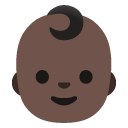


Appearance varies by platform and device. Google Noto, Twemoji, and OpenMoji are open-source.