😼
The Emoji
Cat With Wry Smile
U+1F63C · :cat_with_wry_smile:
Trend 74
Meaning layers
- interpretation
- Used to signal that you are being sneaky, sly, or lowkey plotting something. Also used for passive-aggressive teasing, chaotic energy, or when you know something others don't.
- tiktok usage
- Appears in comment sections to indicate someone is being crafty or petty in an entertaining way — often paired with chaos or revenge content.
- irony level
- 7 / 10
Platform meanings
- meaning
- Signals mischief, a villain arc, or chaotic confidence — used to frame yourself as the sneaky mastermind in a situation.
- trend usage
- Paired with trending audio about revenge, plotting, or doing things your own way. Common in POV content where the creator plays a cunning character.
- hashtags
- #catmode#villainarc#sneakyvibes#plottwist#chaoscat
- virality score
- 72 / 100
Cultural meanings
🇺🇸
Western / Gen-Z
Iconic emoji for villain arc energy, petty confidence, and scheming humor — deeply embedded in Gen Z internet culture as a symbol of chaotic self-awareness.
🇵🇰
Pakistan & India
Used in banter between friends to signal someone is being cheeky or pulling a fast one — popular in youth group chats for playful teasing.
🌍
Middle East
Generally understood as a mischievous or clever expression — used in casual friend chats for playful teasing, though less common than in Western contexts.
🌐
Global Neutral
Broadly read as a smiling or cheeky cat — the mischievous subtext is understood in most digital-native contexts worldwide.
🇧🇩
Bangladesh
Used among younger users in casual chats to imply someone is being clever or slightly sneaky — often in response to a witty comment.
🇱🇰
Sri Lanka
Appears in friend group chats to signal playful cunning or that someone has pulled off something impressive in a slightly underhanded way.
🇨🇳
China
Less popular than local cat emoji or stickers on WeChat, but understood on international platforms as a sly or cheeky cat expression.
🇯🇵
Japan
Cat emoji carry significant cultural weight in Japan — this one is associated with the cunning aspect of cats in folklore, used for playful mischief.
🇰🇷
South Korea
Popular among younger Koreans on KakaoTalk and Instagram for expressing smug satisfaction or playful scheming in a cute way.
🇹🇼
Taiwan
Used in casual digital communication to express a clever, slightly mischievous attitude — often paired with ironic or self-aware content.
🇭🇰
Hong Kong
Common in Cantonese-speaking youth chats for signaling you are being savvy or pulling a smooth move in a situation.
🇵🇭
Philippines
Widely used in Filipino group chats to signal someone is being 'malikot' (mischievous) or cleverly navigating a situation with a smirk.
🇮🇩
Indonesia
Popular on Twitter/X and TikTok among Indonesian youth for expressing sly confidence or quietly celebrating an underhanded win.
🇹🇭
Thailand
Used in Line and social media to express playful cunning — fits well with Thai humor that often involves indirect or sly expression.
🇻🇳
Vietnam
Used among younger Vietnamese users on Zalo and Facebook to indicate someone is being tricky or that you see through their scheme.
🇲🇾
Malaysia
Common in Malaysian group chats for expressing that you are up to something fun or that you know more than you are letting on.
🇸🇦
Saudi Arabia
Used in youth circles on Snapchat and Twitter to signal playful scheming — more common among younger, digitally active users.
🇦🇪
UAE
Popular in cosmopolitan UAE youth culture for expressing sly confidence in mixed-language chats on WhatsApp and Instagram.
🇪🇬
Egypt
Used in Egyptian social media humor to signal someone is being 'shaytan shway' (a little devious) — fits well with Egyptian irony culture.
🇹🇷
Turkey
Commonly used on Twitter and WhatsApp to express that you are being cunning or that you see through someone's ploy — popular in banter.
🇮🇷
Iran
Used in Persian social media and Telegram chats to signal mischief or that you are cleverly navigating a situation.
🇳🇬
Nigeria
Popular on Nigerian Twitter (X) for expressing that you are winning by your own cunning rules — pairs well with hustle culture content.
🇿🇦
South Africa
Used in South African youth digital culture to signal playful scheming or smug satisfaction — common in banter-heavy group chats.
🇬🇧
UK & Ireland
Very popular in British and Irish banter — signals dry, understated smugness or that you are being brilliantly sneaky in a classically understated way.
🇫🇷
France
Used to convey the French concept of 'malice' in a playful sense — signals wit, cunning, and a certain self-satisfied charm.
🇩🇪
Germany
Used in German digital culture less frequently but clearly understood as signaling clever scheming or ironic self-awareness.
🇪🇸
Spain & Italy
Popular in Spanish and Italian social media for expressive teasing — signals you are being furbetto (sneaky little fox equivalent) in a charming way.
🇧🇷
Brazil
Very popular in Brazilian meme culture on Twitter and Instagram — used to signal malandragem (clever cunning) or petty satisfaction.
🇲🇽
Mexico
Used in Mexican digital humor to signal someone is being 'chistoso' in a sly way — common in meme accounts and friend group chats.
🌎
Latin America
Broadly used across Latin America to signal playful scheming, sarcastic confidence, and the satisfaction of getting away with something clever.
🇦🇺
Australia & NZ
Popular in Australian and NZ banter — used to signal someone is being a 'cheeky bastard' in the most affectionate sense of the phrase.
How its meaning shifted
- 2010
Newly introduced — used sparingly and mostly literally as a 'cat with a funny smile', with little established cultural meaning beyond basic emoji novelty.
- 2015
Grew in popularity alongside cat meme culture — began to be associated with scheming cats and smug internet humor as cat memes dominated social media.
- 2020
Solidified as a symbol of chaotic energy, pettiness, and villain arc aesthetics — embedded in Gen Z vocabulary as a marker of sly, self-aware mischief.
- 2026
A stable, culturally rich emoji with strong villain-arc and chaos-neutral associations — used across generations with understood nuance, appearing frequently in trending meme formats and ironic content.
See it on every platform
Adjacent emojis
- Often confused with
- smiling cat with heart eyescat face with tears of joygrinning cat
- Can replace
- smirking faceskullperson shrugging
Share & embed
Frequently asked
01What does the 😼 Cat With Wry Smile emoji mean?
A cat face with a sly, knowing smirk — one side of the mouth curled upward in a wry or cunning smile, suggesting mischief, smugness, or a secret.
02What does 😼 mean on TikTok?
Signals mischief, a villain arc, or chaotic confidence — used to frame yourself as the sneaky mastermind in a situation.
03What does 😼 mean on WhatsApp?
Sent when teasing a friend, hinting at a surprise, or implying you know something they don't. Signals playful smugness in conversation.
04What does 😼 mean in Gen-Z slang?
Used to signal that you are being sneaky, sly, or lowkey plotting something. Also used for passive-aggressive teasing, chaotic energy, or when you know something others don't.
05Is the 😼 emoji safe to use?
A playful cat expressing mischief, smugness, or sly humor — widely used in innocent teasing, banter, and self-aware ironic content.
06What does 😼 mean in texting?
Reflects a sense of knowing superiority or playful cunning — psychologically tied to feelings of being 'in on a secret' or enjoying a private triumph, similar to the Duchenne smirk in social signaling.
07What is the shortcode for 😼?
The shortcode for Cat With Wry Smile is :cat_with_wry_smile:
08What does 😼 mean in dating?
Used to flirt with sly undertones — implies you are up to something cheeky or that you have plans that may or may not be wholesome. Very suggestive without being explicit.
Safety & usage
- Safe meaning
- A playful cat expressing mischief, smugness, or sly humor — widely used in innocent teasing, banter, and self-aware ironic content.
- Caution
- Can be used to mask passive-aggressive behavior or veiled threats behind plausible 'just joking' deniability — sometimes used in subtle bullying or manipulation when paired with targeted comments.
Generally safe and benign; context-dependent toxicity is possible but not inherent. Watch for patterns of use in harassment threads where it is used to mock or belittle under the guise of humor.
How it looks across platforms
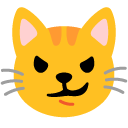


Appearance varies by platform and device. Google Noto, Twemoji, and OpenMoji are open-source.