👩❤️👩
The Emoji
Couple With Heart: Woman, Woman
U+1F469 U+200D U+2764 U+FE0F U+200D U+1F469 · :couple_with_heart_woman_woman:
Trend 72
Meaning layers
- interpretation
- Used by Gen Z to express WLW (women loving women) relationships, sapphic pride, and queer femme identity. Also used platonically between close female friends who consider each other their platonic soulmates.
- tiktok usage
- Appears in WLW TikTok content, sapphic POV videos, queer coming-out stories, and 'girlfriend reveal' posts. Often in bios of queer creators.
- irony level
- 2 / 10
Platform meanings
- meaning
- Signals WLW identity, sapphic relationships, and queer pride. A shorthand for 'I date women' or 'I am in a relationship with a woman'.
- trend usage
- Used in WLW POV videos, sapphic couple content, pride month trends, queer coming-out stories, and 'day in my life as a gay woman' content.
- hashtags
- #WLW#SapphicTikTok#QueerTikTok#GayGirls#LesbiansOfTikTok
- virality score
- 78 / 100
Cultural meanings
🇺🇸
Western / Gen-Z
Widely embraced as a standard symbol of WLW identity and pride; openly used on social media, in bios, and in everyday queer expression without stigma.
🇵🇰
Pakistan & India
Largely avoided in public digital spaces due to social stigma and legal ambiguity around same-sex relationships; used cautiously in private queer communities or by diaspora users abroad.
🌍
Middle East
Rarely used openly due to legal prohibition of same-sex relationships in many countries; may be used discreetly in private encrypted messaging by closeted LGBTQ+ individuals.
🌐
Global Neutral
Universally recognized as representing a romantic female same-sex couple; interpretation depends heavily on local cultural and legal context.
🇧🇩
Bangladesh
Extremely rarely used openly given strong social and legal restrictions; same-sex relationships are criminalized, so usage is confined to very private queer digital spaces.
🇱🇰
Sri Lanka
Used very discreetly if at all; same-sex relationships carry significant social stigma and legal risk, limiting public digital use to private or diaspora communities.
🇨🇳
China
Used cautiously as LGBTQ+ content faces censorship on major platforms; WLW communities use it in private groups or coded language spaces, less freely on public platforms.
🇯🇵
Japan
Used with relative openness in urban and online queer spaces; Japan has a growing WLW community and the emoji appears in yuri fan culture and LGBTQ+ activism contexts.
🇰🇷
South Korea
Used in progressive urban queer circles and online LGBTQ+ communities; still carries social risk in broader Korean society but is common in dedicated queer digital spaces.
🇹🇼
Taiwan
Freely used as Taiwan is the first Asian country to legalize same-sex marriage; the emoji is embraced openly in LGBTQ+ expression and couple representation.
🇭🇰
Hong Kong
Used in queer communities and activism contexts; LGBTQ+ visibility has grown but same-sex unions lack full legal recognition, creating a mixed cultural reception.
🇵🇭
Philippines
Used in LGBTQ+ online communities; the Philippines has a complex relationship with queerness — culturally visible yet lacking legal protections, so use is open online but regionally varied.
🇮🇩
Indonesia
Very rarely used in public digital spaces due to strong social conservatism and regional anti-LGBTQ+ regulations; confined to private queer networks.
🇹🇭
Thailand
Used with moderate openness; Thailand's culture is relatively tolerant of gender diversity but same-sex marriage is not yet legally recognized, so use is common in LGBTQ+ spaces but still coded.
🇻🇳
Vietnam
Used cautiously; Vietnam has become more open to LGBTQ+ visibility in urban areas, and the emoji appears in queer online communities though legal protection is limited.
🇲🇾
Malaysia
Rarely used openly due to strict religious and legal restrictions against same-sex relationships; confined to private messaging among LGBTQ+ individuals.
🇸🇦
Saudi Arabia
Essentially absent from public digital use due to severe legal penalties for same-sex relationships; any usage would be extremely private and coded.
🇦🇪
UAE
Very rarely used publicly given legal restrictions on same-sex relationships; may appear in private communications among expatriate LGBTQ+ communities.
🇪🇬
Egypt
Used only in very private LGBTQ+ circles; same-sex relationships are socially and legally stigmatized, making public use extremely rare and risky.
🇹🇷
Turkey
Used in LGBTQ+ activist spaces and urban queer communities, though increasingly under social and political pressure; Istanbul's queer community uses it defiantly online.
🇮🇷
Iran
Essentially absent from public use due to criminalization of same-sex relationships; used only in extremely private or diaspora digital contexts.
🇳🇬
Nigeria
Very rarely used publicly due to strict anti-LGBTQ+ laws and strong social stigma; confined to private queer networks or diaspora communities abroad.
🇿🇦
South Africa
Used openly in urban queer communities; South Africa has constitutional protection for LGBTQ+ rights and an active Pride culture, making this emoji common in queer digital spaces.
🇬🇧
UK & Ireland
Freely and widely used as both nations have strong LGBTQ+ rights and visible queer communities; a normalized part of digital expression for WLW individuals.
🇫🇷
France
Used openly in a culturally liberal context; France's tradition of privacy means LGBTQ+ expression is generally accepted and the emoji is unremarkable in queer social media.
🇩🇪
Germany
Freely used in a society with strong LGBTQ+ protections and an active queer community; appears commonly in WLW digital expression and Pride-related content.
🇪🇸
Spain & Italy
Freely used in Spain with its strong LGBTQ+ rights record; in Italy, use is also open but with slightly more regional variation given Catholic cultural influence.
🇧🇷
Brazil
Widely used by WLW communities in Brazil's vibrant LGBTQ+ culture; Brazil has one of the world's largest Pride events and significant queer digital presence.
🇲🇽
Mexico
Used in urban LGBTQ+ communities and Pride contexts; Mexico City has a strong queer culture though acceptance varies significantly by region.
🌎
Latin America
Usage varies across Latin America — more open in urban, progressive contexts in Argentina and Chile, more discreet in Central American countries with stronger religious conservatism.
🇦🇺
Australia & NZ
Freely and widely used; both Australia and New Zealand have strong LGBTQ+ rights and inclusive cultures, making this emoji a normalized part of WLW digital identity.
How its meaning shifted
- 2010
This emoji did not exist yet; same-sex couple representation was entirely absent from Unicode, and WLW digital expression relied on rainbow flags, generic hearts, or text-based symbols.
- 2015
The ZWJ sequence was introduced around this period following advocacy for LGBTQ+ emoji representation; initial adoption was slow and limited to early queer digital communities and allies.
- 2020
Significantly more widespread following growing LGBTQ+ visibility, Pride Month corporate adoption, and the mainstreaming of queer identity on platforms like TikTok and Instagram.
- 2026
Fully normalized in WLW digital culture and broadly recognized globally; a standard part of LGBTQ+ identity expression across all major platforms, integrated into mainstream emoji literacy.
See it on every platform
Compare with
Emoji combinations
Adjacent emojis
- Often confused with
- people holding handshandshakecouple with heart person person
- Can replace
- rainbow flagtwo heartswomen holding hands
Share & embed
Frequently asked
01What does the 👩❤️👩 Couple With Heart: Woman, Woman emoji mean?
Depicts two women connected by a heart, representing a romantic couple of two women. It is a ZWJ sequence combining Woman, Zero Width Joiner, Heavy Black Heart, Zero Width Joiner, and Woman.
02What does 👩❤️👩 mean on TikTok?
Signals WLW identity, sapphic relationships, and queer pride. A shorthand for 'I date women' or 'I am in a relationship with a woman'.
03What does 👩❤️👩 mean on WhatsApp?
Used between female partners to express love and commitment. Also used by friends celebrating a friend's same-sex relationship.
04What does 👩❤️👩 mean in Gen-Z slang?
Used by Gen Z to express WLW (women loving women) relationships, sapphic pride, and queer femme identity. Also used platonically between close female friends who consider each other their platonic soulmates.
05Is the 👩❤️👩 emoji safe to use?
Representation of a loving romantic relationship between two women; used for LGBTQ+ pride, visibility, and couple expression.
06What does 👩❤️👩 mean in texting?
Carries deep emotional weight for WLW individuals as it represents visible, normalized representation of their identity and relationships. Using it publicly can be an act of self-affirmation and coming out.
07What is the shortcode for 👩❤️👩?
The shortcode for Couple With Heart: Woman, Woman is :couple_with_heart_woman_woman:
08What does 👩❤️👩 mean in dating?
Used in DMs or bios to signal interest in women or sapphic relationships. Placing it in a bio communicates queer availability and identity to potential partners.
Safety & usage
- Safe meaning
- Representation of a loving romantic relationship between two women; used for LGBTQ+ pride, visibility, and couple expression.
- Caution
- In hostile contexts, this emoji may be weaponized in homophobic harassment targeted at queer women or used mockingly in anti-LGBTQ+ rhetoric.
While the emoji itself is positive and inclusive, its use can draw targeted harassment in homophobic communities or on platforms with inadequate content moderation. Users in countries where same-sex relationships are criminalized should exercise caution with public usage.
How it looks across platforms
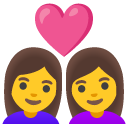
Appearance varies by platform and device. Google Noto, Twemoji, and OpenMoji are open-source.